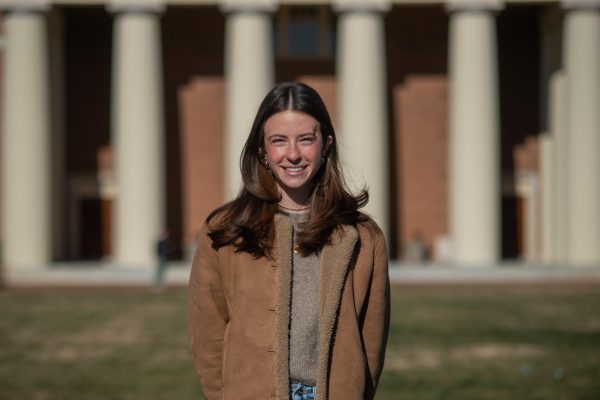


This letter represents the view of Old Gold & Black Managing Editor Maria Silveira, not the Old Gold & Black.
Growing up as the granddaughter of four Cuban immigrants who left a homeland where free speech is suppressed, I learned that exchanging ideas and perspectives is a privilege. When certain stories go unnoticed, our democracy is threatened, and our empathy for differences dwindles. This is especially true of historically marginalized voices, whose representation in mainstream media is essential, whether that be through traditional journalism or through pop culture moments like Bad Bunny’s Super Bowl halftime show.
Bad Bunny’s performance may seem insignificant, but I found it a profound attempt to reunify a polarized country with a shared experience to uplift the Hispanic community and all Americans. The opportunity to instill a similar unification and understanding through writing is what made me fall in love with journalism. Stories, from those on television at the Super Bowl to within the pages of this newspaper, keep us free and unified.
The Old Gold & Black is constantly searching for stories that represent the beauty and diversity of our campus. Student journalism programs are uniquely positioned to uplift our peers, professors and community members directly from the inside. On a small college campus, it is easy to find yourself in an echo chamber of information, but breaking out of these bubbles is the only way to truly understand each other. Telling the stories that represent a diversity of voices requires our newsroom to come together, leverage our differing experiences, put aside our biases and seek out the truth.
Learning how to report news on our campus with compassion and understanding has reinforced why my grandparents left their small island country to chase the American dream. As the product of hard-working immigrants, continuing to tell the stories that matter in our Wake Forest community is always top of mind. It is my duty as a citizen and as a student journalist to uplift marginalized voices and to lead with empathy, because representation of diverse stories strengthens democracy– now more than ever.