

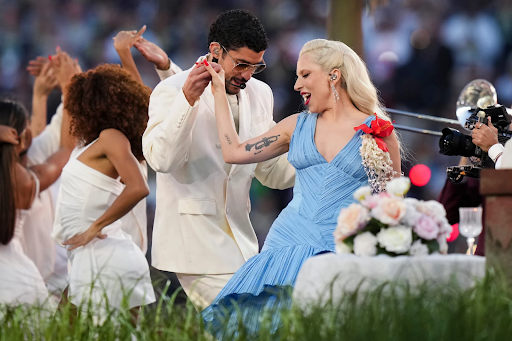
Latin rapper and singer Bad Bunny has over 150 million monthly listeners. Last year, he was the most-streamed artist on Spotify, with 19.8 billion streams. Needless to say, he earned his spot as headline performer at the 2026 Super Bowl halftime show. He joined the ranks of legendary artists with a show that joyfully and elegantly celebrated Hispanic culture and American culture, succinctly represented by the football he carried throughout the show, inscribed with the words, “Together, we are America.”
However, Bad Bunny also addressed grave topics in his performance. In a political climate filled with discrimination against Latino people, including ICE’s recent surge of detentions, deportations and violence, he had to. And unsurprisingly, he faced ugly backlash.
The show opened with a man playing a guitar in a sugarcane field, referencing the historical importance of the crop to Puerto Rico’s colonial economy, then cut to Bad Bunny walking through paths in the field past various vendors who evoked a typical community in the U.S. territory.
If you were paying close attention, you might’ve noticed the number 64 on Bad Bunny’s jersey. The Puerto Rican government claimed that just 64 people died on the island during 2017’s devastating Hurricane Maria, while researchers have estimated the true toll may be closer to 4,700.
Another scene featured dancers climbing on utility poles, alluding to Puerto Rico’s inconsistent power supply. Residents lose 27 hours of electricity every year due to storms, compared to just two hours on average in the mainland United States. The countless struggles his fellow citizens face meant it was essential for Bad Bunny’s show to be about more than just music when he took one of the world’s largest stages.
Some expressed discontent that Bad Bunny performed in Spanish, including President Trump.
“Nobody understands a word this guy is saying,” Trump wrote on Truth Social.
But as he’s one of the most popular musicians worldwide, it would appear that Bad Bunny’s listeners are perfectly happy with Spanish-language music. Additionally, over 40 million Americans speak Spanish at home, so to say that a Spanish-language Super Bowl halftime show is “un-American” is simply untrue.
Trump wasn’t Bad Bunny’s only critic, and as one might expect, the online discourse surrounding his show was filled with racist and nationalist sentiments.
“Was a single word of English spoken during the Super Bowl Halftime Show?” Nick Adams, an Australian-American conservative commentator and Trump’s nominee for ambassador to Malaysia, wrote on X. “Someone needs to tell Bad Bunny he’s in America. This is an abomination.”
“If we can learn anything from Bad Bunny’s Super Bowl performance, it’s that we should be deporting even more people.” Braedan Sorbo, an actor and the son of political commentator Sam Sorbo, also posted on X.
Rep. Andy Ogles (R-Tenn.) went so far as to push for a federal investigation into the show, claiming that it included excessively “provocative” dancing and language, but it’s clear that the right’s discontent with Bad Bunny is about more than just dancing.
At a time when ICE is conducting racial profiling against Hispanic people, and even speaking Spanish in public can make one a target of federal agents, Bad Bunny’s language hit the right note at the right time.
“¿Dime esto es lo que tú quería?” Bad Bunny sang, Spanish for “tell me, is this what you wanted?”
Then Lady Gaga, a white woman born in the continental United States, sang her song “Die With a Smile,” entirely in English.
Senior Mariana Padilla, who is from Puerto Rico, said in a statement that she found Bad Bunny’s performance meaningful.
“At a time when immigration enforcement and anti-Hispanic rhetoric feel heightened, having a Hispanic/Latinx artist on one of the biggest stages in the country sends a clear message: we are still here,” Padilla said. “After centuries of colonization, political intervention and attempts to erase our language, culture and identity, especially in places like Puerto Rico, we continue to resist and redefine ourselves.”
Bad Bunny’s last defiant act came at the end of his performance, when he said “God bless America,” and listed almost every country in North and South America.
Senior Juan Londoño, who is Colombian, said he found this to be the most powerful moment of the show because it “reimagined an identity that is under attack – putting South America on the same global stage as the United States.”
Padilla said that the moment “transformed the word [“America”] from a term often used exclusively to mean the United States into a celebration of the continent as a true melting pot of cultures.”
“That felt powerful, intentional and deeply affirming,” Padilla said.
By emphasizing that the United States is not the only country in the Americas, Bad Bunny directly opposed the Trump administration’s stirring of animosity and division.
“Seeing him wave our flag proudly, speak Spanish unapologetically and declare “Seguimos aquí” felt like a statement of resilience,” Padilla said. “It was more than a performance; it was cultural affirmation. It reminded everyone watching that Hispanic identity is not something to be marginalized or silenced; it is vibrant, enduring and woven into the fabric of this continent.”
At the finale, the screen displayed the words “The only thing more powerful than hate is love.” Combined with the powerful political messaging, Bad Bunny’s performance was a moment of inspiration and compassion that we desperately need as a people.


