

Editors note: All opinions expressed in this article are held by Lydia Derris, not the Old Gold & Black.
Wes Anderson, the darling of indie cinema, is widely adulated for his films that feature pastel palettes and obsessive symmetry. But, his latest work ventures further into more complex territory, which he has long been associated with: imperialism.
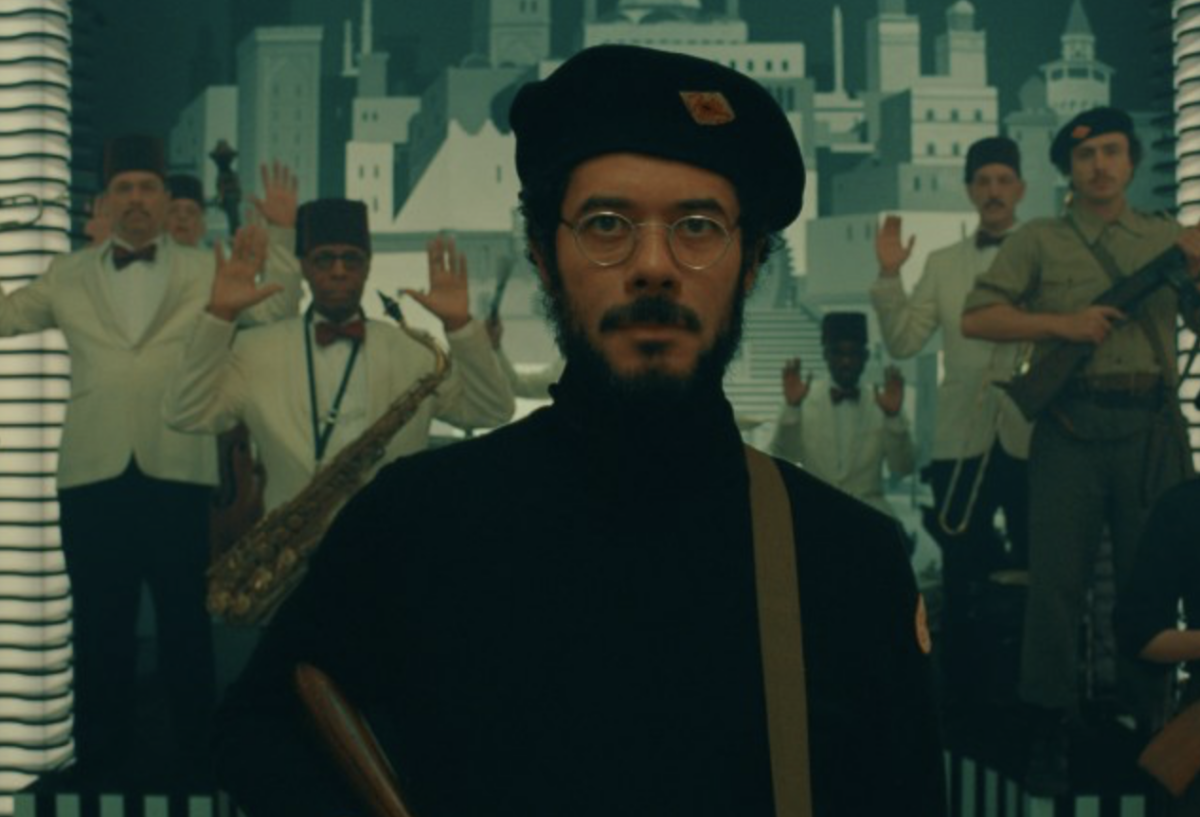
Anderson traditionally uses stylized and culturally vibrant backdrops for his predominantly white casts, but in “The Phoenician Scheme,” this posturing becomes especially pronounced. His work is visually sumptuous, perhaps, but troublingly shallow, as the cultures on display are flattened into props, their intricacies sacrificed for visual spectacle.
The story follows European tycoon “Zsa-Zsa” Korda’s (Benicio del Toro) colonial infrastructure project in a fictionalized Middle East. While the plot is labyrinthine, the essential effect is that Middle Eastern imagery is filtered through a Western lens, the cultural pretext minimized and contorted to make the film digestible for Western audiences.
As theorized by Edward Said, Orientalism names the ideological framework through which the West has historically represented the East, rendering it exotic, regressive and fundamentally “other.” Anderson’s cinematic landscape both reproduces this legacy and carves out new aesthetic iterations of it.
His deployment of “the East,” its people and geography and cultural signifiers, participates in a long-standing tradition of Orientalism in Western art and literature.
This is best evidenced by his reduction of Eastern characters, leaving them underdeveloped or erased altogether, while the cultural region itself becomes a stage against which Western subjectives are dramatized.
While Anderson is ostensibly conscious of the imperialist and orientalist aesthetics his films deal with, his visual structure essentially resists reckoning with the economic dispossession and the cultural genocide that drives colonial expansion.
His signature framing paradigm, referred to as a tilt-shift depth-field or “miniature faking,” renders political negotiations and violence toy-like and surreal, allowing him to build an exquisitely subdued world, down to the frame, the implication being that the brutality of historical conquests are softened into curiosities.
Rather than dismantle this paradigm, the film recycles it, hampering any potential colonial critique, namely, any interrogation of how imperialism commodifies culture and enforces power hierarchies, with whimsy.
This time though, the film feels embalmed. The viewer gets the sense that Anderson is aware he is repeating himself, that his once magical and light aesthetic is inundated with the weight of something more complicit and oppressive. There is scant beauty, yes, but also a resonant ache of a filmmaker reckoning with the limits of his own form.
The film ends up only reinforcing the very themes it (subversively) set out to critique: romanticized exoticism and cultural reductionism.
This raises the crucial questions: Why has the historically apolitical Anderson chosen now to make a film about the carving up of the Middle East by colonial powers?
Anderson’s work continues to receive widespread acclaim, particularly among Western audiences; it’s perplexing, given that we live in a moment where cultural appropriation and artistic responsibility are under intense public scrutiny. The relative silence around Anderson’s aesthetic choices feels a bit surreal. Part of the reason is that Anderson’s works operate as self-contained in their storybook artificiality, insulating them from deeper interrogation.
This is not to say that artists must avoid engaging with cultures that are not their own; quite the opposite. But there is a clear line between elegant cultural storytelling and sheer aesthetic exploitation of those cultures, and Anderson, more often than not, ends up on the wrong side of that line.
Ironically enough, when he steps away from overt cultural settings and focuses on fictionalized metaphorical worlds, like in “The Grand Budapest Hotel,” Anderson crafted what many consider his most successful and complex film.
It’s not about avoiding other cultures, but engaging with them thoughtfully and avoiding the pitfalls of nostalgia-driven exoticism.