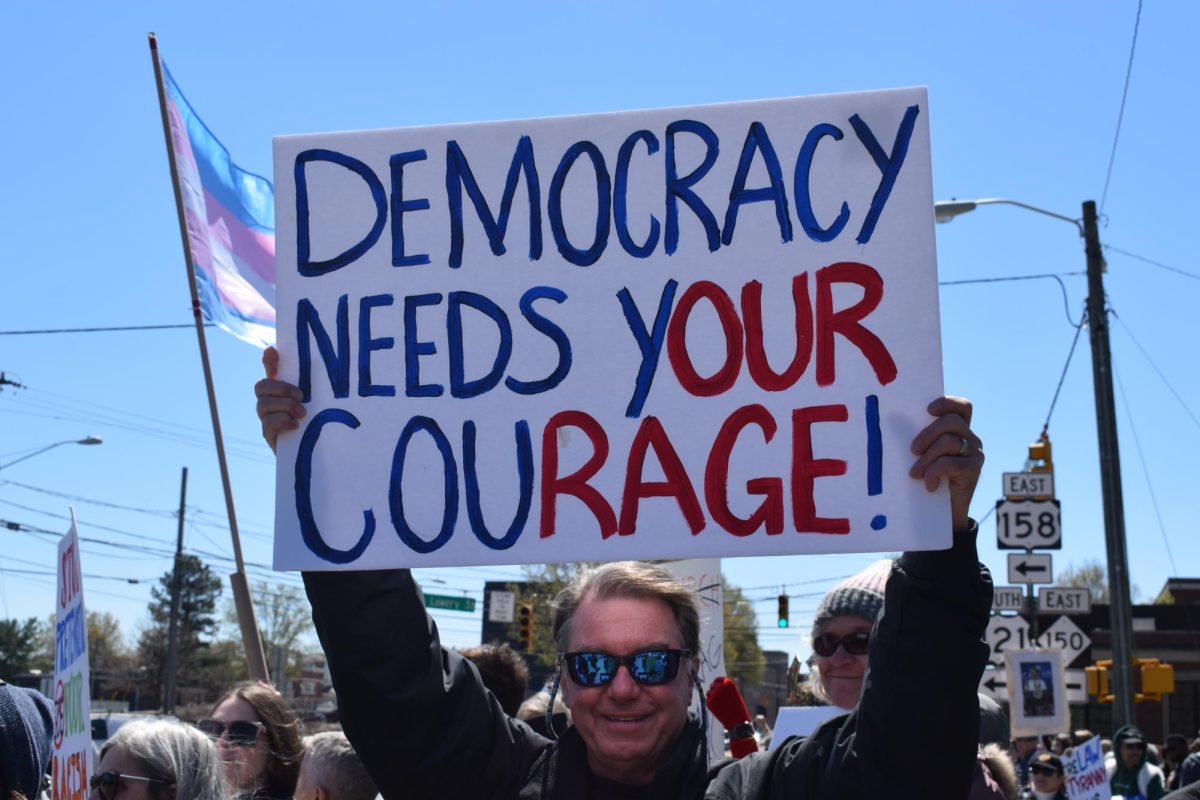


Crowds turned out in downtown Winston-Salem, N.C., on Saturday afternoon to protest President Donald Trump’s second administration. They joined the second wave of nationwide “No Kings” protests, defying what organizers called Trump’s abuse of power.
Protestors lined Main Street and stood on the stairs of government buildings, including city hall. Participants included locals and organizations across the Triad, including Wake Forest University’s College Democrats. They held signs, wore costumes and chanted slogans criticizing the Trump administration’s actions on issues like immigration, the economy and threats to democracy.
Kwaku Sarpong, a third-year student at the Wake Forest University School of Law, said he’s most concerned with what he called Trump’s defiance of the rule of law and actions like attacking political opponents.
“I think it’s just very concerning to see all of that being thrown out the window,” Sarpong said. “It feels like no one’s concerned. It’s like a perversion of the law as well as getting rid of the law.”
Others like Fletcher Wall, a lighting restoration professional, called on the administration to address the rising cost of living and livability for working people.

“If the Trump administration can’t reduce our cost of living,” Wall said, “I’d like to see the State of North Carolina raise the state minimum wage to a living wage of at least $23 an hour.”
After the first nationwide “No Kings Day” movement this summer, protestors hit the streets again, joining an estimated seven million at one of the over 2,700 demonstrations organized across the country. Crowds also packed other cities in North Carolina, from Charlotte to Wilmington and in between.
Others protesting hoped to raise awareness and get more people involved in condemning the administration. Jeanne McGaffigan is a communications official for the progressive civic engagement group, Camel City United Indivisible, and began organizing after participating in last April’s “Hands Off” rallies. She hopes that Saturday’s protests will attract more young people to show up and make their voices heard.
“I’m hoping that is starting a trend,” McGaffigan said, “that young people will show up and realize that if you have millions and millions of people protesting the same thing, then something’s gotta change soon.”
McGaffigan also noted that she knew several people, either from other countries or with relationships with people from abroad, who were afraid to protest on Saturday.
Quinn Fabish, another third-year student at Wake Law, hoped the rally would expose the problems with Trump’s actions to people from across the political spectrum. She reframed the issues being raised altogether as bipartisan.
“I would hope that people would realize that this is a non-partisan issue. This is not something that is Democrats versus Republicans,” Fabish said. “This is more so the citizens, the people in this country, not just citizens, versus an authoritarian government that is prioritizing wealth and status over the protection of the people.”