
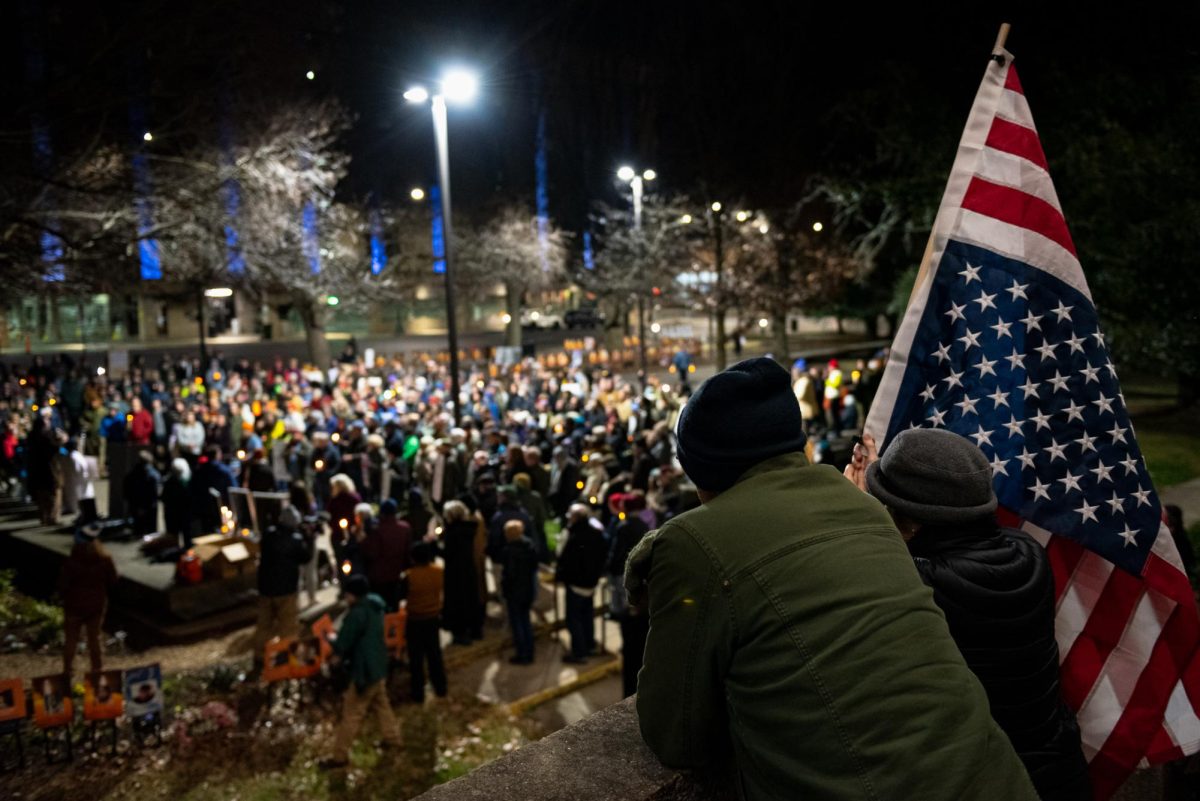
Around 200 people gathered in downtown Greensboro, N.C. Wednesday night for a vigil remembering Renee Good, the American citizen shot and killed by an Immigration and Customs Enforcement (ICE) agent in Minneapolis on Jan. 7.
Attendees carrying signs and flags filled the square in front of the Melvin Municipal Office Building. They lit candles, laid flowers and drew with chalk at an altar featuring photographs of Good and others killed during the Trump administration’s immigration crackdown, including Silverio Villegas González, Keith Porter, Jaime Alanís Garcia and Roberto Carlos Montoya Valdés.
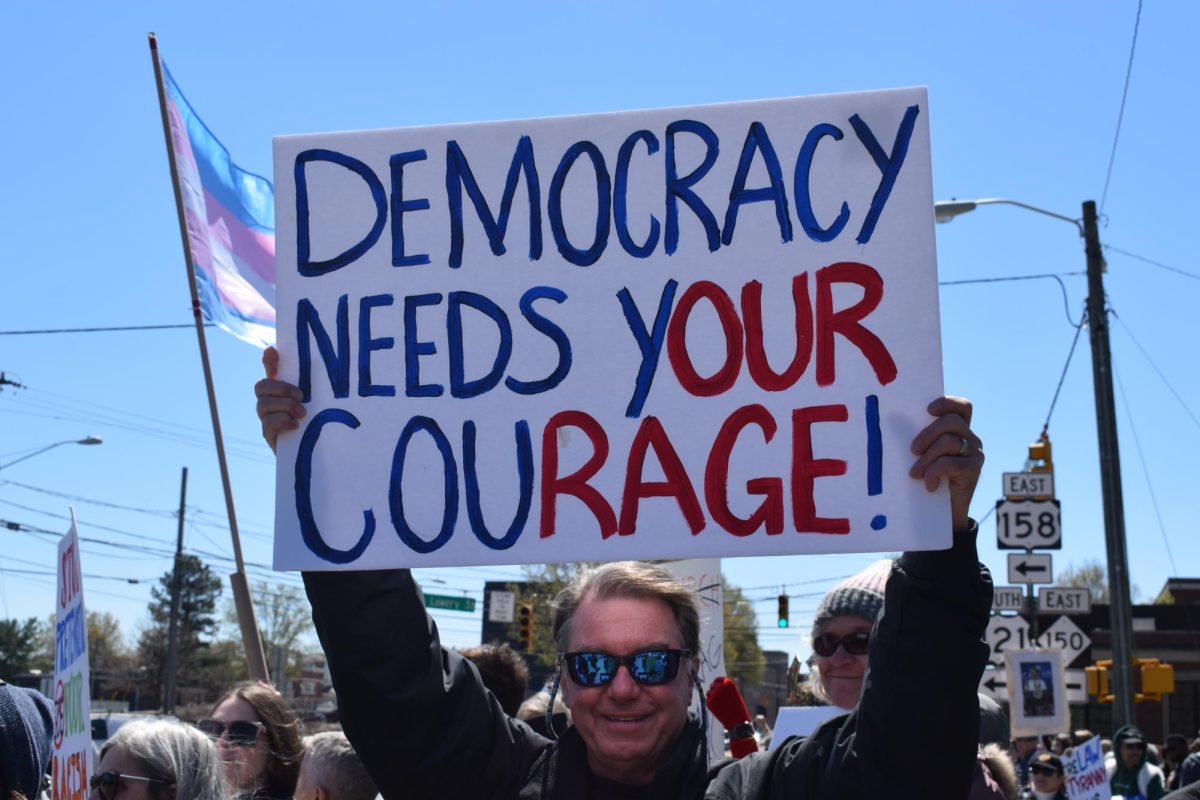
Rusty Weadon of Greensboro brought a large American flag to the vigil. He said he viewed protesting as his “patriotic duty.”
“I’d much rather be at home warming my bones, but it’s important that people turn out,” Weadon said. “The most American thing you can do is to speak out.”
Rennie Salata, a minister at Center United Methodist Church in Greensboro, said he came to the vigil both to mourn Good’s death and to express his “solidarity with [his] immigrant neighbors.”
“We’re seeing more and more people harmed and killed, not only our immigrant neighbors but also U.S. citizens,” Salata said. “And really, it doesn’t matter about the status.”
President Trump’s political allies have characterized Good, a 37-year-old writer and mother of three, as a domestic terrorist and asserted that the ICE officer who shot Good acted in self-defense – claims disputed by many experts who have analyzed footage of the shooting. While Trump’s aggressive anti-immigration policy has faced public backlash before, Good’s death has sparked a renewed wave of protests in her home state of Minnesota and across the nation.
In Greensboro, local clergy led the crowd in prayer, hymns and moments of silence while activists denounced ICE’s tactics, called for a transparent investigation of Good’s death and shared their experience volunteering to verify suspected ICE sightings. North Carolina House Representative Kanika Brown started a chant.
“Whose streets?” Brown asked.
“Our streets,” the crowd replied.
The Latino political advocacy organization Siembra NC, which has spearheaded statewide efforts to document and protest immigration enforcement operations, sponsored the event in collaboration with activist group Indivisible Guilford County.
David Smith, a Quaker minister and organizer for Indivisible Guilford County, said local activists coordinated quickly to plan the vigil.
“The most important thing we can get out of this is meeting each other, learning what each other are doing [and] finding where our talents… can be put to the best use,” Smith said. “That’s how you defeat tyranny – by building community, coming together and resisting.”
Smith added that he wasn’t surprised to see a large turnout for the vigil.
“We’ve had a lot of moments along the way for the last couple of years, but this one is very different,” Smith said. “I think it’s really waking up a lot of people to… realize the severity of the situation, and they are now willing to stick their necks out and take the risks that they thought they weren’t going to have to take.”
Ruby Menjibar, a student from Charlotte, N.C. at the University of North Carolina at Greensboro, said ICE wrongly detained her cousin over the holidays, an experience that motivated her and her family to get more involved in political activism.
“It’s time… for me to stand up and do something in the smallest way possible, as much as I can,” Menjibar said.
Activist Shaman Sellars helped create a dispatcher system within the Piedmont Triad to alert volunteer verifiers of possible ICE sightings during the “Charlotte’s Web” enforcement operation in North Carolina in November. Though the agency’s presence has largely faded from the state in recent weeks, Sellars said he encourages North Carolinians to remain vigilant.
“There’s no reason to think that ICE and Customs and Border Control are not going to move back into the state,” Sellars said. “This downtime that we have right now is the time to ramp up our preparedness.”