
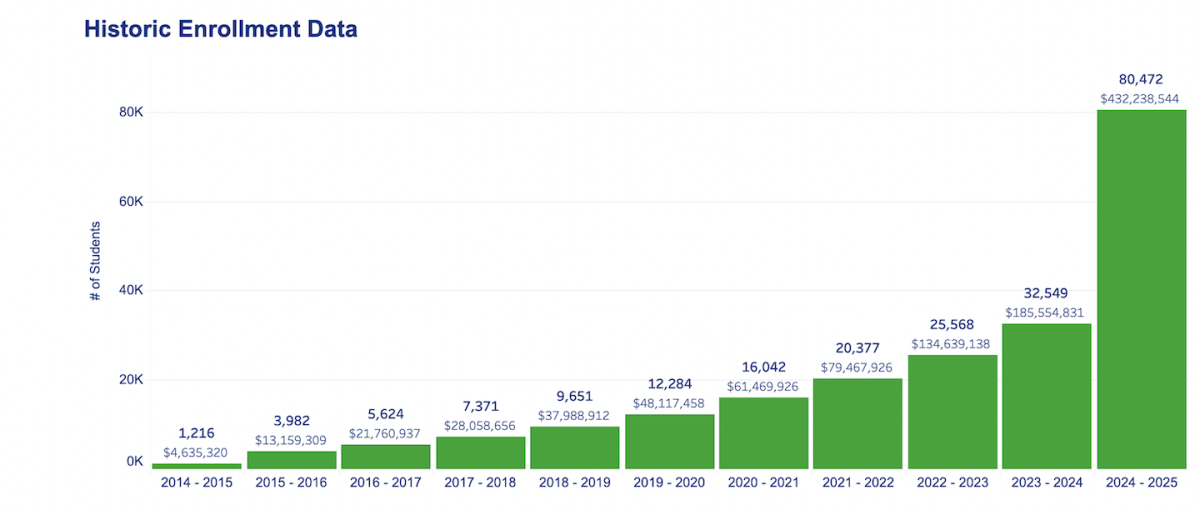
Two years after the North Carolina legislature eliminated the income cap for the N.C. Opportunity Scholarship, enrollment in the state-funded school voucher program has skyrocketed. Over 100,000 K-12 students, including 4,229 in Forsyth County, now receive tuition assistance at private schools around the state as of Jan. 2026 – a dramatic increase from fewer than 33,000 students during the 2023-2024 school year.
Supporters of the program say the $3,000 to $7,500 most participating families receive expands access to private schools and allows parents greater flexibility in selecting supportive educational environments for their children, especially those with unique learning needs such as disabilities. Opponents argue that the vouchers funnel hundreds of millions of dollars away from struggling public schools to subsidize costs for high-income families.
Statewide statistics
During 2024-2025, the first school year following the abolition of the income ceiling, 42% of Opportunity Scholar students came from families earning above $115,440. Several private schools also increased tuition in light of the new policy, drawing criticism from public school advocates.
As private schools are held to fewer standards than public schools and do not publish standardized test scores, it’s challenging to evaluate participant outcomes. One statistic that is documented: race. White students benefit disproportionately from the Opportunity Scholarship program.
Though intended to improve access to private education, many argue that voucher programs perpetuate socioeconomic segregation, especially given the racist history of private schools across the South. In 2024, ProPublica identified 20 North Carolina schools that originated as segregation academies and still primarily enroll white students. Unlike public schools, private schools may reject applicants, and some of these academies might do so, surreptitiously, on the basis of race.
WFU student weighs in
Sophomore Hannah Laxton grew up in Yadkin County, N.C. and attended Calvary Day School, a private, Christian pre-K-12 institution. While she didn’t use a school voucher and wasn’t aware of any classmates who did, Laxton said she is generally supportive of the program.
Citing uneven academic offerings across Winston-Salem’s high schools along with the school district’s disastrous budget crisis, Laxton said she believes parents are justified in sending their children to private schools.
“It’s just a known fact that our education system in North Carolina is not where it should be,” Laxton said. “There are some schools that are super good and there are other schools that are just not very good.”
Laxton said she believes she would have been “really behind on class” and unprepared for the rigor of Wake Forest if she had attended her assigned public school, Forbush High School in Yadkin County. She added that if she had children, she would enroll them in local private schools rather than WS/FCS unless they were zoned to the affluent, highly-ranked Reagan High School.
“The schools here are so vastly different in quality,” Laxton said. “There are a lot of good elementary schools around here, but if it came to high school, if I weren’t in Reagan [High School’s zone], I’d send [my children] to a private school immediately.”