

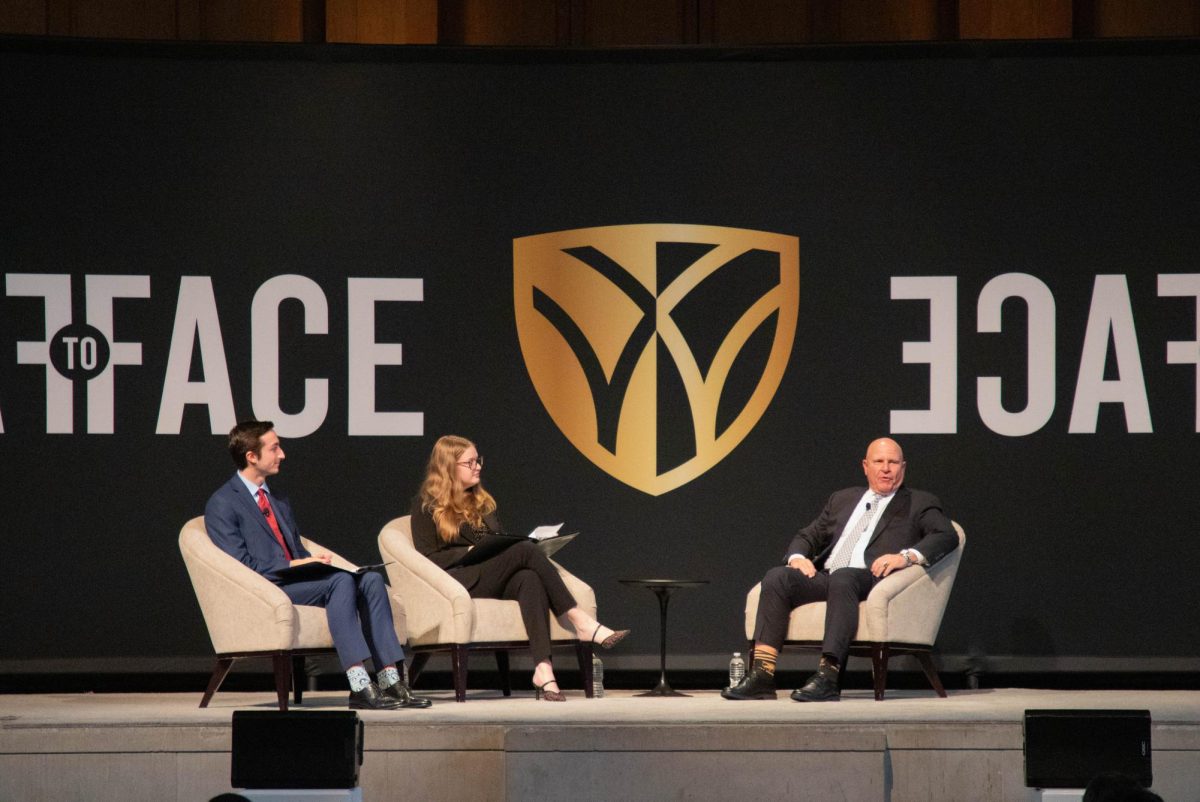
In a student-facing Face to Face speaker event in Wait Chapel on Feb. 26, Lt. Gen. H.R. McMaster drew from his 34 years in the U.S. Army and tenure as National Security Advisor to emphasize the importance of collaborative, mission-driven and Constitutional leadership.
“Your role as a military officer is to execute and implement the policies and decisions of your civilian bosses,” McMaster said. “Our democracy was founded on the radical idea that sovereignty lies with the people.”
A renowned strategist, McMaster served as National Security Advisor to President Donald Trump from 2017 to 2018. He left the White House after reportedly encountering leadership differences with the president.
Management master’s student Sailor Troutman and recent School of Business graduate Matthew Littrell moderated the event, which was hosted by Army ROTC cadet Reesa Devers.
McMaster began the conversation by reflecting on his childhood in Philadelphia, recalling an early fascination with military history.
“I always just was drawn to the Army,” McMaster said. “I was just enthralled with the idea of being challenged and having the privilege of being part of missions bigger than myself. And then also having the leadership challenge of building cohesive teams that are prepared to fight together and look out for one another.”
McMaster explained that his time as a rugby athlete at the United States Military Academy reinforced his belief in the value of collective effort.
“It was really how the team plays together to determine the outcome more than any other factor,” McMaster said. “There’s not typically one great star.”
When asked about his service during the Gulf War, McMaster recounted the 1991 Battle of 73 Easting, in which his unit defeated an opposing Iraqi force against daunting odds.
“In a 23-minute-long and extremely intense battle, we were able to destroy a force that was about ten times larger than us and suffered no casualties, thank God,” McMaster said.
He attributed the success to his unit’s rigorous preparation and the bonds they formed through that training.
“We trained together very, very intensely,” McMaster said. “You develop a mentality and a feeling for one another, almost like a family, and you don’t want to let the other members of your family down.”
When considering military strategy, McMaster said that combat readiness requires more than just technical training.
“Tactics are important, sure,” McMaster said. “But there must be a mental, moral and physical preparation for combat. Spiritual preparation for combat is just as important as well. But on the opposite end of the spectrum, fear is the worst thing that can happen in combat. It leads to hesitation, which can get you killed.”
The discussion later shifted to politics, with McMaster urging students to reject hostility and prioritize thoughtful, substantive dialogue.
“I think the most important thing is to try to transcend the vitriolic kind of partisan discourse you see,” McMaster said. “It’s so sad to see facts get thrown in the trash bin, all because of a bias towards a certain party. Everybody is entitled to their own opinion, but not to their own facts.”
Turning his focus to those currently serving in the military and government, McMaster advised public servants to uphold Constitutional principles. He warned of danger if the military and the executive branch turned against one another.
“It undermines sovereignty,” McMaster said. “It undermines the Constitution.”
Reflecting on his time in the Trump administration, McMaster emphasized that leadership carries an obligation to provide candid advice.
“You owe that person your best advice,” McMaster said. “What the heck is advice anyway if you’re just telling someone what they want to hear? What I would do with President Trump was clarify what that person wants to achieve.”
“Mr. President, are these the right objectives?” he continued. “Is this the overarching goal? And then once he says yes, then you bring in the options.”
First-year Declan Flood said he appreciated McMaster’s remarks on Constitutional responsibility.
“It really made me think about how important it is to listen to different perspectives and focus on facts instead of just opinions,” Flood said.
Several attendees said McMaster’s insights from combat resonated with them beyond a military context, including first-year Jake Winslow.
“Hearing how he prepped his team for combat showed me that trust and teamwork are everything, even outside the military,” Winslow said.


