


Like many universities founded in the American South, Wake Forest University has historical ties to slavery. In 2019, sociology professor Joseph Soares and his social theory class brought to the University’s attention that Wake Forest’s endowment was funded by the auction of 16 enslaved human beings. Soares and his class planned the first Commemoration of the Enslaved in 2019.
The President’s Office has since led the annual Commemoration of the Enslaved, including the most recent event held on the steps of Wait Chapel on Tuesday, Apr. 28. However, in an interview with the Old Gold & Black, Soares voiced dissatisfaction with the President’s Office’s management of the commemoration.

Wake Forest acknowledges its involvement with slavery
The University has made efforts to acknowledge its past involvement with slavery and honor the enslaved. The Provost’s Office created a committee during the 2016-2017 academic year to study Wake Forest’s ties to slavery, and in September 2020, President Nathan O. Hatch created the President’s Commission on Race, Equity and Community, the Slave, Race and Memory project and an Advisory Committee on Naming.
In April 2021, the Board of Trustees unanimously voted to create a campus memorial. During Wake Forest’s 192nd Founder’s Day, Wake Forest University President Susan R. Wente announced that the Board of Trustees had approved the final design for the memorial to honor the enslaved. Construction will begin soon on an amphitheater memorial located on the hill at Parking Lot S near the head of the Reynolda Trail Loop.
In an interview with the Old Gold & Black, Soares criticized Wente’s Founder’s Day Speech.
“You could think that ‘Oh, it’s great the president’s office is doing this,’ but the problem is, we have a president who cannot even say the word slavery when she is supposed to be making a special statement about it,” he said. “We were told the Founder’s Day Speech would include a special announcement about the commemorative monument that is being built. This person is trying to gaslight, obscure and, in my opinion, sabotage any effort to have this be an important public tradition.”
Soares criticized the following section of the Founder’s Day speech delivered by Wente:
“We’re taking thoughtful action on the April 2021 Board of Trustees Resolution that endorsed the campus memorialization project. I am truly grateful for the steering committee of faculty, staff, students and alumni that worked diligently, so that now, based upon the unanimous approval of the Board of Trustees earlier this month, we will take the next steps forward on the final design and construction of our campus memorial. An amphitheater and garden concept placed at the intersection of Wake Forest Road and Eure Drive on what is now Lot S.”
She continued: “This memorial is designed to bring people together, to invite all in. To remember, to honor, to reflect on our past and to learn, to discern how all can be founders for the future. This is the Wake Forest that we are founding together. A Wake Forest of opportunity, discovery, honesty and excellence.”
In an email to members of the Slave, Race and Memory project, Soares criticized Wente’s omission of specific reference to the enslaved individuals.
Soares wrote: “How is anyone who doesn’t already know that this is about commemorating Wake’s enslaved supposed to learn that from [Wente]’s comments?”
He continued: “[Wente] managed to avoid any mention whatsoever of Wake’s enslaved. The Trustees are mentioned twice, faculty, staff and alumni are given a shout out, but the enslaved?!?!? This statement falls far short of ‘thoughtful action … honesty, and excellence.’ If anything, it is the exact opposite. I think this is more of an exercise in obfuscation than in telling Wake’s full story, in honoring Wake’s involuntary enslaved founders, in announcing a space for reflection and progressive movement.”
When asked about Wente’s choice of language during her speech, Jose Villaba, vice president and special adviser to the president, said in a statement to the Old Gold & Black the following:
“[President] Wente’s remarks about the memorial at Founders Day were a progress update on the project; three sentences of a much longer speech,” Villaba said. “The three years of conversations with campus and community stakeholders led to the conceptual design for the memorial and have helped shape and expand the purpose of the memorial. It will be both a way to remember and reflect on the institution’s ties to slavery, as well as elevate unrecognized labor and contributions to founding and sustaining Wake Forest University.”
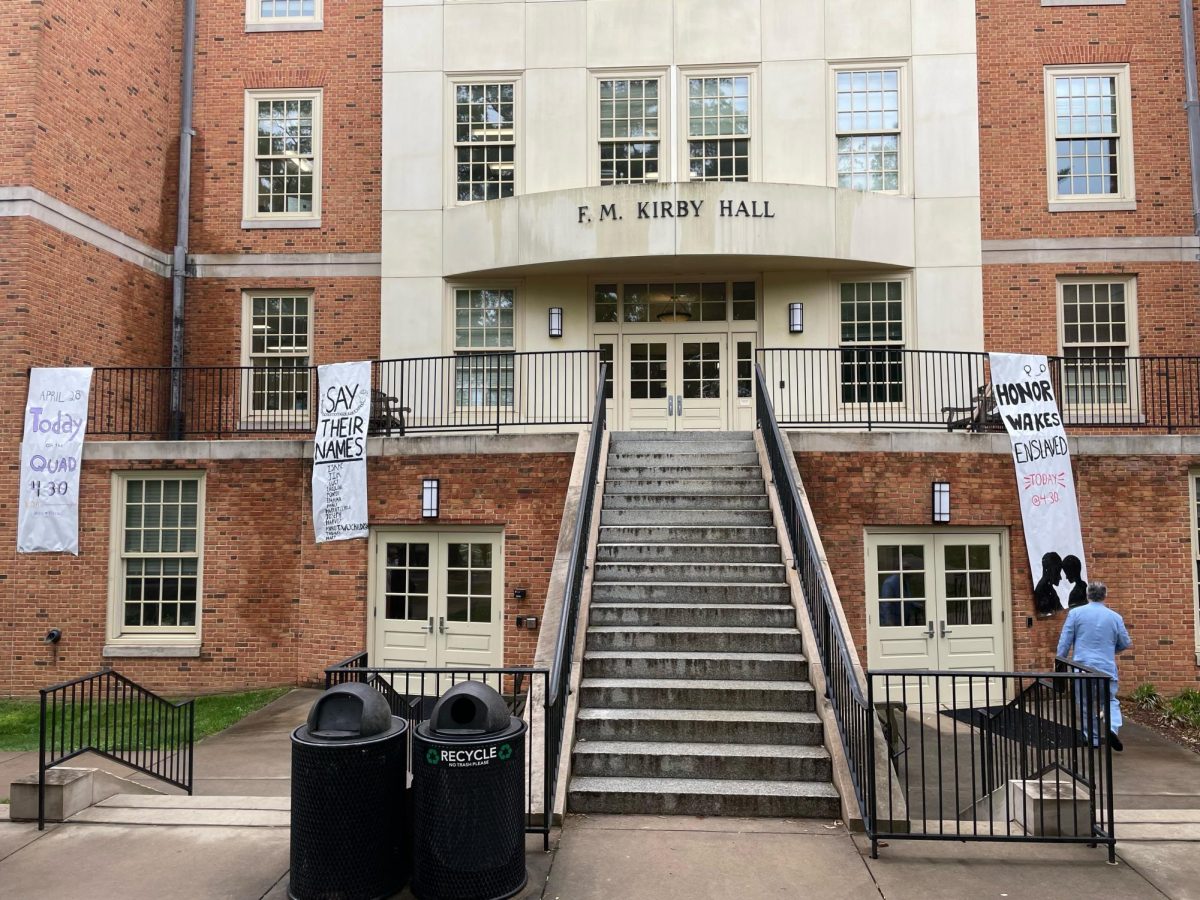
Soares said that he and the students in his sociology class took an active role in advertising the 2026 event because he did not trust the president’s office to do so effectively. Soares referred to a photograph from the seventh commemoration and described the turnout as “pathetic.”
“We’re doing work that the University should’ve been doing years ago,” Soares said. “I’m very upset. I do not trust the President’s office to give this a full effort to maximize participation, and that’s the whole point.”
The commemoration of the enslaved planning
In February, the president’s office notified the steering committee that the commemoration, which is typically held outside Wait Chapel, would instead be held in the parking lot by the future memorial site. Soares objected to this.
“My students and I are going to do it in front of Wait Chapel, regardless of whether the president’s office is doing it in the parking lot or not,” Soares said. “Then they changed their mind and said it’ll be at Wait Chapel.”
Villaba said that the parking lot was originally considered due to its proximity to the memorial’s location.
“Other sites were considered early in the planning process when exploring opportunities to connect the event with the location of the memorial that was announced during Founders Day,” Villaba said.
While the event was ultimately moved back to Wait Chapel, the commemoration Soares envisioned was still different from the one the President’s office held. He wanted student organizations to be involved in reading the names of those who were enslaved, but said this was turned down by the planning committee. Soares also shared that a music professor, whom he declined to name, offered to have their class perform at the beginning of the commemoration. Instead, the president’s office opted to play “We Shall Overcome” on the Wait Chapel carillon.
“They don’t want student organizations participating, reading names; they don’t want music that is offered by someone who would then be involved more in the event,” Soares said. “All of these are ways of building out and broadening the event.”
In response to community criticism, Villaba said the following in a statement to the Old Gold & Black on April 27: “This is a community event and feedback from the community about how to acknowledge and honor enslaved individuals will inform how the event evolves. Since it is an annual event, we welcome suggestions after tomorrow’s event that can be used for planning and developing next year’s Commemoration.”

Campus holds commemoration
“It wasn’t until 2018 that the university started to make very intentional efforts to lift up the stories, voices and experiences of enslaved peoples with ties to this institution,” Villaba said in his opening remarks at the commemoration. “That spring, students in the divinity school partnered with students in the sociology department to plan and hold the first commemoration of the enslaved.”
University Chaplain Chris Donald then said a prayer asking for forgiveness and called for remembrance of the enslaved. Next, Sean McClure, project manager for the Slave, Race and Memory project and senior program coordinator for the Center for Research, Engagement and Collaboration in African American Life, expressed how oppressed communities turn memory into meaning.
“Storytelling is both testimony and dream,” McClure said. “A way of saying we were here and a way of imagining what freedom might yet become. We now inherit a sacred responsibility. We must tell the story.”
Tanya Zanish-Belcher, an archivist and director of special collections and archives at Z. Smith Reynolds Library, led the naming and remembering of the enslaved individuals who were sold to benefit Wake Forest College.
“We remember and say the names of all the individuals we know and we acknowledge those whose names we do not know,” Zanish-Belcher said. “The search for their names continues as does the work to acknowledge and repair our past. We remember in the hope that doing so is another step forward on our journey towards reconciliation in our communities.”
Former president of the Black Student Alliance Chase Clark, 2025-2026 student body president Amaya Williams and Mary Tribble, the fourth great-granddaughter of Samuel Wait, read the names of enslaved people exploited at Wake Forest. They concluded the reading with the words “We remember and honor you.” They asked attendees to respond with the same words.
Known names of enslaved adults exploited by the university include: Ellick, Harry, Charlotte, Johnson, Anderson, James, Lender, Mary, Sarah, Phillis, Mary, Lucey, Venus, Patience, Mary, George, Murphy, Ted, Amy, Rose, Martha, Lexy, Mary Sherwood, Aggy, Maranda, Mary, Harris, David, Virtn, Betty, Inez, Harvey, Tom, Venus, Chold, Mary, Emma, Lettice, Isaac, Jim, Lucy, Caroline, Pompie, Nancy, Harriet, Joseph, Harry, Ann and Thomas. Several children were also exploited by the university.
Further information regarding Wake Forest’s ties to slavery can be found here.
Following the reading of the names, Vice President for Campus Life Shea Kidd Brown sang “(Take My Hand) Precious Lord” (1932) by Thomas A. Dorsey, a gospel song written to find comfort in despair.
The commemoration concluded with a final speech from Villaba thanking all who planned and attended the event. He said that the enslaved individuals’ stories exist beyond Wake Forest.
“So much of our history is unknown, and so much remains to be unwritten,” Villaba said. “The stories of Nancy, Henry, Emma and Joseph, will never be confined to Wake Forest College. Neither should any of our stories.”
Soares’s students share criticism
Nur Turner is a junior in Soares’ “Sociology of Contested Pasts” class. She shared that she was pleased with this year’s commemoration and was glad Wake Forest University made a conscious effort to acknowledge its past.
“It was refreshing to see so many people come together with respect and kindness to bring a sense of justice to those who were enslaved and sold for the university’s endowment,” Turner said.
Students played a large part in advertising the event through the creation of banners, yard signs and flyers made by Turner, Sarah Grace Raynes and other classmates. These materials were distributed across campus. In addition, Turner reached out to several student organizations, as well as neighboring colleges, to increase attendance.
“This was the first year the advertising was student-led, and largely because of this, it was the biggest turnout the event has ever had,” Turner said. “Even though some individuals took down our signs prior to the event taking place, it did not stop our mission. It is apparent that if this event had been advertised solely by the President’s Office, there would not have been such a large gathering.”
She continued: “This makes me wonder why they choose to advertise the event so minimally. As a junior, I know the pride this university takes in its social gatherings, yet I saw almost no coverage besides the marketing done by Professor Soares’s class. It is ironic that the point of the event is to remember these injustices, yet the administration barely allows others to know the event is happening. While the speakers were refreshing and mentally stimulating, we must continue to take action face-on so we can collectively remember these decisions properly as a university.”
Senior Sofia Miguel, another one of Soares students, noted the strong student presence at the commemoration held on April 28.
“Seeing students at the event after the hard work of posting flyers, placing yard signs that repeatedly got taken down, and painting posters to advertise the event was extremely rewarding,” said Miguel. Yet, even with student support and continuous advertising, this still isn’t enough. To fully honor our past, we need more attention to this event and more general knowledge about our University’s past, especially from the administration.”
Miguel continued, reflecting on the campus memorial: “The space they are constructing to honor these individuals will be in a barely trafficked area on campus, where the message will be lost. To many students, this placement can feel disconnected from the importance of the history being commemorated. If Wake Forest is truly committed to acknowledging this past, the memorial should be placed somewhere that encourages reflection, visibility, and engagement from the broader campus community. Were these lives we used for our benefit truly only worth an ignored commemoration and hidden memorial space? I believe their legacy deserves more.”
The commemoration is meant to serve as an opportunity for the present Wake Forest community to acknowledge the past and use that knowledge to improve as a society.
“Social memory for sociologists is something that is inextricably connected with how societies remember the past matters and that we do feel a sense of purpose in trying to get societies to imagine the past in ways that enable us to imagine a better tomorrow,” Soares said.


