
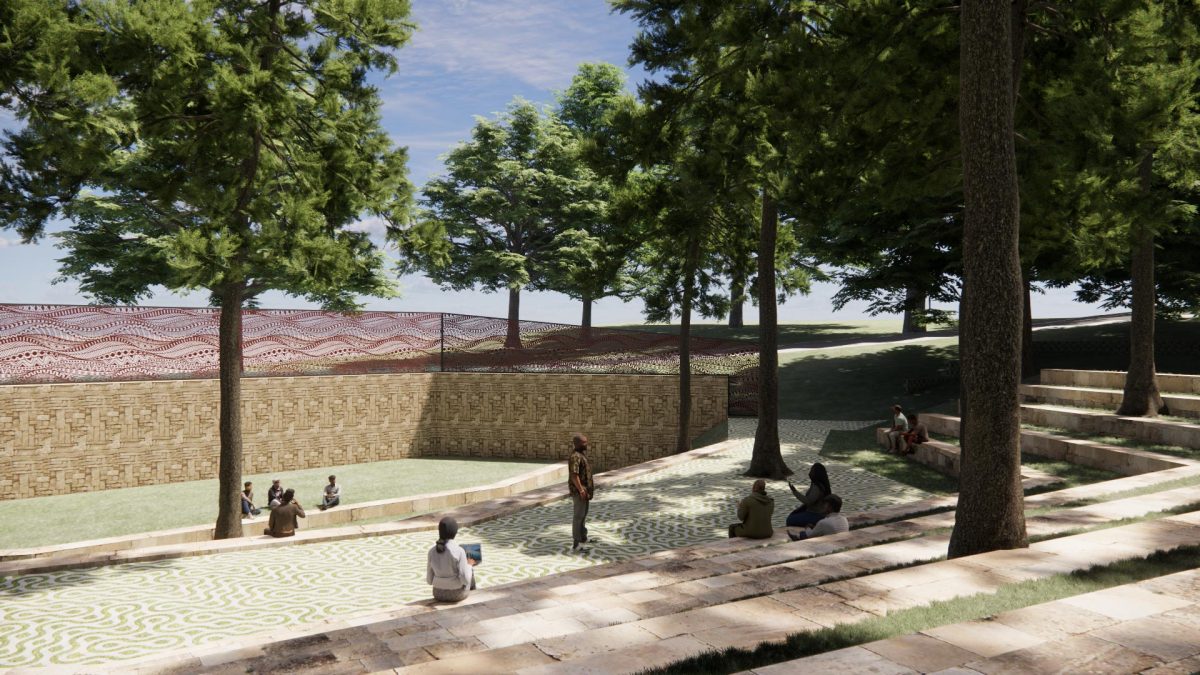
Wake Forest will soon begin construction on an amphitheater memorial honoring the enslaved individuals whose labor and sale contributed to Wake Forest history, President Susan R. Wente announced at the 192nd Founders Day celebration. Located on the hill at Parking Lot S near the head of the Reynolda Trail Loop, the memorial will mark the culmination of a years-long planning process.
“To reflect and remember the forced work and contributions of [enslaved] people is part of the reason why it is important for all universities with ties to slavery to acknowledge and amplify these connections,” Vice President and Special Advisor to the President José Villalba said in an emailed statement. “It is also important for current students, faculty and staff to honor all who helped found the institutions in which they are enrolled or employed.”
According to the “To Stand With and For Humanity” essay series commissioned in February 2020 by former Wake Forest President Nathan O. Hatch, Wake Forest sold 16 people in 1860 to fund the school’s first endowment. Wake Forest also used dozens of enslaved adults and children as contract laborers on the school’s original campus in Wake Forest, N.C.
In September 2020, Hatch created an Advisory Committee on Naming to contextualize the University’s history of racial injustice.
In April 2021, the Board of Trustees responded to the committee’s findings by voting unanimously to create a campus memorial. The Board voted unanimously again in February 2026 to approve a proposed design concept and campus location for this memorial.
Architectural and design firm Baskervill led the planning process in close collaboration with the Campus Memorial Steering Committee appointed by President Wente in 2023. The steering committee, composed of University faculty across disciplines, provided direction and input throughout the memorial’s conceptual development.
“To be part of a committee that sought to respect, appreciate and hold these voices up is one of the most rewarding things I’ve ever been a part of at Wake Forest,” Villalba, who served as chair of the committee, said.
The steering committee began by visiting the Memorial to Enslaved Laborers at the University of Virginia and the Hearth: Memorial to the Enslaved at the College of William & Mary to learn from these other universities’ planning processes. Following more research, the committee identified and met with diverse campus groups to present their goals and receive feedback on what the community desires from this memorial.
Lisa Blee, associate professor of history and steering committee member, said it is important to note that this memorial is only a starting point for remembering the history of racial injustice and enslavement.
“It was important in our steering committee conversations and with the designer, to always acknowledge that this memorial that we’re thinking about has to be part of a much longer process that might just start with a memorial,” Blee said.
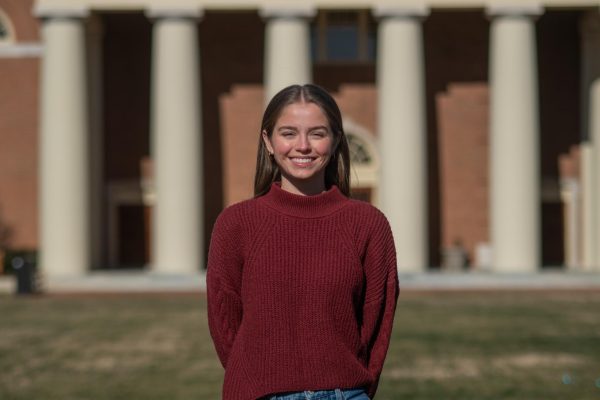
Senior Chase Clark, president of the Black Student Alliance, served as a representative on the steering committee to bring a student perspective to the project.
“I feel like my voice was most effective in the question of which spaces on campus do we feel like this memorial will be most effective? Where do we actually go and spend time as students more often than not?” Clark said.
Following these deliberations, Baskervill presented five possible design concepts for the memorial. In October 2024, the University held three events and released a survey to receive community feedback on the proposed design concepts.
This feedback guided the university to decide on an amphitheater design located at Parking Lot S. The site provides an existing tree canopy and connection to the Reynolda Trail, making it both accessible and peaceful.
The Lot S location also serves as the midpoint of a linear axis between Wait Chapel and Reynolda Village. The campus memorial website describes Wait Chapel as “an architectural witness to the University’s entanglement with enslavement,” while Reynolda Village holds the history of the Reynolds family’s connection to systems of labor and power. Positioned between the two sites, the memorial serves as a “moral and historical fulcrum” that recontextualizes the University’s history as one with forced labor at its foundation.
Villalba expressed the importance of understanding Wake Forest’s founder, Samuel Wait, as a slaveholder who benefited from exploiting others’ labor.
“With the memorial in the foreground and Wait Chapel in the background, it calls the viewer to reinterpret and interrogate Wait Chapel and the man for whom it is named,” he said.
Blee said accepting and honoring the University’s difficult past is necessary for members of the community today.
“If we’re going to be loyal to an institution and think about ourselves as part of an institution, then we have to own all of it,” she said. “I think these memorials bring greater depth to our understanding of who we are.”
Clark acknowledged that not all students or community members may embrace the memorial, but said she hopes it will become an important source of conversation and reflection over time.
“It’s a conversation that can be uncomfortable, and it can be difficult, and it can be really sad,” she said. “I don’t imagine that it’s going to be openly received and everyone’s going to be singing kumbaya around the memorial.”
She continued: “I do hope that, if nothing else, for the larger community, it opens up space for conversation and dialogue around the University’s ties to enslavement, and not only in a way of just rehashing the history, but of thinking about how that even impacts us today, and particularly the Black student body today.”