

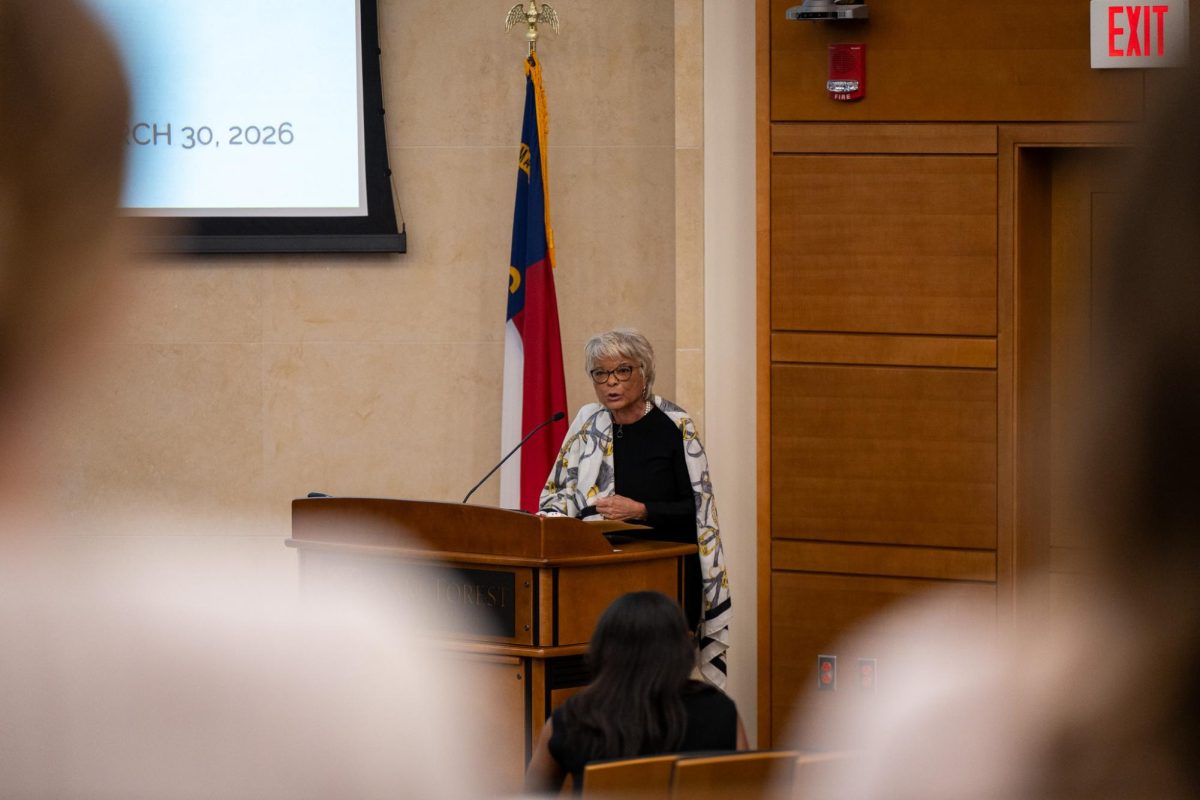
On March 30, distinguished alumna and civil rights advocate Professor Beth N. Hopkins (‘73) reflected on her experience as one of the first Black female students at Wake Forest in a keynote address to launch the Office of Leadership Engagement’s first annual Leadership Week.
“Beth Hopkins is a trailblazing leader who we can learn a lot from as a role model,” senior and Leadership and Character Scholar Juan Londoño said. “One of the most effective ways of deciding what type of person you want to be, and what character you want to work towards, is to look at role models and take inspiration from them.”
As one of two Black women living on campus and among fewer than twenty Black students in her first year at Wake Forest in 1969, Hopkins faced significant discrimination from students and faculty.
“Never in my wildest dreams did I imagine that I would be returning to Wake Forest,” Hopkins said.
However, despite these challenges, Hopkins graduated with honors in 1973, received her law degree from William & Mary and, after a distinguished career as a federal prosecutor, returned to Wake Forest in 1983 as a professor of history and law.
“Wake Forest actually helped me to appreciate also how institutions and people can grow who are set in stone,” Hopkins said. “My group sort of cracked the stone and revealed a whole new way…of thinking on both sides of the coin.”
Hopkins said Wake Forest has become more inclusive since she was a student.
“Wake Forest has come from 18 Black students to over 300 and an appreciation for all kinds of culture,” she said.
Hopkins’ career has been recognized with Wake Forest’s 2023 Distinguished Alumni Award and the 2023 Billie Jean King Champion of Equality Award. Her legacy is also honored through initiatives bearing her name, including a summer stipend for Wake Forest School of Law students, as well as the 2025 renaming of South Residence Hall for her and her late husband, Dr. Larry D. Hopkins.
The Office of Leadership Engagement coordinated the keynote speech as part of their new initiative, Leadership Week.
“Since the Office of Leadership Engagement is a new office, Leadership Week is a great opportunity to build awareness, engage students with our programming, and share the opportunity to join our Leadership Board next semester,” Coordinator of Leadership Initiatives in the Office of Leadership Engagement Melina Traiforos shared. “Our office focuses on three key areas: self-knowledge and awareness, purposeful leadership and driving social change.”
In alignment with the Office of Leadership Engagement’s broader mission, Beth Hopkins spoke on the importance of leadership as a foundational skill for students navigating through life.
“You need to learn how to be an effective leader and how to navigate some of the pitfalls that you will encounter as you become a person who will take our nation, our community, our school, or all in a different direction,” Hopkins said.
Additionally, Hopkins spoke to the importance of the intangible facets of leadership: integrity, spirituality, courage, patience and hope. In her experience, she said, staying true to one’s morals and identity will place one on the right path, even if it’s not the path one initially imagined.
While Hopkins never intended to return to Wake Forest, she realized that her undergraduate career was part of a larger plan for her life. Wake Forest ultimately became something far beyond what she had imagined as a student.
“When I was 18 years old, I never dreamed that a building would be named with my signature on it, and my husband’s signature,” Hopkins said. “You have to yield to a plan because there is a master plan for you.”
Traiforos and the Office of Leadership Engagement believe Hopkins provides an inspiring example of leadership for students.
“There’s a common misconception that some people are simply ‘born leaders,’ but in my experience, the strongest leaders are those who have faced challenges, engaged in deep self-reflection and intentionally developed their skills over time,” Traiforos said. “This stage of life is a critical period for growth, and what students learn now will carry into both their personal and professional lives.”
By learning more about leadership and how to become a better leader, students have a unique opportunity to see not only personal and professional growth but also to create a meaningful impact in their community.
“Hang on to hope, and in your leadership roles, demonstrate compassion and charity and kindness,” Hopkins said. “Spend time generating positive energy so that good things will happen to you. As a leader, endeavor to be passionate, committed and undaunted in your quest to be. Endeavor to demand what is right, and question what is wrong. Endeavor to pledge allegiance to those things which are reflected by the goodness of our community.”


