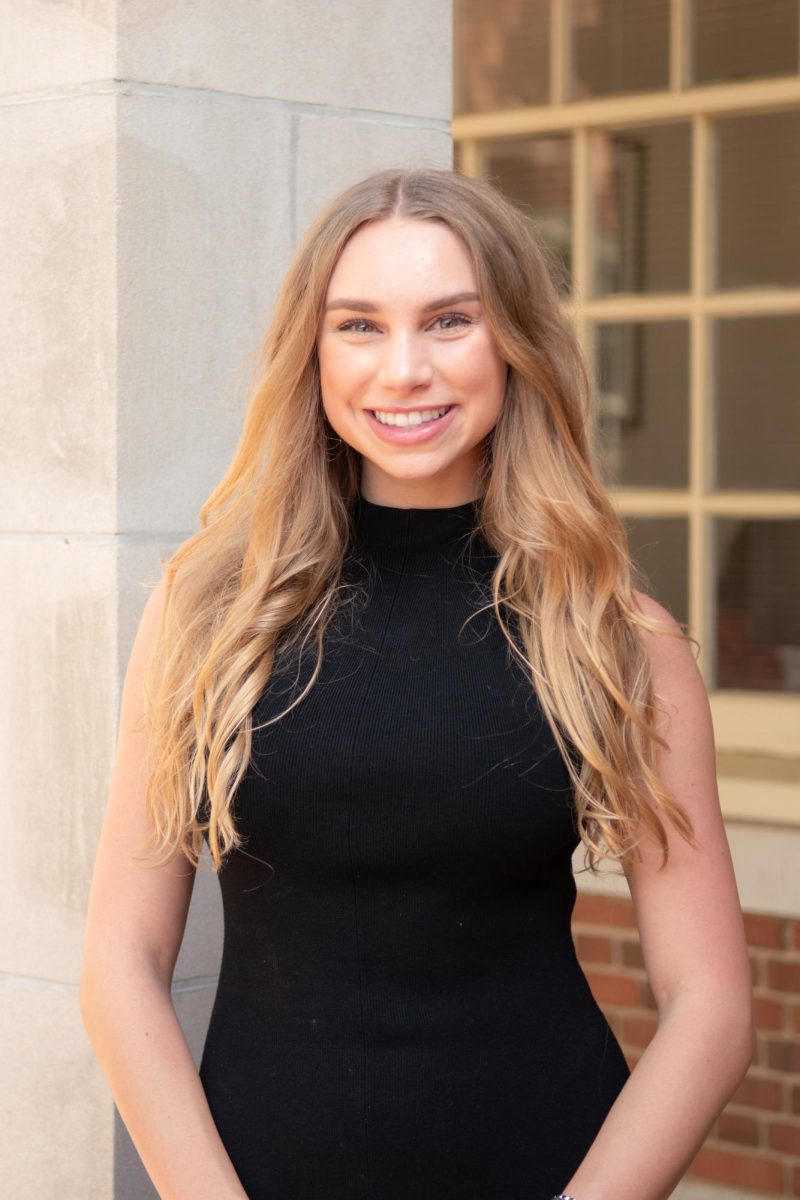


Annelise Witcher’s fascination with anthropology emerged from a favorite television show, “Bones,” which focuses on the work of a forensic anthropologist who solves crimes. When applying to college, Witcher was drawn to an education in people and culture. She was also specifically intrigued by Wake Forest’s Lam Museum of Anthropology.
“There’s not really a specific focus on any one particular field of anthropology at Wake Forest, but most of the classes are either archeology-based or cultural, and I’m kind of somewhere in between both of those,” Witcher said.
During her four years studying in the anthropology department, Witcher has appreciated how the subject broadens her perspective of other cultures.
“I came from a very, very conservative bubble, and I didn’t know a lot of people other than my very straight, white, Christian community,” she said. “And so coming to Wake Forest and then learning about anthropology and expanding that knowledge base and that cultural understanding was really helpful to me.”
Witcher believes that her lessons in anthropology have also influenced how she relates to people in her personal life.
“I am queer and I am disabled, and so I don’t exactly fit the mold that I was raised in, but it also helps me to connect with other people,” she said. “Because, you know, most people don’t fit that mold either.”
A specific lesson that has stuck with Witcher from her undergraduate studies is the importance of understanding the history of academic disciplines.
“It’s important to recognize that even though anthropology claims to have had good intentions from the very beginning, of understanding other people, it was still very much rooted in racism and genocide,” she said. “I think we’ve moved really far away from that, but you can’t understand where a field has come in the modern era without understanding its history, however dark and awful that may be.”
Witcher is one of four students graduating with an anthropology degree this year. She shared that one of her favorite aspects of the major is the small size of its community.
“Because it’s so small, all the students pretty much know each other, which is nice, and the professors are super amazing and wonderful…I feel like we’re all friends,” Witcher said.
Dr. Timothy Gitzen taught Witcher’s first anthropology class and made a distinct impression on her understanding of the subject.
“Coming from a very different experience growing up and then coming here, and jumping right into anthropology, and talking about queer life, and women’s and gender studies and all of that—it was jarring, but in such a good way,” she said. “[Dr. Gitzen] was… very excited about people learning new things and about challenging people’s preconceptions of various things.”
Another anthropology professor, Dr. Karin Friederic, played a key role in supporting Witcher as she learned to live with a disability in her first semester of college.
“Dr. Friederic has been really wonderful,” Witcher said. “She does a lot with disability studies… Becoming disabled in the first semester here was very much a challenge, and Dr. Friederic was really wonderful in pointing me towards some resources and checking in on me.”
Alongside her course studies, Witcher works as a museum assistant at the Wake Forest Lam Museum of Anthropology. In her role, Witcher works at the front desk, gives tours to visitors and updates terminology in the museum’s database.
“The museum opened in 1963, so as you can imagine, language changes and terminology changes, and things that may have been OK to describe things with are not necessarily the best words to use for them now,” she explained. “So I helped a little bit with renaming things to give them a more proper, polished, sensitive name.”
Following graduation, Witcher will spend the summer working at the Lam Museum while starting her job search. At the museum, she has previously worked with 3D digitization using photogrammetry software, and she hopes to continue this work in the future.
“I would like to go into museum work that focuses on digitizing collections and conserving cultural heritage for years to come,” she said.