
When the vast network of pipes, cisterns, permeable pavers, concrete retaining walls and even tree roots beneath Wake Forest’s campus experiences a failure, rainfall can inconvenience or even endanger the University. When that stormwater management system succeeds, almost nobody notices.
Except Utilities Systems Manager Seth Looney. So does the rest of the Utilities team, who maintain the technologies that ensure rainfall can dissipate within 48 hours and enter the watershed in a controlled manner.
“It’s literally everywhere around you,” Looney said. “There are curb inlets on the street, there are catch basins… and there’s a huge, complex maze of pipes that connects all that stuff together.”
The need for resilient stormwater management systems is increasing as climate change leaves communities around the world more vulnerable to flooding. Sea level rise and warming temperatures contributed to Hurricane Melissa’s devastating impact on Jamaica in late October, according to The New York Times, and future storms will continue to gain intensity and frequency.
Compared to other communities, Wake Forest is able to invest significant resources into protecting its land from damage. Crystal Dixon, an associate professor of the practice in Wake Forest’s Environment & Sustainability Studies Program, pointed out that less privileged individuals, cities and even countries often bear the brunt of extreme weather.
“This is a systemic issue,” Dixon said, citing the respective impacts of Hurricane Melissa in Jamaica in 2025, Hurricane Helene in Western North Carolina in 2024 and Hurricane Maria in Puerto Rico in 2017. “Delays in response… are creating and exacerbating the inequities and the health disparities that result from these natural disasters.”
Despite Wake Forest’s assets and the fact that the Reynolda campus has rarely experienced catastrophic weather, even seemingly minor precipitation can cause disruption. When distributed across the 345 acres of Wake Forest’s Reynolda campus, for example, just one inch of rainfall adds up to nine million gallons of water.
Some of that water evaporates and some soaks into the soil. But once the air and ground are saturated, the water that remains retains the power to erode enormous amounts of earth, damaging infrastructure in the process.
“Just imagine if that all hit Silas Creek at one time,” Looney said. “It would be destruction like crazy.”
Wake Forest’s stormwater management begins with the forest itself: the Utilities team works closely with University Arborist Jim Mussetter to preserve trees when renovating drainage systems.
“Without trees, the earth just washes away,” Mussetter said. “They’re pumping water out of the earth and transpiring into the atmosphere and over the course of 10 to 15 years, it’s thousands of gallons of water.”
After the trees have absorbed what they can, rocks and sand both slow the remaining flow and filter out sediment and pollutants. One surprising location for this operation is the walkway outside of Farrell Hall, which is made of permeable bricks.
“That was a really good way of utilizing something that [we] needed anyway, and now it works twofold, doing water quality and quantity,” Looney said.
After passing through a filter or drain, excess water enters underground cisterns, then gradually exits into concrete pipes measuring up to four feet in diameter. These lines direct rainfall to one of two places: the West Creek between the North Campus Apartments and the Scales Fine Arts Center or the Tohi Garden behind Maya Angelou Residence Hall.
Looney is just now turning to proactive improvements after two years of repairing or replacing these deteriorated, decades-old structures.
“Stormwater has a way of telling you what you’re going to do,” Looney said. “The first part of my tenure has been to catch up on where there’s erosion.”
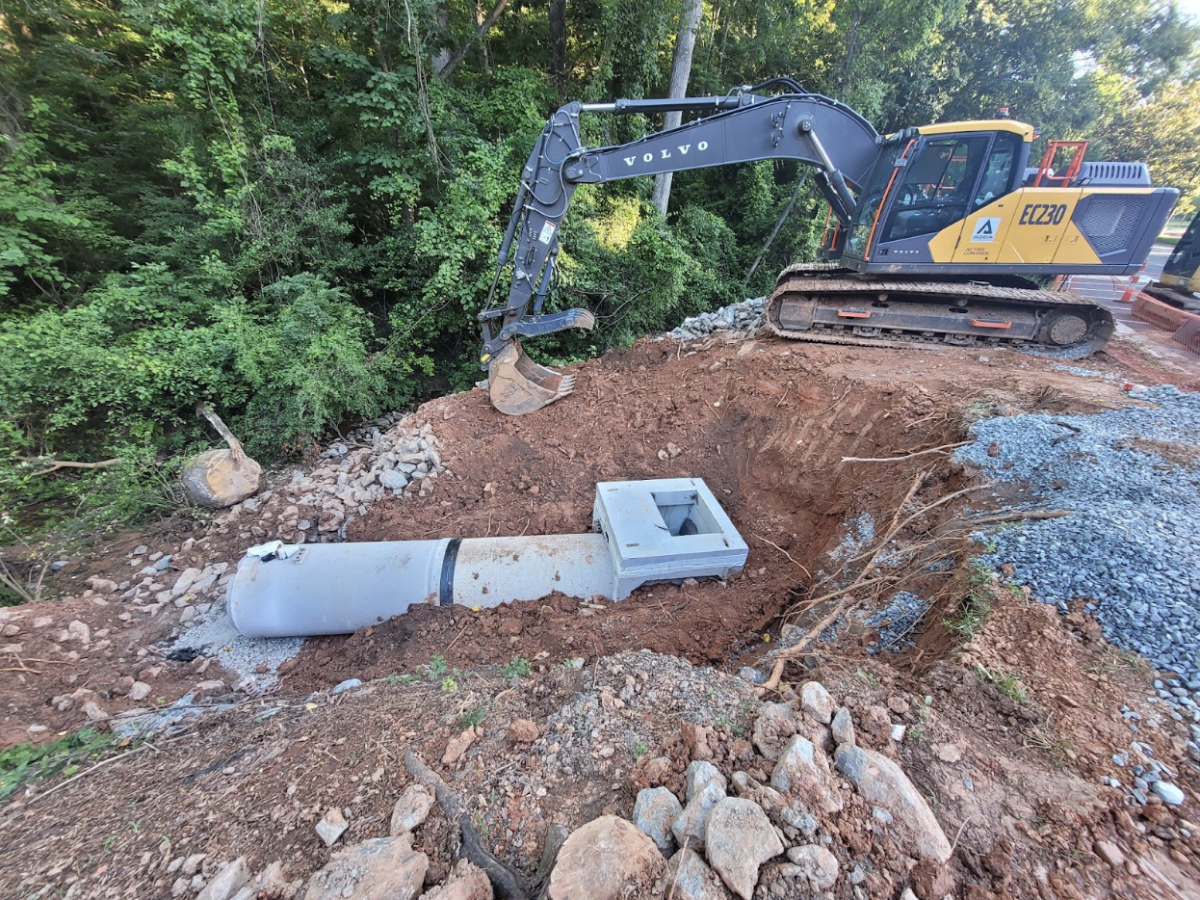
One particularly challenging project this past summer: a separated pipe that threatened to compromise Parking Lot S southwest of Davis Field. Instead of flowing into its prescribed 16-foot-deep reservoir at the edge of the lot, the stormwater began to erode the land beneath the pavement.
“It just got bigger and bigger,” Looney said. “Every time that we would get close to being able to get in there and start working, we’d have another rain.”
By the time the Utilities team remedied the problem, Looney said, running water had carved out a hole the size of a “big excavator.”
Apart from such uphill battles, Looney is also accustomed to the fact that the more that the Utilities team accomplishes, the less students notice the need for their presence.
Senior Caroline Song was surprised to learn about the extent of the stormwater infrastructure on campus.
“It’s easy to look at a puddle and be like, they’re not doing anything,” Song said. “But there’s obviously a lot of water that falls on this campus and it has to have somewhere to go. It makes me feel better to see that something’s being done.”