
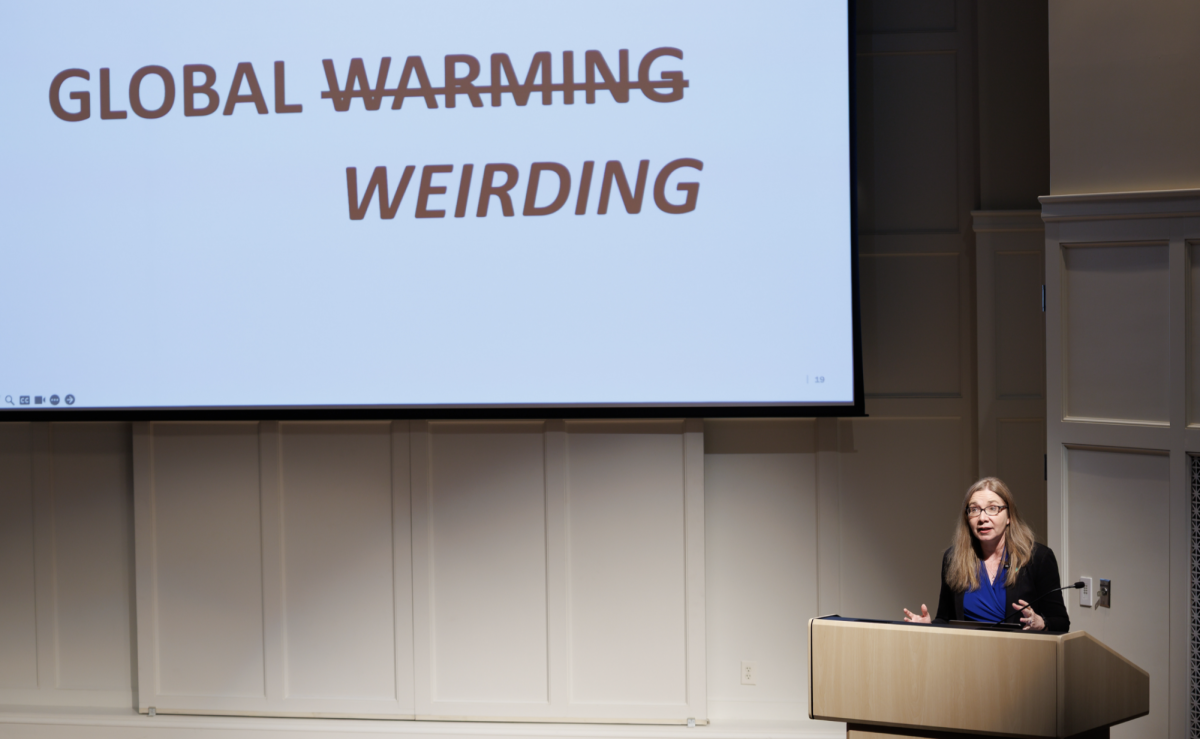
On April 21, Dr. Katharine Hayhoe, the chief scientist at The Nature Conservancy, an environmental advocacy organization, visited Wake Forest to present her talk: “Adapt, Mitigate, or Suffer: Connecting Global Climate Change to Local Impacts and Solutions” in the Porter Byrum Welcome Center.
Hayhoe’s presentation introduced listeners to the concept of “global weirding.” She discussed more severe allergies, increasingly frequent natural disasters, droughts in April, and overall weirder weather as signs that climate change is already affecting many.
Despite the clear evidence that our world is getting hotter, Hayhoe finds that many people are more receptive to the idea of “global weirding” than “global warming.” She said that while it may seem like no one cares about climate change, 63% of people in the United States are truly worried. But 50-67% of people feel completely helpless and hopeless about climate change.
However, Hayhoe says that we can fix this. She said that the best way to fight climate change is to do something—anything—and then talk about it.
Hayhoe’s talk also analyzed news organizations’ framing of climate change issues. She pointed out that modern headlines are often designed to cause panic because fear and anxiety drive engagement.
However, reading negative news does not often motivate action. Hayhoe argued that rather than trying to scare people into acting, advocates have a higher chance of making an impact if they appeal to hope.
Old Gold & Black Environment Editors Reese Lile and Ella Jennings had the opportunity to sit down with Hayhoe and ask her some questions about her work. She provided insight into her motivations for becoming a climate scientist, as well as how she approaches her own battle against climate change.
This interview has been edited for clarity and brevity.
Reese Lile and Ella Jennings: What has been your career trajectory along the way to serving as the chief scientist for The Nature Conservancy?
Katharine Hayhoe: I had grown up living in Colombia… I had friends who lived in houses that were on the side of a mountain, and when the floods came, they were swept away. I lived in a place where you didn’t have water coming out of the tap all the time, and if it did, you definitely didn’t want to drink it. And so I knew what it was like to be vulnerable to extreme water pollution and extreme weather disasters. When you don’t have a National Guard, you don’t have insurance to help you rebuild your house. And then when I learned that climate change was making all these things worse, and the people who had done almost nothing to cause it were the ones who are experiencing the worst impacts, I thought, ‘Well, that’s not fair, and I need to do something about it… So that was when I decided to become a climate scientist.
Lile and Jennings: You are here at Wake Forest for your talk: Mitigate, Adapt or Suffer. Why do you choose to visit universities to speak about these issues?
Hayhoe: Today, when you look at the world, most people are worried about climate change, but young people are worried the most. You’re making decisions right now about what you’re going to be doing with your life and how you’re going to make a difference…. This is a really important time to recognize that to care about climate change. You don’t have to be an environmental science major or an environmental studies major. You don’t have to be in science at all. You don’t even have to consider yourself an environmentalist. You just have to be a human living on planet Earth, because you’re already being affected.
Lile and Jennings: Do you have any ideas for how we can create systematic change concerning issues like climate change?
Hayhoe: I would make a class on climate and nature mandatory for every student across the whole university…I tried it out myself. I teach a graduate class that is open to students across the whole university. So any student can take it, and it just sort of goes through the basics of what is happening on the Earth, why it matters, and what we can do about it…Imagine if every university in the U.S. had a class that everybody took in whatever field they were in on what they could do to help with climate, nature and people… I feel like that would change the world.
Lile and Jennings: Tell us more about how you think about balancing sustainability and economic development.
Hayhoe: People often think we have to pick between people versus the planet, or the environment versus the economy. We do not. The value that nature provides to our economy is double the value of global GDP every year. Double. But we don’t price it into our economy. Nature doesn’t have a price to it, unless we cut it down and kill it. And so imagine if all of nature disappeared from the face of the planet. How long would the economy last? It would be done with, and we’d be done with it too. So it is not a case of choosing between the two. It’s a case of needing to finally wake up and recognize that the entire foundation of our economy is nature, and we have to treat it accordingly.