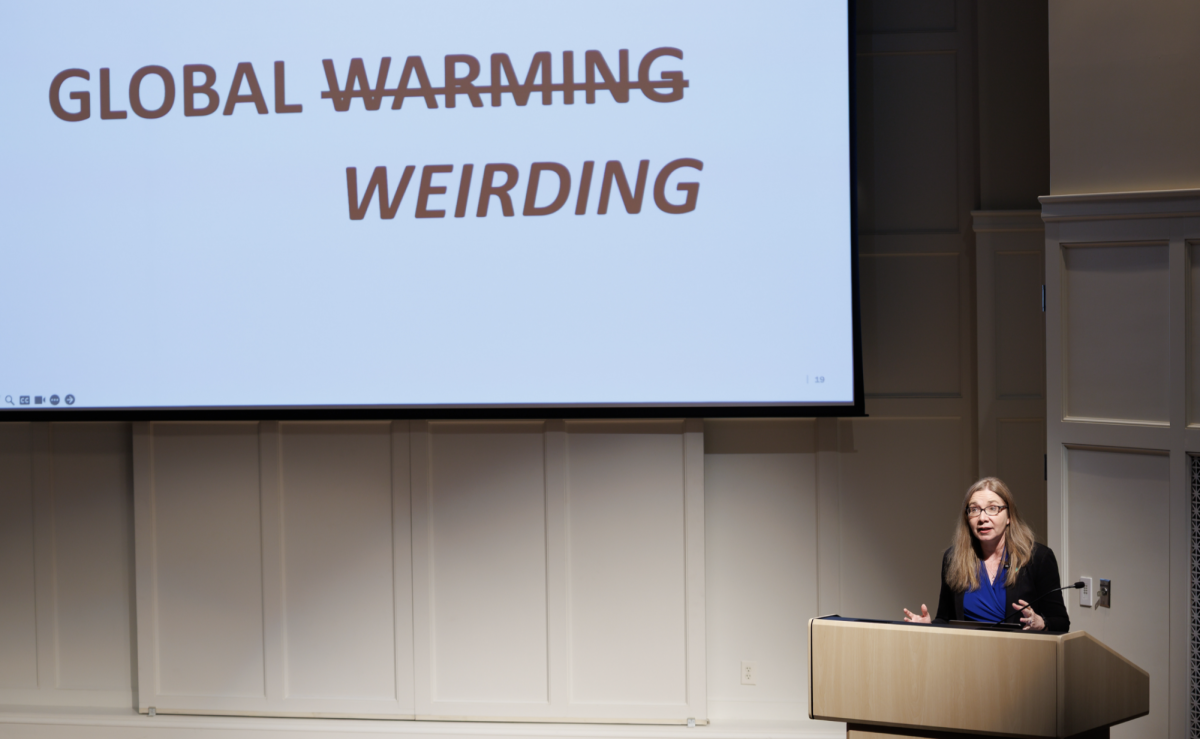


This past week, the Sabin Center for Environment and Sustainability hosted the “Sustainable, Just & Abundantly Wild: Effective Action at Every Scale” conference. Jill Tiefenthaler, the CEO of the National Geographic Society, attended the conference as the keynote speaker, giving a talk titled “From Exploration to Action: Accelerating Impact to Meet this Moment.”
Teifenthaler has served as the CEO of National Geographic since 2020, and previously worked as the Provost of Wake Forest University from 2007-2011. The Old Gold & Black had the opportunity to sit down and speak face-to-face with Teinfenthaler for insight on her thoughts about the crucial role of the collegiate world, college students and young people in sustainability.
This interview transcript has been edited for brevity and clarity.
Reese Lile: What do you see as the biggest points of collaboration between National Geographic and Universities like Wake Forest?
Jill Tiefenthaler: At National Geographic, we have our Explorers program, and one of the things we’re always doing is looking for talent on campuses. We have a Young Explorers program, as well as a big Explorers program. Several of the faculty here at Wake Forest are our Explorers.
We also think there are opportunities to do more. We also have an externship program at Nat Geo, which is for young people who want to get involved. They do a 10-week externship virtually with students from all around the world who learn about a particular topic, such as ocean conservation or freshwater. We have an internship program as well. I think these kinds of events, like the one we’re partnering with the Sabin Center on, are great examples of how we can get people motivated and share the science broadly.
As a longtime educator, I’m a true believer that one of the most important things we can do is educate this next generation and equip them with the tools and opportunities that will enable them to make a difference.
Lile: What kinds of skills do you look for when you’re looking for people to bring to the table at National Geographic?
Tiefenthaler: Passion may not be a skill, but I think passion and commitment are really important. I think that shows you’re willing to do what it takes to build the skills and knowledge that you need to actually carry out the work. I’m amazed every day by our Explorers and the dedication they have to a place or a topic. That kind of dedication and passion is not something that everybody has, but it’s essential for the long haul to get the work done. People give up a lot to do the work, whether it be money, fame, fortune, family or time. I’m always amazed by the dedication people have and how much they care about the natural world.
Lile: Do you have any advice for female undergraduates who might be interested in going into traditionally male-dominated fields, such as environmental science?
Tiefenthaler: Finding good role models is absolutely critical, and often they are women. Sometimes they’re not. Some of my most important people who helped me in my career are men. Nathan Hatch was one of them, who is the president at Wake Forest. He hired me and took a big gamble on a very young, somewhat inexperienced woman from Colgate University and brought me in here to be Provost. He gave me a lot of mentorship, but also room to grow.
Finding a community that can help you get to where you want to be is really important. The other thing is to embrace some of the hard parts. A lot of women have imposter syndrome. I still struggle with that somewhat today, and being comfortable talking about it and recognizing it can be really hard sometimes.
One of the difficult things for women leaders is criticism. Sometimes you don’t have quite the armor, right, that others might have. So again, being surrounded by friends and family is important. My husband has sustained me through many difficult leadership roles, as well as raising our family at the same time that I was doing all of those jobs. It is extremely important to have a good support system, a good mentor, and role models. And then, when you get to be in those roles, surround yourself with those people who work with you, who are even better than you are. That’s what makes really great leadership.
Lile: How do you stay positive in the face of detrimental environmental news hitting our desks seemingly every day?
Tiefenthaler: For me, it’s enjoying the beauty of the natural world, whether it’s a hike when I’m back in the mountains in Colorado, or outside of DC, or getting to travel to some amazing place I haven’t been before. So, one point is just continuing to appreciate the beauty of our world.
The other thing is the people. I am inspired by the people I am around every day. And having spent 30 years on college campuses as an educator, sometimes it’s a bummer when people are not uplifted. Because nothing uplifted me more than being around 18 to 22-year-olds—the amount of energy, the ideas, poking holes in things and challenging everything. I think it’s one of the most dynamic places anyone can be.
I stay positive because of young people and because of the people out there who are doing the work that matters. And it’s also important to remember that we live in a great time. I know this is hard for us, and sometimes people are cynical about this, but in many ways, if you go back and think about when you’d rather live, I can’t imagine another time I would rather be. There is so much technology at our fingertips that can do really good things, and we can travel, we can see each other and we can connect with each other globally. If we can use all of that for good, the potential is incredible.