
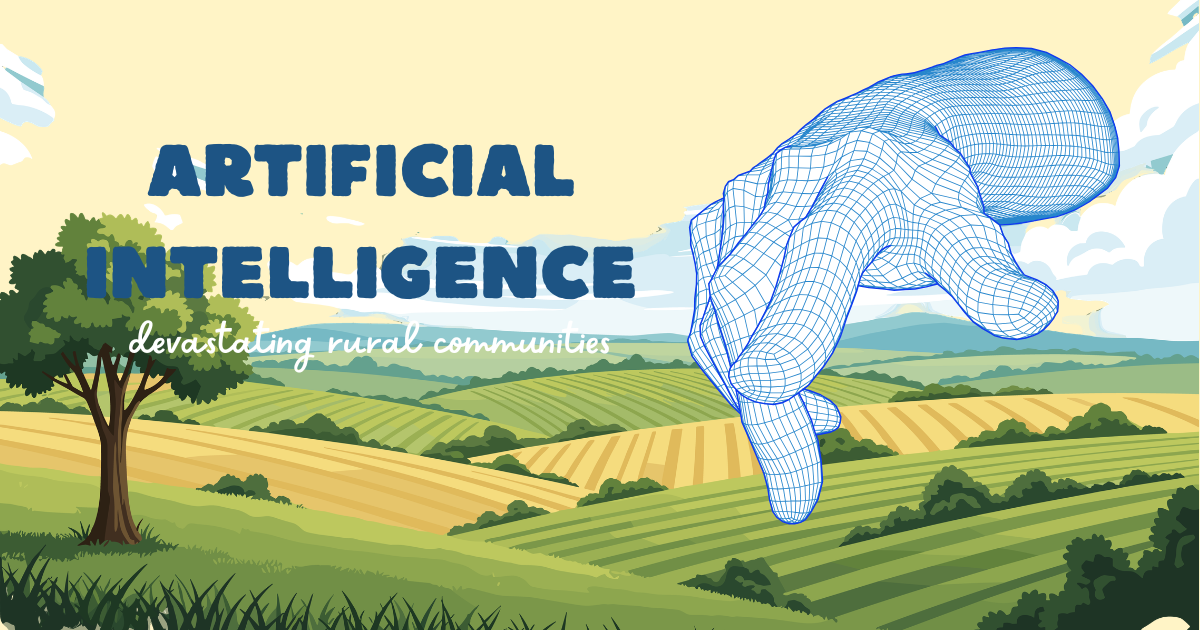
ChatGPT has been a lifesaver for me in college. It helps me understand complex topics and condenses my readings. But as my life as a college student gets easier, low-income families’ electricity bills are skyrocketing, the world is running out of drinking water and climate change is rapidly accelerating.
Picture this: Meta’s 2-million-square-foot data center is built 400 yards away from your home, your kitchen tap is run dry and you are forced to buy gallons of water from the grocery store for drinking and showering. Thanks to the sediment in your pipes, you will have to replace all your appliances, including your plumbing system, dishwasher, toilets and washing machine. Bright lights and loud humming noises from the data center prevent you from sleeping at night. This is not just a hypothetical. This is the reality of the Morris family in Mansfield, Ga.
There are currently over 4,000 data centers in the United States, harming countless families like the Morrises. They are popping up all over North Carolina, including one proposed just 15 miles north of Wake Forest’s campus in Rural Hall, Forsyth County.
As artificial intelligence becomes more and more common, so do massive data centers—large facilities with thousands of computers and servers. They power our internet searches, emails and websites, as well as receive our AI inputs. Data centers have been around for a long time, but the rise of AI means that they are growing exponentially.
Currently, data centers account for 4.4% of the United States’ total energy usage, and that proportion could rise to 12% by 2028. This colossal energy usage is rapidly accelerating climate change. For me, the tremendous amount of natural resources used to run these facilities is unimaginable.
For instance, there are 92 data centers in North Carolina, which consume millions of gallons of clean water a day. To answer all of our seemingly harmless queries to ChatGPT, a large data center uses 5 million gallons of water a day, equivalent to the water footprint of a city of 50,000 people.
These impacts do not even touch on the millions of acres of deforestation and loss of ecosystems resulting from the construction of these 4,000 data centers around the United States, which accelerates climate change and creates an even larger surplus of carbon dioxide in the atmosphere.
It’s not just affecting the planet. Communities close to data centers are also seeing increases in their monthly electric bills–up to 25% in areas like Northern Virginia, where my uncle’s hometown of Sterling is currently home to over 100 data centers.
I’m not saying we should completely disown AI; rather, we should be conscientious when we use AI. You can type “-ai” following a Google search to avoid an AI overview. Maybe we don’t need to tell AI “thank you,” or maybe we avoid using ChatGPT as a friend or a therapist. Maybe we don’t use AI to generate videos of planets being used as jams and spread on toast. AI use should be reserved for responsible practices, such as study assistance, getting feedback on writing projects, or idea generation.
We may not feel the impact of data centers at Wake Forest, but as a university, we are creating an impact felt by the communities surrounding us. As a start, Wake Forest’s AI guidelines could mention being conscientious about environmental impact when using AI tools. By using AI sparingly and raising awareness of the detrimental environmental effects it creates, we can channel our “Pro Humanitate” energy and set an example that other universities can follow.