

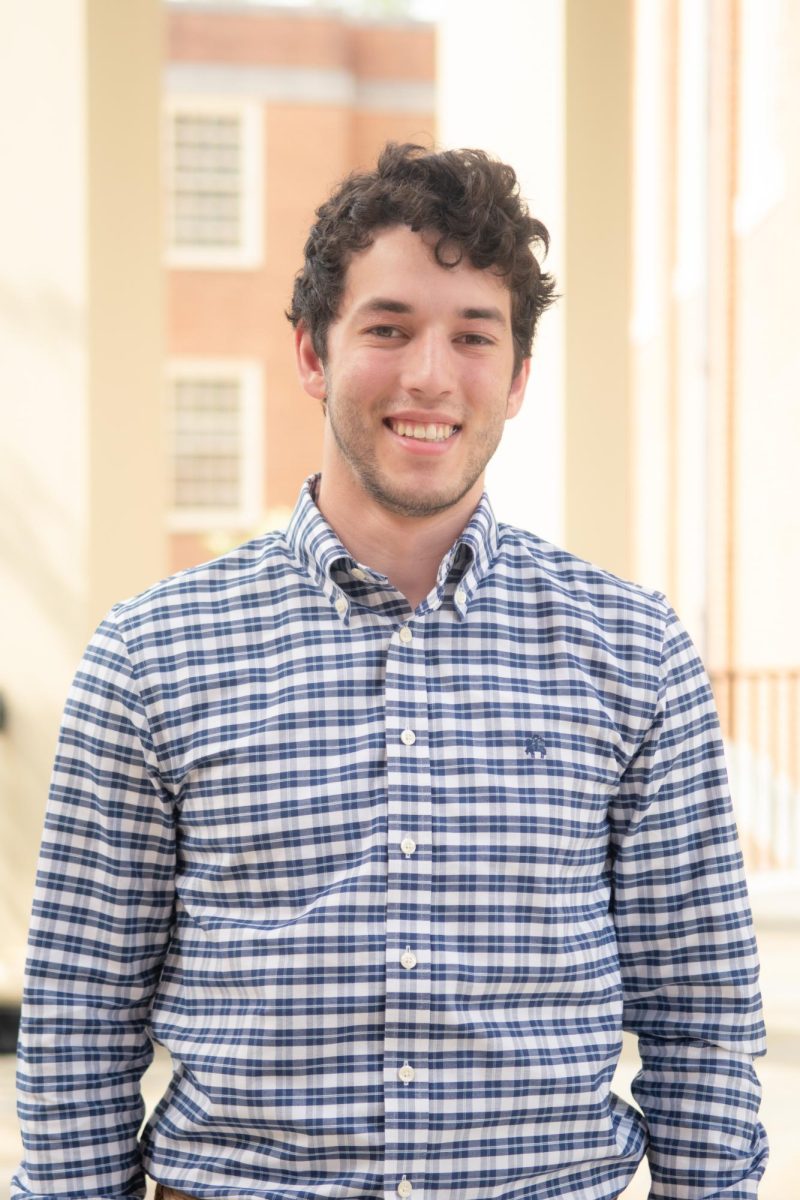
North Carolina native Eddie Bricio did not always have his sights set on Wake Forest. In fact, it wasn’t until his senior year of high school that he considered becoming a Demon Deacon.
“I wanted to go to a smaller school [with] small classes,” Bricio said. “But I also wanted to have a bigger school community in the sense of having sports, a nice campus, resources, things like that. Wake Forest was close to me, so it felt like the best option.”
Bricio’s interest in the academic study of faith began in high school, where he had the opportunity to sit in on divinity school classes at Duke University. This early experience shifted his perspective on the field.
“The day that I sat in on these divinity school classes [was when] I realized that religion is something that is so much bigger than going to church every day,” he explained. “It’s used to shape organizations and everyday life, really. It was interesting to learn how powerful it is.”
Though he eventually decided against a formal divinity degree, the Department for the Study of Religions at Wake Forest became Bricio’s new academic home. He said the department’s strength lies in its versatility.
“The way [religious studies] is done here at Wake Forest, at least throughout my experiences, is really multidisciplinary,” Bricio said. “It draws on other fields a lot. There’s a lot of sociological and historical literature. All of those fields kind of converge into religious studies.”
A highlight of his time at Wake Forest was during the fall semester of his junior year, when he studied at the Flow House in Vienna, Austria. Bricio said studying abroad allowed him to observe his studies in a global context outside of the university’s walls and align his coursework with the rich cultural and religious history of Europe.
“I think the entire study abroad experience is something incredibly unique and special,” Bricio explained. There are obviously deep, religious histories in the city of Vienna, and it was nice to have the opportunity to align the city with the curriculum.”
Among those who shaped that experience was Professor Jarrod Whitaker, who served as the faculty advisor at the Flow House that semester and continued mentoring Bricio throughout his undergraduate career and even outside of the classroom.
“[Professor Whitaker] definitely uses a very sociological perspective to talk about religion,” Bricio said. “That kind of led me towards the path of picking up a sociology and history minor. Even though I finished my major requirements, I still have a great relationship with him—I even go to his house for dinner. [Professor Whitaker], like others in the department, has just become friends as well.”
Reflecting on his time on campus, Bricio remembers his start in Collins Residence Hall fondly. If he could give his freshman self any advice, it would be to cherish the sense of belonging he found there. While Collins is often the butt of the joke for many Wake Forest students, Bricio insisted the experience was vital for building the community that sustained him for four years.
“Living in Collins and the community, I found that there was everything I needed to have to show me that I belong at Wake Forest,” he explained. “In this close-knit community, I met the same people that I would go to basketball games with, or the library to study.”
Bricio plans to enroll in law school this fall at Campbell University in Buies Creek, N.C. While the jump from religious studies to law might seem large to some, Bricio sees the subjects as perfectly paired.
“I can’t wait to apply what I’ve learned to my future career,” Bricio said. “The analytical skills and the understanding of human systems I developed in religious studies are things I’ll use in law and beyond.”


