

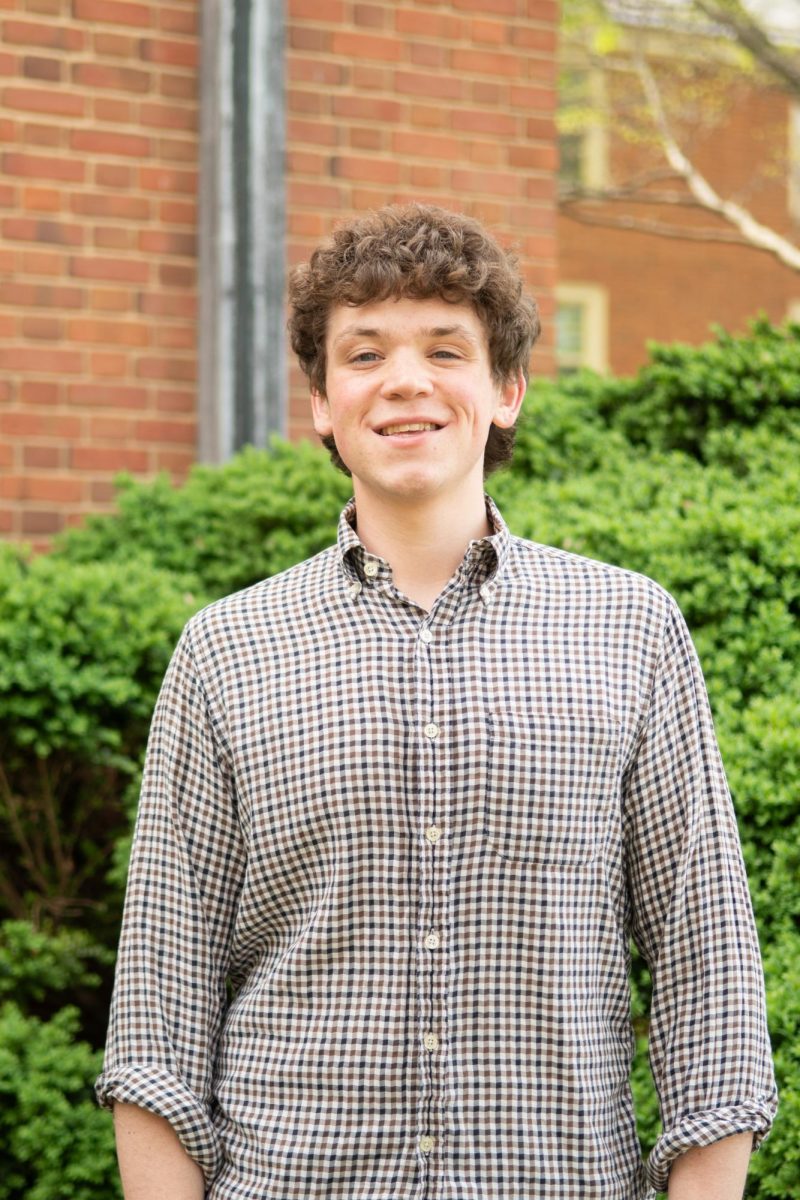
Jeremiah Wilder started studying Russian in 2022, just months after Russia invaded Ukraine and escalated one of the world’s deadliest ongoing wars.
“That was very heavy,” Wilder said.
But he added that by studying Russia’s official language—and Eastern Ukraine’s de facto language—he has learned not to stereotype individuals by their nationality.
“I remember we had Russian journalists come to my class last week and be like, ‘Putin’s cancelled Russia, Russians and Russian,’” Wilder said. “Over 140 million speak [Russian as a first language], and most people don’t have the same ideas. It is something that you should approach with an open mind.”
According to Jeremiah Wilder, the fewer than ten Russian majors and minors at Wake Forest, who are taught by just two professors, exemplify that open-minded perspective.
“I like my classmates because we’re all different,” he said. “It takes a certain kind of person to study Russian.”
He said collaboration with his fellow students, and especially with heritage speakers, has reframed his understanding of education from a competition among individuals to a communal pursuit.
“I was always told I was the best at school my whole life,” Wilder said. “That was something I never had to grow in, because it’s kind of a paralysis when you’re told you’re the best. It inhibits you.”
He said studying Russian has freed him to explore his intellectual range more fully. He recently wrote his honors thesis on nihilism and generational turmoil in Russian literature, and found the process enjoyable compared to the “stressful” research required for his economics thesis.
“Literature’s different, because you can just say what you want, as long as you support it,” Wilder laughed. “And I’m very much a yapper.”
He’s excited to continue discovering new ideas after he graduates.
“One of [my] main objectives is to scratch the surface of who [I am] as a person… finding what makes me feel fire, you know?” Wilder said. “What makes me feel passionate. That’s one good thing about Wake Forest and the liberal arts in general.”
While in college, Wilder discovered a love for travel. He studied abroad in the Netherlands and Sweden during the academic year, and also spent a summer interning in South Africa through the Rusty Johnson scholarship.
“I never left the country before,” he explained. “And then I studied abroad for two semesters and a summer. I went to probably 30-some countries. I had a ball.”
He said his journeys brought him “a lot of meaning.”
“It made me realize that when you think … you have life figured out, or how to interact with people, or even the world, when you think you have it scratched—no, no you don’t,” Wilder said.
He added he values opportunities to step into the unknown.
“I’m OK with uncertainty, because it’s something fun to embrace,” he said. “I’m someone who likes choices. I’m also a dreamer. That’s my favorite thing to do when I’m bored. ‘What could I have done? What can I do in the future? What can I change?’”
Wilder’s college career planted in him a curiosity and zest for life. He said he’ll carry both with him as he plans for his graduation.
“I think I was very much… approaching life to be the best,” Wilder said of his worldview before enrolling at Wake Forest. “But I don’t think that’s the answer. It’s really doing what makes you feel fulfilled… that’s my main goal moving forward. I’d rather be happy and living life fully than having the best job and being stressed out every day in my life, you know?
His next leap of courage: his future career. After graduation, Wilder will move to Boston to work in consulting.
“I don’t know if it’s something I want to do my whole life, but it’s something I’m very happy about,” he said.


