

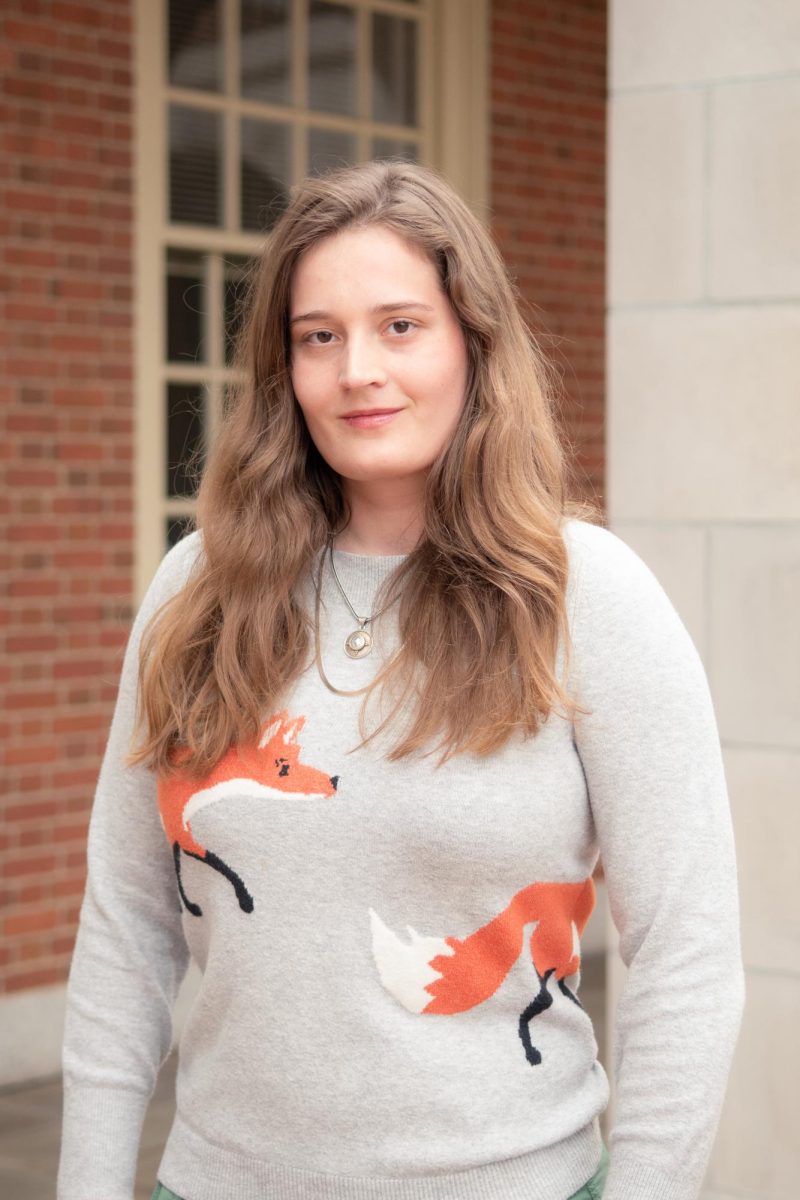
Isabella Romine’s time at Wake Forest University has been defined by global engagement, intellectual curiosity and a commitment to not just understanding but improving the world around her. A double major in politics & international affairs and Russian, Romine’s path reflects both academic ambition and the personal experiences that have shaped her worldview.
Romine said she chose Wake Forest after being drawn to its smaller class sizes and close access to professors, a setting that she expected would foster meaningful academic relationships. Romine was also named a Signature Scholar and received the prestigious Reynolds Scholarship. Beyond providing her with full financial support, this scholarship opened doors that extended far beyond the classroom, with funding for study abroad programs as well as for summer programming that aligned with her interests.
Notably, Wake Forest allowed her to defer her scholarship for a year so she could live in Moldova studying Russian through the National Security Language Initiative for Youth, an experience that would prove transformative.
While Romine was abroad, Russia invaded Ukraine. The war’s escalation brought her studies to a stark, immediate reality.
“I volunteered at a Ukrainian refugee center, where I helped coordinate supply runs, guide refugees through the facility and connect them with essential resources,” Romine said. Her proficiency in both Russian and English allowed her to bridge the gap between volunteers and refugees.
These experiences left a lasting impression. For Romine, seeing firsthand how children react to the trauma of war was especially affecting.
“It forever changed how I view the world and how I approach politics and my own actions,” she said.
For Romine, politics is not abstract, but tied to language, identity and lived experience.
“If you don’t let those experiences be the ones that shape and guide you and how you want to interact with the world, then I think you’re doing something wrong,” she said.
Throughout her courses at Wake Forest and six study abroad experiences, Romine has developed a nuanced understanding of global issues.
“There is a lot of complexity that our society doesn’t necessarily reward,” she explained.
She sees this as especially true in an age where “information can travel through social media very quickly but without a lot of fact-checking.” This can lead to what she describes as the “flattening” of stories, where important context is lost.
“I have grown comfortable with being able to say that I do not have all of the answers,” Romine said. “[There is] always more to learn.”
This openness, she believes, is essential for meaningful engagement with political issues.
Romine credits several professors with shaping her academic journey. Peter Siavelis, who led her study abroad program in Chile, played a key role in both her classroom learning as well as her exploration of South America. Adam Lenton, who specializes in the post-Soviet sphere, has also been a consistent source of support and mentorship.
“Dr. Lenton has basically always been in my corner and supportive of my academic career,” Romine said.
Lenton’s class on the Russia-Ukraine War, which evolved throughout the semester due to the ongoing conflict, exemplified the dynamic nature of political study.
As she looks toward the future, Romine remains guided by a desire to serve others. She hopes to eventually return to Washington, D.C., where she previously interned with Radio Free Europe/Radio Liberty and in Representative Steny Hoyer’s office. While her exact path is still unfolding, her mission is clear.
“I am driven by a desire to have a real vocation where I am able to help people and where I am able to help people and use the skills I developed at Wake Forest,” Romine said. “There’s not going to be success in every case, but if we do not try, there will never be any success.”


