

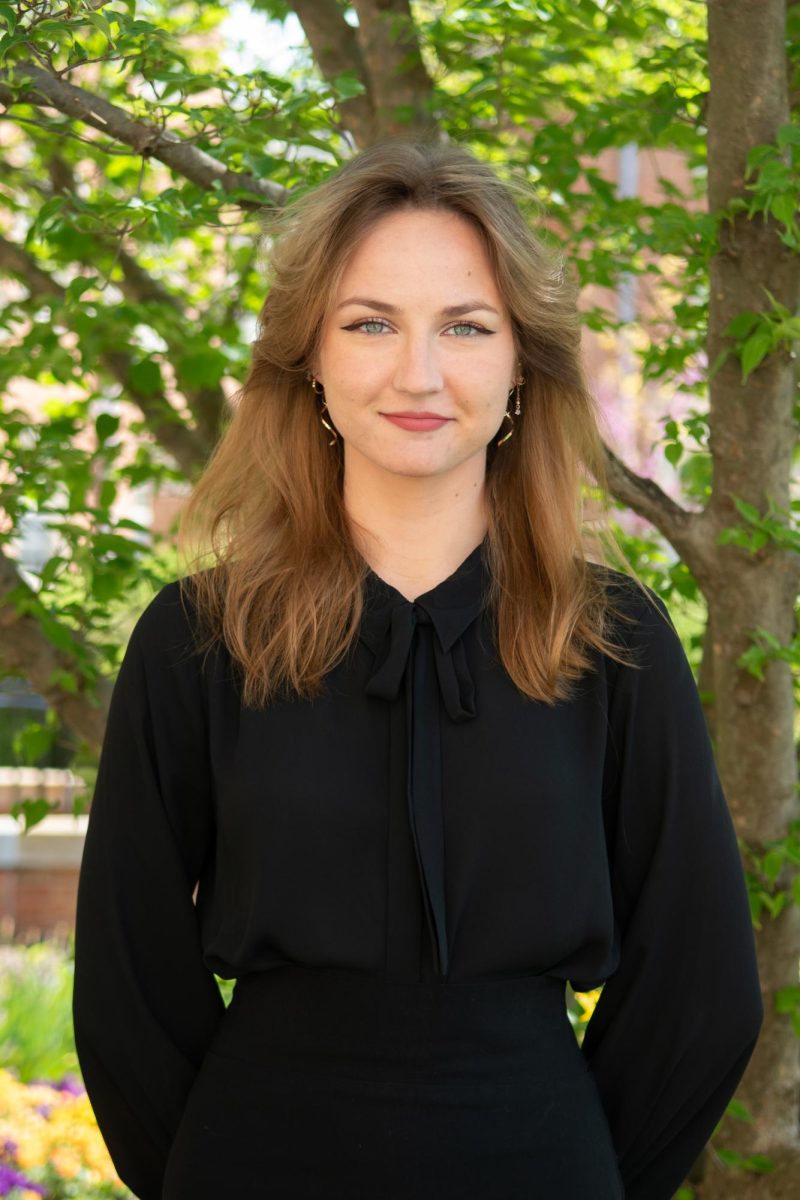
Born in Russia, Avelina Axonov moved to Charlotte, N.C., with her family at 15. Mastering a new country and a new language was the only beginning; soon, Axonov found herself looking for her next great challenge. Axonov first attempted to teach herself Japanese at age 14, intrigued by its reputation as one of the world’s most challenging languages. During her sophomore year at Wake Forest, she rekindled her interest in Japanese poetry and literature.
“I felt this urge to learn something,” Axonov said. “I started reading some poetry translations in English, and… it sucked! [English translations] did not preserve the rhythm and beauty of the language. The author of the translations would sacrifice tone because they wanted to show metaphors.”
So she decided to pick up where she left off by learning the alphabet, following Japanese language instructors on social media and even buying the same textbooks used by Wake Forest professors to teach herself.
At the time, she intended to major in engineering with a biomedical concentration, but was drawn to Japanese Language and Culture courses. She would sit outside of these lectures with her ear pressed against the heavy wooden door, desperate for any glimpse of the professor’s words. She was constantly envious of the laughter that escaped the cracks.
Fortunately, after rearranging her class schedule, including a sacrifice to an 8:00 a.m., she was able to register for a Japanese class and expand on her curiosity through the Japanese Studies Club (JSC), for which she now holds an executive position.
“One of the requirements for the Japanese classes is five cultural activities,” she explained. “So I started coming there, not because I needed credit, [but] just for fun! I would stay after, help the exec clean up [and] get to know some people.”
It was at JSC that she met a teaching assistant, and they engaged in conversations to practice her Japanese. Through these conversations, Axonov also developed a desire to study abroad to immerse herself in the culture fully.
During her junior year, she decided to study abroad in Tokyo, Japan, and was bitten by the “study abroad bug.” Since then, she has travelled around the world, exploring Tokyo, researching indigenous cultures in Okinawa and Hokkaido, and visiting Hawaii. She eventually proposed a “second senior year” to continue her love for research.
“Okinawa is nicknamed the ‘Hawaii of Japan’, so I wanted to go to the actual Hawaii to compare them,” Axonov explained. She researched how indigenous groups preserved their endangered languages and traditions despite governmental pressure to assimilate into the mainland culture, and presented her findings at URECA.
While Axonov remained dedicated to her cultural studies, her technical path shifted. She eventually dropped her biomedical engineering concentration after realizing a distaste for biomechanics, finding a new niche in electrical and computer engineering. This pivot allowed her to merge her complex technical skills with her love of the ocean. Under the mentorship of Professor Kyle Luthy, she began researching underwater camera systems.
“If I could just look at the ocean underwater, that would be the ultimate goal,” she said.
After this semester, Axonov plans to continue her education for one more semester at Wake Forest to conduct research in Antarctica, Wake Forest’s first study abroad excursion of its kind. Axonov plans to analyze the effects of climate change on the continent’s natural system.
The trip is a landmark opportunity, but it came with a significant financial hurdle.
“I was DoorDashing the whole winter break to pay for my deposit,” she laughed. “I’m gonna suck all the possibilities out of this time at Wake Forest.”
Soon, she hopes to continue her postgraduate studies by obtaining a doctorate in marine biology. Whether she is translating 20th-century poetry, engineering deep-sea cameras or trekking across Antarctic ice, Axonov proves that the most rewarding path is often the one you have the tenacity to carve out for yourself.


