
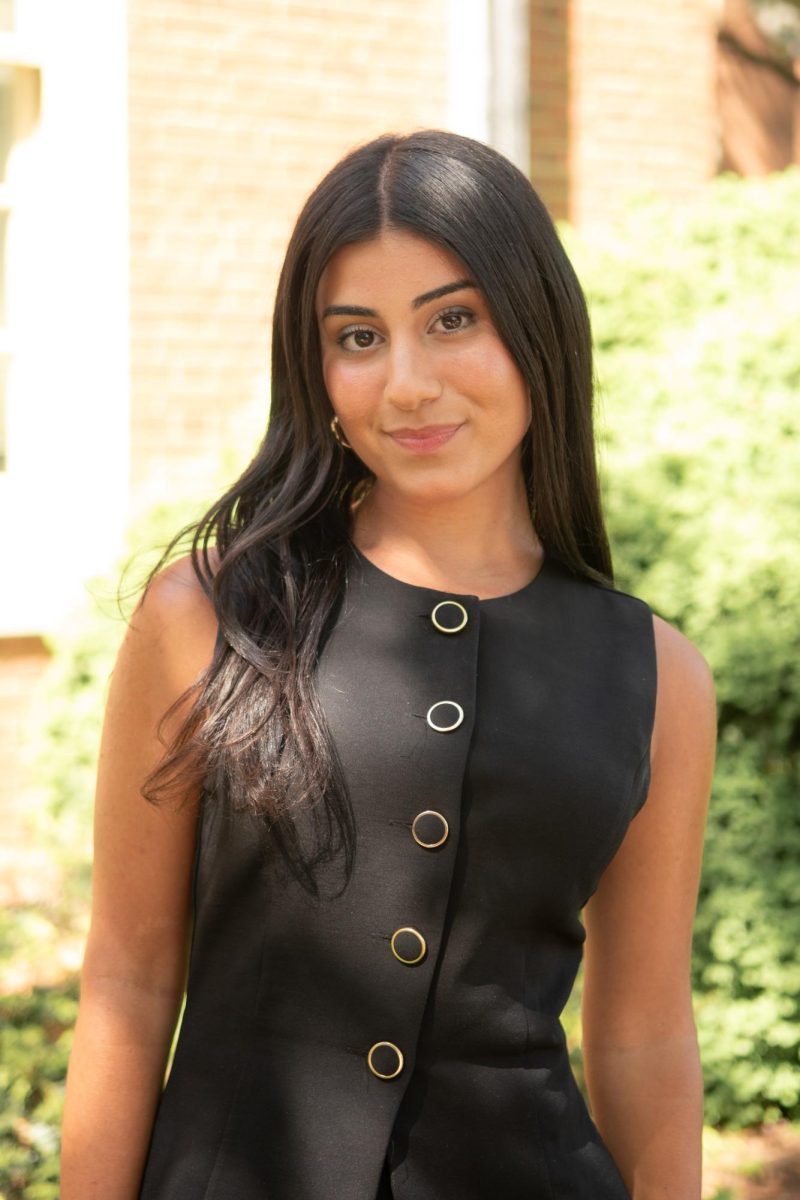
Roksanna Keyvan grew up in the south of Florida, near the Everglades, where she first discovered her love of the environment.
“I used to go to this nature camp, and it had a conservation center and a wildlife hospital,” she said. “So I grew up ever since the age of five just being in nature, catching snakes, catching any critter imaginable. I just had no fear of it, and that’s where my love of the environment started.”
Coming into college, Keyvan was looking forward to a liberal arts education that would encompass her wide array of interests. When she learned of the interdisciplinary major at Wake Forest prior to her freshman year, she knew it was the perfect path for her.
“I think for me, that’s what I really needed, especially because I didn’t fit in one disciplinary box,” Keyvan said. “I knew I didn’t want to do just history, or just art or just environmental studies. I wanted to think across them.”
The interdisciplinary major option allows students to propose their own course plan across departments. Keyvan combined anthropology, environmental studies, politics & international affairs and sociology into her four years of coursework. The unofficial name she gave her major was “environmental and social justice.”
“I wrote a whole proposal about how… all the issues that are happening globally today are cross-cutting,” Keyvan said. “When you think about climate change, you think of global conflict, you think of international disasters; all of these issues are intersecting. And I really wanted a degree that allowed me to explore those without having to worry about four statistics classes that really mean nothing. I’ve had so much fun.”
During her time as a Wake Forest undergraduate, Keyvan has gained vast experience in the fields she hopes to eventually enter. The summer before her senior year, she worked in London under an international terrorism lawyer at the nonprofit Girls Human Rights Hub to create a cross-sectional database that helps lawyers access resources related to human rights.
“I realized that I’m not going to be a lawyer, but I’m thinking about how to innovate at the intersection of law and all the things that I care about, [like] human rights [and] environmental studies,” she explained.
A pivotal class for Keyvan was her first anthropology course, her senior fall semester with Professor Karin Friederic. Despite including the discipline in her interdisciplinary course plan, the class was her first formal introduction to the field of anthropology.
“[Friederic] completely introduced me to this whole world,” Keyvan said. “And I was like, this is awesome, this is what I’ve been looking for—how to analyze people, how to study them. This is the missing link that I had been looking for.”
Following her graduation, Keyvan will pursue a Master’s of Philosophy at the University of Cambridge in global risk and resilience. The interdisciplinary program will be half taught and half independent research.
“When I was applying to grad schools, I was just thinking about all these ideas, and it completely shifted how I wrote my application [and] how I wrote my proposals,” Keyvan said. “I actually used the ethnographies from Professor Friederic’s class and the ideas from Professor Hall’s [history] class, combined into one and then submitted a research proposal to Cambridge.”
Keyvan shared that the biggest lesson she’s learned from her studies at Wake Forest is to always consider the big picture.
“You need to know the context, because you don’t know how many forces from all different parts of the world… went into shaping what you’re seeing in front of you,” she said. “Try to find connections even when you think there might not be one, because that’s where you can find the answer to something that no one has ever thought about.”