

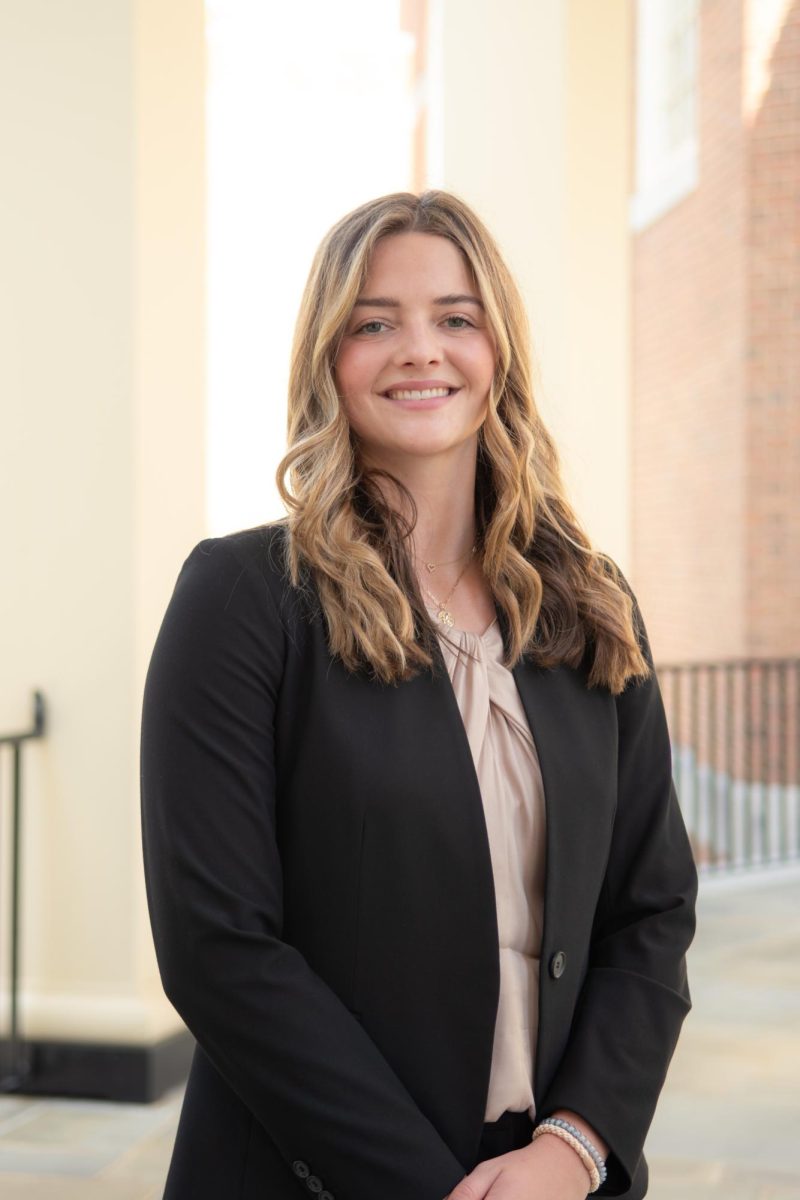
Olivia Sullivan’s journey as a history major at Wake Forest reflects both her intellectual curiosity and her commitment to understanding the world through the stories that shape it.
Sullivan’s decision to major in history came naturally to her, as it was always a subject that “clicked” for her. As a child, Sullivan spent hours flipping through textbooks and studying maps.
“I was fascinated by the way so many different materials were put together to sort of make sense of an event or a period of time,” she said. “I have always been in love with narrative, and history in particular, because it is so cyclical.”
This curiosity carried into her high school career, where her American History class further deepened her interest. Sullivan explained that as she has grown up, she has come to further appreciate the power of history to reveal patterns over time. For Sullivan, studying history is not as simple as memorizing dates or the names of the monarchs of old, but about “learning how to frame a narrative with concrete experience.”
“There’s a lot of beauty in crafting our own story based on the stories of other people in the various forms that they come in,” Sullivan said. She sees history as a mosaic made up of different human experiences.
Through her studies at Wake Forest, Sullivan said she has gained a more critical understanding of the world.
“There are a lot of things you accept to be true, that when you take undergraduate courses, you start to pick those apart,” she said.
A particularly transformative experience was her study abroad program in Copenhagen, Denmark, where she saw more deeply how historical context shapes the present conditions of countries outside of America.
She also highlighted the importance of recognizing “history in silences,” or the gaps and omissions that are often present in history education. She said engaging in these complexities has allowed her to better understand bias and nuance.
“It’s enlightening to see how biases play a role and how there are a lot of shades of color that we don’t really think about until they’re brought to our attention,” Sullivan said.”
One of Sullivan’s favorite aspects of studying history at Wake Forest was the classroom experience.
“Some of the most intellectually engaging conversations—not only as a student but throughout my lifetime—have been at Wake Forest in the classroom, where you’re sitting at a long discussion table and there’s five of you and the professor.”
This environment, according to Sullivan, encourages students to articulate their ideas clearly and back them with evidence, while also remaining open to different viewpoints. Combined with the mentorship of dedicated professors, these supportive spaces have been central to her growth as a student.
Among her professors, she said Dr. Ben Coates stood out as particularly influential. As Sullivan’s honors thesis advisor, he provided crucial guidance and support, helping her navigate the research process and refine her work. Sullivan said that she “could not have done [her thesis] without him.”
Following her graduation, Sullivan plans to pursue a master’s degree in History at the University of Texas at Austin. She said she may be interested in becoming a professor.
While she acknowledged some worries about making the most of the opportunities and resources she has received, Sullivan makes a point to remain optimistic and develop a clear sense of purpose.
“As long as you work hard and have some sort of direction and a reason for that direction, then doors open,” she said. “They may not be the door you think is going to open, but things kind of work out in a roundabout way, and I’m confident that there’s a lot of really exciting, intellectually engaging things ahead for me, especially as I enter a world that I’m unfamiliar [with].”


