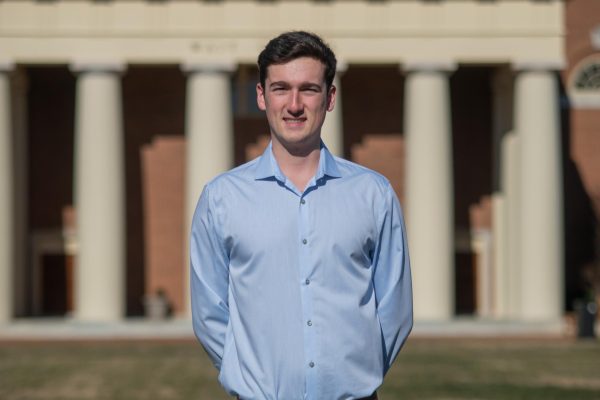


Liza Hunter grew up wanting to be a Tar Heel like her parents, but decided to apply Early Decision to Wake Forest after she fell in love with the campus on her tour. She pivoted again when picking a major.
“Both of my brothers had studied business, and they [told me] just go the business route,” Hunter said. “And I [said], no, I want to be different. So I tried to do politics.”
However, she soon realized that another department was better suited to her skill set.
“I quickly realized that I was not a good writer, and I dread writing papers, so I didn’t want to do [politics],” Hunter said. “So I quickly pivoted to be an economics major.”
Hunter said she felt like she fit in the economics department because she could learn from those around her, and the students could all help each other.
“I might not be the smartest in the room,” she said. “There are some people you can tell [are] really intelligent. And I don’t think that that has bothered me because, obviously, I learned more from them.”
Facing challenges has not dampened her interest in economics, but has actually made her more motivated in her studies.
“What I’ve learned about myself is that some of the concepts don’t really come to me very naturally,” she said. “I have to work harder, and I guess that’s why I like it a lot, because I do have to work harder. It’s definitely made my work ethic stronger.”
One of Hunter’s favorite classes in the economics department was Game Theory with Fred Chen.
“That was really fun, because he did this thing he calls flipping the classroom,” Hunter said. “He lectures a little bit, but we mainly do a lot of exercises in class, so it’s not as lecture-heavy. And I appreciated that. I definitely grasped onto concepts more easily in that environment. He was just a very approachable person.”
She emphasized that what makes certain professors stand out is their ability to connect to students and make them feel comfortable and engaged, even in a lecture.
“I’ve only had [Curtis] this semester,” Hunter said, “but he’s a very nice guy [and] also tries to relate to the students. I think that it is more beneficial to the professor and to the student when you really do care about interacting with your students instead of just [saying], ‘you guys have to learn this and spit it out on an exam.’”
Hunter said she enjoys applying her studies beyond the classroom.
“The most significant thing [I’ve learned] is that economics is everywhere,” she said. “I think that you can [take] what you’ve learned in whatever into a multitude of jobs and careers. I think that you need to know some of the basic concepts of economics over those who haven’t studied it. It’s very useful to know what’s happening and why.”
Following graduation, Hunter plans to move back to Charlotte, N.C., her hometown, to work at Barings, an asset management firm she interned at last summer.
“I’ll be specifically doing accounting [and] financial reporting,” she said. “So reporting the earnings every quarter, helping with the nitty gritty stuff that’s not the pretty work of managing portfolios, but I kind of like being behind the scenes and doing things that still matter.”