


For the past six Thursdays, University Marketing and Communications has included artificial intelligence-generated cartoons in their “WFU Should Know” emails.
These messages are broadcast to all Wake Forest students, many of whom delete the emails without a second thought. Only the few who scroll to the very end of the list of public service announcements even see the images.
At first glance, the phoniness of these pictures is obvious. Body parts melt into each other. Faces distort. Perspectives defy physics. For now, Marketing and Communications’s unnecessary use of AI is just a cheap, embarrassing gimmick.
But AI “slop” doesn’t always look so sloppy. Every time an institution acquiesces to the temptation of easy content, we’re resigning ourselves to a reality where imagination is worthless and the slop can just slip by.
The unnecessary use of cheesy images
I’m no anti-AI purist, and I cannot write this column from any high horse. I’ve played around with ChatGPT to test the hype, and every once in a blue moon, I do use the model to complete tasks. Last semester, for instance, I generated practice quizzes for myself when memorizing lists of vocabulary for final exams. Likewise, this summer I turned to ChatGPT to locate the URL of a Swedish train timetable after an hour of Googling to no avail.
However, I communicate with my own words. My writing for the Old Gold & Black has always and will always come from natural intelligence, as do the contributions of all my colleagues at the newspaper. As student journalists and photographers, we hold ourselves to a standard that our university unfortunately fails to meet.
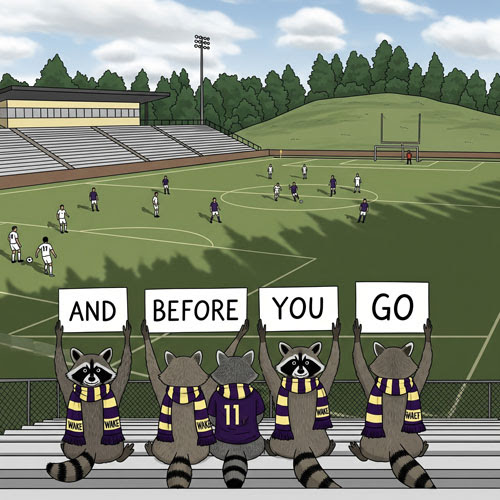
(Courtesy of Wake Forest Marketing and Communications)
In some cases, AI can be genuinely useful. However, churning out cheesy comics is not one of these cases. There is no reason for Marketing and Communications to generate unnecessary addenda for routine emails that would read the exact same without artificial content.
If the University must add visual appeal to their messages, there are actual creatives on campus who would be happy for work – just look at the talented corps of students who work for the Old Gold & Black.
Employing humans would not only result in a far more tasteful product sans uncanny ChatGPT sheen, but would also signal that the University is serious when we say that we apply our learning and work to the service of humanity.
Is the use of AI truly ‘for humanity’?
By now, AI’s ethical shortcomings are well-documented. Generative AI models amplify and accelerate humankind’s most shameful wrongs: environmental destruction, racism, sexual exploitation of women (and children) and even theft of intellectual property.
Already a fraught tool in the hands of individuals, AI can be even more damaging when adopted by authorities. With AI’s help, the Trump administration has descended to new, though unsurprising, depths of indecency. When the White House posts AI music videos advertising “Trump Gaza,” AI Studio Ghibli-inspired memes of crying migrants and AI magazine covers declaring Trump a “king,” it’s no wonder that our country is suffering a massive crisis of institutional distrust.
It’s times like these when Wake Forest should use our status as a prestigious, privileged and principled institution to stand as a beacon of truth. In contrast to the overwhelming crudity of Trumpian AI, Marketing and Communications’ email images seem so minor. Paradoxically, that is why they matter.
Our culture has already lost much of its bias towards information that is real, original and inspired; deciding which uses of AI are acceptable will be one of the most challenging responsibilities for our generation. So, especially while we’re within such a tightly knit community like Wake Forest, let’s not be too quick to acclimate.
Let’s scrutinize our current uses of AI and decide to rely on our own natural skills and capabilities as much as possible. Let’s value what is truly by and for humanity.








Faculty in Support • Oct 2, 2025 at 11:47 am
What a thoughtful piece from the Features Editor, Miriam Fabrycky. Thank you for taking the time that so few do to pose some important institutional questions to our community.