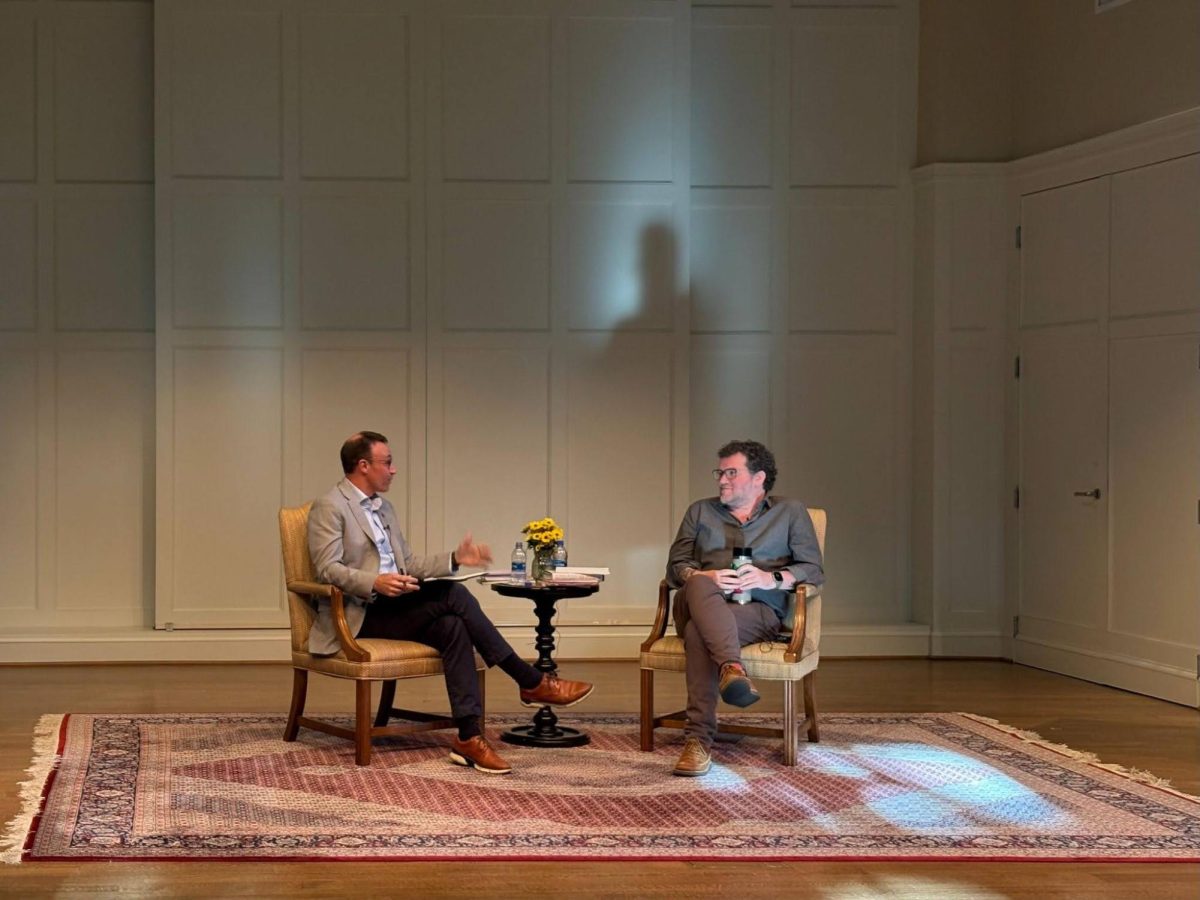


John Currie is Vice President and Director of Athletics at Wake Forest. In his fifteenth year as a Power Four Athletics Director, he sat down with Benjamin Pappas, Old Gold & Black video contributor, to reflect on his work. The full interview, available on the Old Gold & Black’s YouTube channel, has been edited for brevity and clarity.
Benjamin Pappas: Can you describe your role as Athletics Director?
John Currie: I work to deliver on the five core goals of athletics at Wake Forest: creating a world-class student-athlete experience; integrity in academics, compliance, finance, inclusion and safety; value to the university and Winston-Salem and Triad communities; winning championships and creating the best fan experience in North Carolina.
Pappas: How do you see collaboration between athletics and students showing up in your role as Athletics Director?
Currie: One of the things we do in athletics is bring people together. I was a student at Wake Forest in the early 90s, and even got my first job as an intern at the Deacon Club. Some of the great lifetime memories that Wake Forest alumni talk about are celebrating an athletic win on the quad or being in a party together after a big win. The unifying aspect of those moments is unique, because it’s not individual groups celebrating: it’s a collaboration of all groups. I was talking to a former football player who said his best memory of Wake Forest was not one of his big football wins; it was celebrating with students on the quad. To him, that was iconically Wake Forest.
Pappas: What recent changes have you seen in the fan experience at Wake Forest?
Currie: There have been a lot of changes to athletics in the past six years. COVID-19 acted as a reset for us because, coming out of the pandemic, we had two classes that had never seen the Wake Forest fan experience. We also had a really good football team with high anticipation. That became the year that we collaborated with Campus Life to transform the student tailgate zone, which previously was discombobulated and underwhelming. We also created the first-year field run, which is a tradition that now every current class has taken part in.
Pappas: What impact does Wake Forest’s fan base have on the athletic department?
Currie: There’s really a symbiotic relationship between fans and athletes at Wake Forest. When you have full stadiums and excited fan bases, that’s motivating for student athletes. When we talk about having 80% of our students at a game, that’s better than any other school in America except maybe the service academies. We also work hard to ensure our student-athletes are engaging with fellow students and other athletic teams at Wake. I remember early in the year, Josh Harrison, a junior on our football team who is injured this year, was out there at a soccer game leading cheers in front of the team. That doesn’t happen everywhere in the country. That’s what defines the Wake Forest brand.
Pappas: How do you encourage such a high student turnout to games?
Currie: A lot of people come to Wake Forest familiar with the Big Four and the ACC, but others come from places where college athletics aren’t a big deal. So we have to educate students. Why is it a big deal that we’re a part of the Big Four? Why is it a big deal that Wake Forest and NC State have the second-oldest continuous football rivalry in the country? Why is it important that we’ve won 11 national championships? There’s a lot of education that goes into it. And then there’s Screamin’ Demon Rewards. The app gives you the ability to track attendance and provide incentives for staying at games. Ultimately, it has to be fun and easy, because Wake Forest students are busy. We have to be efficient and communicate well so that students are excited to contribute to the energy of the fan base.
Pappas: What are your goals for the student fan experience in the future?
Currie: We have several new staff members in our fan experience office, like Gray Bray, who is our announcer at the games — he’s really passionate. I would say there are opportunities to build an even more robust and broad group of student leaders, with opportunities for students from all different class years to get involved in different organizations. And I also think that building moments of tradition into the games is important. At football games, for instance, they introduced a new tradition where they play a specific song at the end of the first quarter. So we’re getting people into a pattern of knowing that song so that at future games, everybody sings it.
Pappas: Is it difficult to start new athletic traditions?
Currie: Yeah, sometimes it takes a little while to figure things out. One of the great traditions that not everybody knows right now is that at the end of our football games, the team goes over to the marching band and they all link arms to sing the alma mater. And the students that are left there sing it with them. There was a bigger crowd at the Georgia Tech game because it was really down to the wire, and so there was a bigger crowd doing it. We saw some students who were starting to leave and then were like “Oh, this is cool. We should stay.” And they turned around and came back in to be a part of that moment.
Pappas: If you could send one message to student fans, what would it be?
Currie: Don’t ever underestimate how one person and another person and another person cheering for a common thing is really strong and powerful. It’s amazing at Wake Forest that we have such a spirited fan base, and it’s exciting to think about how we can pull even more people in as it grows.