
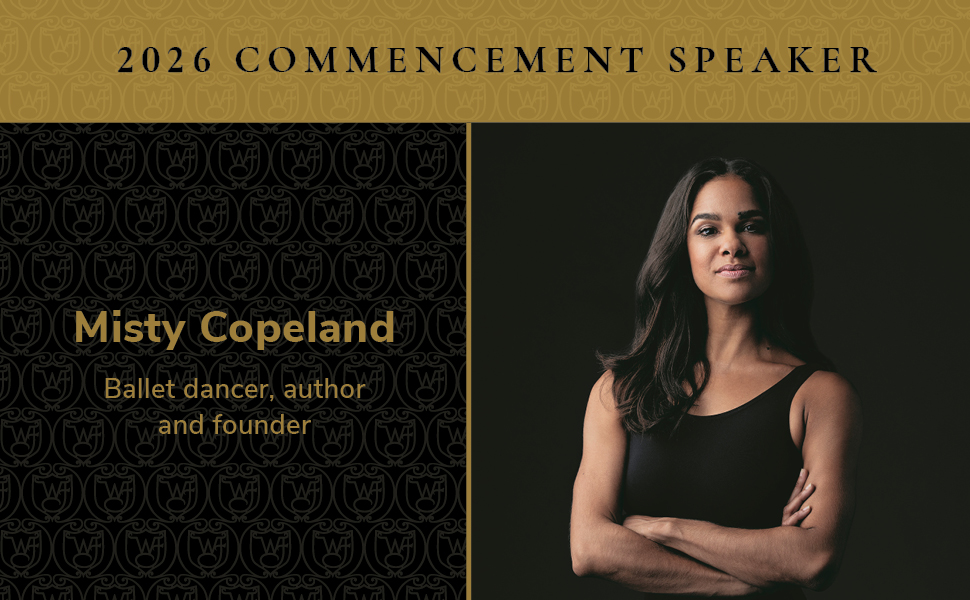
Misty Copeland is a renowned ballet dancer, author and philanthropist who will deliver the 2026 Wake Forest University commencement speech on May 18. Copeland was the first African American principal ballerina at the American Ballet Theatre and continues to be a catalyst for representation and change.
She founded the Misty Copeland Foundation in 2021, to bring greater diversity, equity and inclusion to the ballet community. Copeland is also a New York Times Best-Selling Author for her autobiographies, “Life in Motion: An Unlikely Ballerina” and “Letters to Misty: How to Move Through Life with Confidence and Grace” and her children’s books “Bunheads” and “Firebird.”
Copeland joined Old Gold & Black Editor-in-Chief Mattie Stillerman for a phone call to discuss how she embodies Wake Forest’s motto of “Pro Humanitate.” This interview has been edited for clarity and brevity.
Mattie Stillerman: The motto of Wake Forest University is “Pro Humanitate,” meaning “for humanity.” It reminds students to reflect on what it means to be human. How does this phrase resonate with you?
Misty Copeland: To me, it’s really thinking beyond yourself. It’s thinking beyond your personal success. I think that our responsibility as human beings is to live life, experience it, soak up everything and then [ask], “How are we getting that back? How are we using that in acts of service or something that’s bigger than ourselves?” I think for me, that’s really meant just as understanding artistry, not just as performance, but as a way to open doors and create possibilities for others.
Stillerman: What does it look like to “open doors” for other young dancers rather than just succeed individually?
Copeland: [Opening doors] has been different throughout different periods of my life and my career, but it’s something that I thought about early on. I really think that’s a reflection of the mentorship and guidance that I received throughout my journey. It made me feel like, “Oh, this is just what the response is to having nurturing and love that people pour into you.” The natural and organic and authentic response is to try to give that back to other people.
Throughout my journey, I’ve mentored a lot of young people. I’ve received letters and there are people that come up to me. I’ve stayed in touch with some young people that have come into my life 15 to 20 years ago, and are still very much part of my life. I think that it’s a beautiful responsibility to have—to be able to lend guidance and help. It works both ways. It’s not just one-sided when it comes to counselor and mentorship roles.
Whether I’m writing about Black dance history and creating in art an opportunity for us to have our own documentation of history, where there’s gaps and it doesn’t exist, or through [the Misty Copeland Foundation] that I’ve founded—in the work that we’re doing, which is creating access and opportunity for young people.
I’m thinking about giving back to the teaching artists in the dance communities that I’m a part of. By bringing them into the foundation and giving them all the tools that they need to go out into the field and be prepared and feel really empowered. Whether that’s financially or what we’re paying them—really thinking holistically about how we are giving back and supporting in a way that’s going to make a real impact on the communities that we’re serving.
Stillerman: When you think about your younger self just starting out in ballet, what would make her most proud, and how does the work you’re doing now with the Misty Copeland Foundation reflect that?
Copeland: I think about who I was as a young person, before the arts entered my life. That person was, it sounds terrible to say about myself, but kind of like an empty shell of a person—with no real sight, no real mission or goal or dreams ahead. I feel like that young girl would be so impressed and proud of the person that I’ve become. Most importantly, the ways in which I have taken my art form and the tool that I’ve learned through it and how I’m navigating from within the framework and discipline of dance.
Being able to use my voice, beyond the movement and body, but my actual voice. I think that my 13-year-old young self would be blown away because I was so introverted and shy. That’s something that’s extremely important to me in the work that I’m doing through the Misty Copeland Foundation, through our programs. This is not just a typical traditional ballet class where you’re coming in and you’re doing the steps, but it’s about creating leaders in the communities that we’re serving. Really pushing them to not just use their dance voices, which is their body and movement and the language of ballet, but pushing them to use their actual voices in the structure of our classes, which is very unusual for ballet.
I think that it’s all a reflection of who I was as a young person, what the arts and dance gave me and the things I want to highlight and then tie into the next generation.
Stillerman: As the first Black principal dancer at American Ballet Theatre, your success carried deep symbolic weight. What do you think about the relationship between representation and lasting change?
Copeland: To me, I don’t understand how one can exist without the other. In order to see real impact, you have to see representation. If you want to see a whole community—a whole in terms of humanity and in the world—how can you have a real impact if you’re not reaching everyone and if you’re not representing every type of person in terms of the cultures and backgrounds and communities? In order for [change] to last, we have to be inclusive, we have to all do our part. It’s about thinking about what our younger selves have needed and how we [are] really living up to fulfilling that. [Asking], ‘How are we better than we used to be?’
I always come back to this idea that one of our responsibilities is to make the next generation better than we were. I think that it’s all connected and tied together to how you really make a lasting impact. That’s coming together in community and being consistent in the work that we’re doing.
Stillerman: You are an inspiring role model for many. You have dedicated your life to creating positive change for those around you. Many Wake Forest students will enter fields where they’ll have influence—what does it look like, in practice, to “open doors” for others?
Copeland: I really think it’s about two things. It’s thinking of yourself [and] thinking of the things that you want for yourself, for the world that you’re entering into. But it’s also thinking bigger than yourself. It’s focusing on those nuances and the detailed idea of being a part of your community and society. Once you step out of school and into the professional world, I think then it becomes “How am I contributing to something that’s bigger than me?”
There’s something so incredibly beautiful, exciting and empowering about that next step. And I’m just so excited to be able to come [to Wake Forest University] and really speak to my own experiences and what it’s been like for me to take all that I’ve learned and how I’ve transitioned in my own way into so many different chapters. Coming from this chapter [as a young person] in their journey and stepping into a true idea of what adulthood looks like.
Stillerman: What does a life that is both ambitious and humane look like in real, everyday decisions—not just big moments?
Copeland: When I think about my life and the way that I am in practice every day, it’s all consistent and connected. The way that I am approaching my life is the way that I am in the daily things—it’s how I’m approaching the big things; it’s how I’m approaching the Misty Copeland Foundation Benefit that just happened. It’s about how I am preparing and pouring into myself so that I am so enough to be able to give to others.
I think that’s a daily practice that then allows you to be able to think bigger and do these bigger things. It can be from the smallest, simplest things of waking up, [and thinking] ‘How am I setting the tone for my four-year-old son, who’s watching? Really being grounded and balanced to bring myself the time to breathe and be there for him. Moving forward, how am I doing that so that I can be there for the teams that I am so fortunate to be a part of, whether it’s my foundation and my production company or the boards that I sit on?
I think it’s really being consistent in the daily practices that then will result in the way that you’re approaching bigger contexts and ideas in your life.
Stillerman: What did it mean to you to wear the Firebird costume and dance on the Oscars stage this March, especially after a full hip replacement in December?
Copeland: There are important moments that have happened in my career, and they tend to never be at the right time. Whether it be my first performance in a principal role or the [role of] the Firebird, and simultaneously dealing with one of the injuries of my career, learning to understand the importance of the moment, channeling how I am going to still be able to take advantage of this opportunity without hurting myself. I feel like my life has been a balance of understanding how to do this. So when the opportunity came, [“Sinners” director] Ryan Coogler’s team called and said it would be so meaningful to have [me be] a part of this moment.
To be a part of the moment, they said, “This doesn’t have to be a big dance number. [I] could just stand on the stage, and it would represent something meaningful.” It was taking that idea and then going with how I act and do some movement safely because it was so important.
I think it was honoring a lineage and this symbol of the Firebird that was so interestingly connected to the movie and that scene in particular. [Coogler] went crazy. He said “Okay, we’re going to get the Firebird costume. It’s all coming together. It just makes sense.”
It was such an honor to be able to bring ballet into another cultural space. Representation, to me, is a responsibility. It means so much to be able to stand in these spaces and represent ballet in this way.
Stillerman: Many graduates will face setbacks that force them to rethink their path. What did your recovery teach you about adapting and combatting discouragement?
Copeland: My biggest lessons have been after experiencing injury. Throughout my career, I’ve learned incredible lessons. You learn so much about yourself. I think [my] advice for graduates would be to stay open to detours and things not always being exactly as you planned them in this linear experience. Discipline can carry you when your confidence can’t.
I think being consistent and being on it will allow you to have this kind of freedom within the form. And I think that’s probably how I’ve looked at my journey. You put in the work and you’re consistent and you’re diligent. Because you’re that way, when these moments happen and they’re not what you’re expecting, you still are prepared in a way. You have to have a little freedom within this kind of structure you’re setting up for yourself.
Stillerman: If you could give one piece of advice to graduating seniors, what would it be?
Copeland: Step into this next chapter of your life with purpose and possibility—allowing that to feel bigger than fear. It’s really about stepping into who you want to be—not forgetting that you need community and you need support around you. That’s been at the backbone, at the spine of everything in terms of success—my confidence in who I am.
Step out there with pride [and] boldness and be open to allowing people into your circle who are going to be there, who understand you and that you can confide in and process things [with] and then can be there to support you.