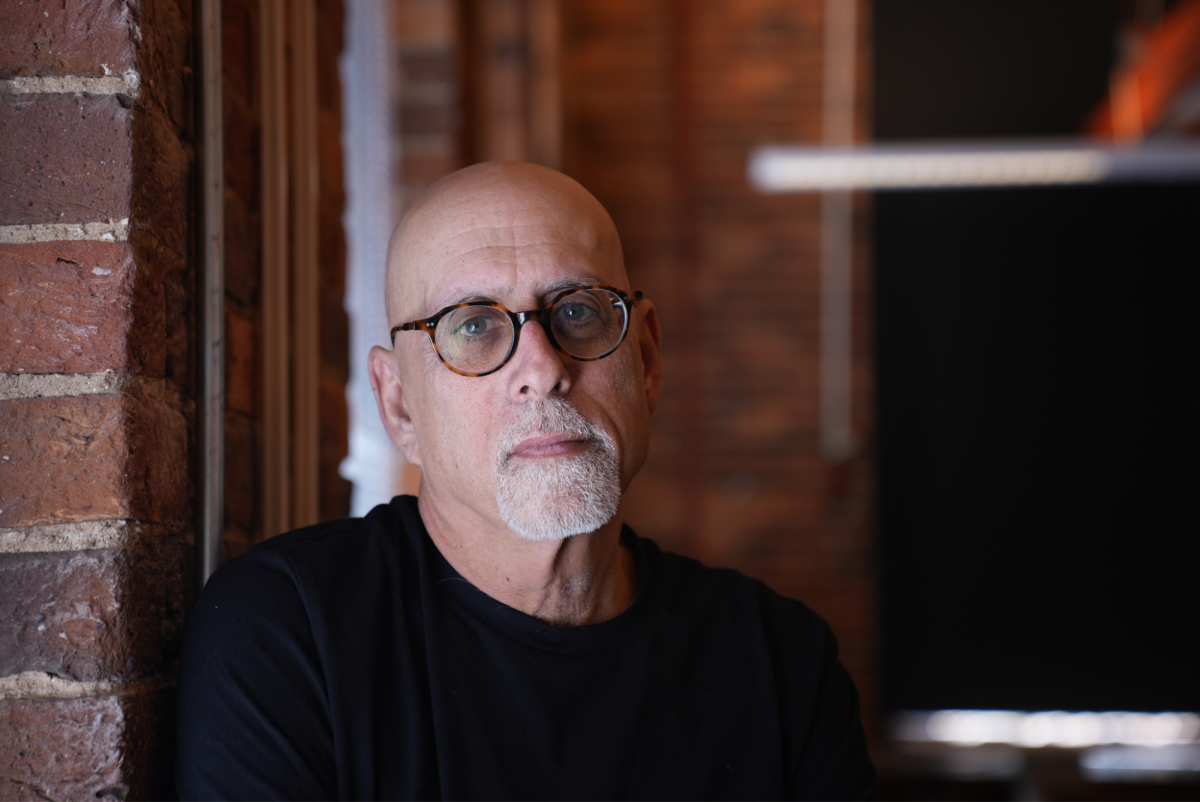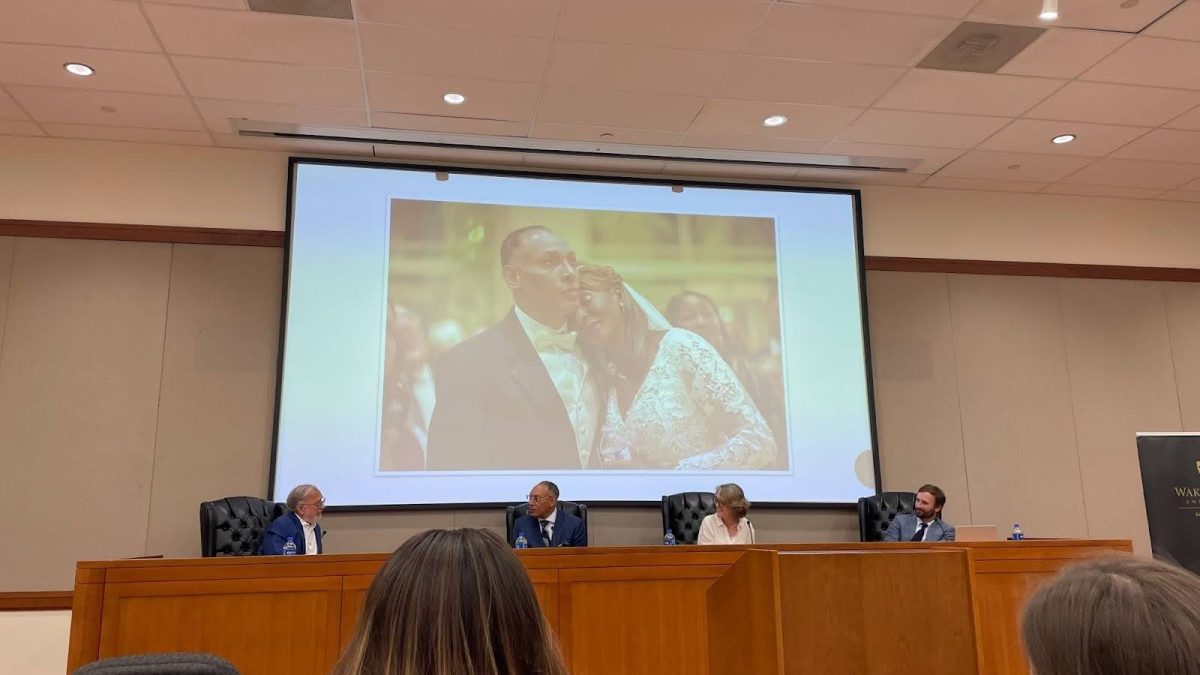

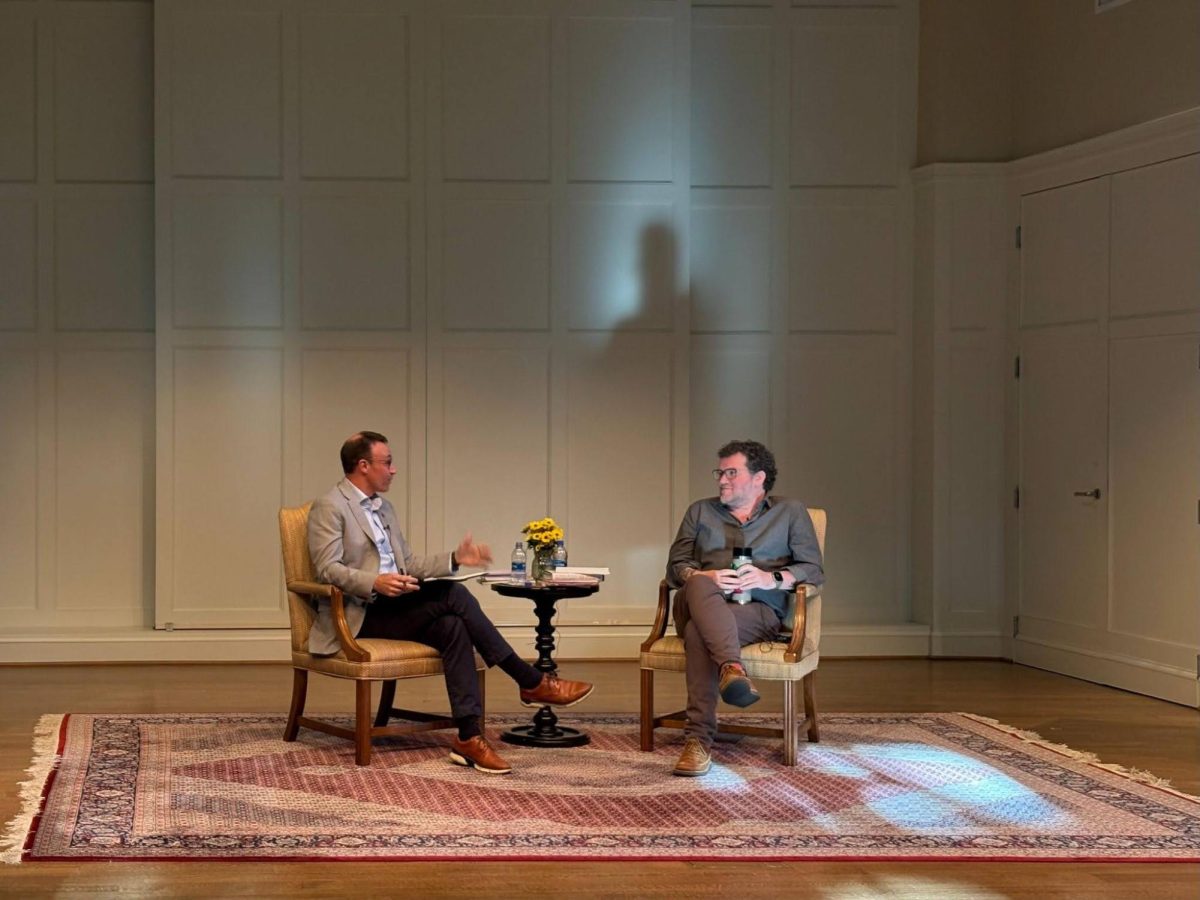
A captivated crowd of over 200 gathered in the Porter Byrum Welcome Center, their eyes glued to the stage, where world-renowned poet Pádraig Ó Tuama sat with a book in hand. The sound of the audience’s scribbling pens ceased as he recited the poem “The Facts of Life” from his 2018 collection “Sorry For Your Troubles.” He read the last stanza without looking down at the book.
“So you might as well live
and you might as well love.
You might as well love.
You might as well love.”
When he finished, the audience erupted with applause, a reaction that was quite common that evening.
On Monday, April 20, Wake Forest students, faculty and community members had the chance to attend a public event featuring Ó Tuama, learn from his artistic journey and hear some of his poems read aloud. Ó Tuama is an Irish poet, theologian and conflict mediator best known for his numerous poetry publications and acclaimed podcast “Poetry Unbound.”
“I believe that poetry is best when read aloud, and the chance to hear a few of Ó Tuama’s poems directly from him was so powerful,” Wake Forest Fellow Lillie Sutton, a former scholar in the Program for Leadership and Character, said.
The Program for Leadership and Character organized the event, during which Ó Tuama participated in a conversation moderated by Dr. Michael Lamb, executive director of the Program.
“Pádraig and I met three years ago at a retreat on poetry here in North Carolina,” Lamb recalled. “We have had an ongoing conversation about poetry and character, so I’m thrilled to have a chance to continue that conversation.”
One of Ó Tuama’s most notable qualities is his ability to recognize and handle the ambivalence he feels towards parts of his identity as an Irish man who was raised Catholic.
“His upbringing and Irish heritage add such a unique layer to his writing and perspective,” Sutton said. “I was particularly struck by the way he is able to sit in the tension of the wrongs that have been done in his country, while also recognizing the hurt his own people have caused in turn. He is uniquely patriotic while maintaining a staunch sense of accountability, which is such a hard tension to hold well.”
Sutton has also engaged with Ó Tuama’s poetry in an even closer setting. She is enrolled in a course offered by the Program for Leadership and Character called “Virtue and Verse: What Poetry Can Teach Us about Character,” which explores poetry’s influence on character development and human flourishing. The course encourages students to examine poetry as a foundational aspect of the human experience.
“We talk a lot in the Program for Leadership and Character about habituation,” Ann Phelps, director of programming for Leadership and Character, said. “It’s one of our seven strategies, along with reflection. And those two strategies are really coming out in full force in this course.”
Phelps, who created the class alongside Lamb, believes that one of poetry’s most important offerings is its demand for intentionality, which she said is often ignored in the modern world.
“We are living in an age in which words make our reality to an unprecedented level,” Phelps said. “Words are the way that we create our culture, create our world, create our identity… We can publish things so easily now on social media, with the click of a button. We need to think carefully about words, and think about the language that we use.”
The course employs an unusual structure, with only six classes spanning over four weeks, during which Phelps and Lamb tackle lessons on virtue ethics, poetry analysis and form. They said this intensive structure makes the niche class more approachable.
One of the most alluring offerings of the class was two writing workshops led by Ó Tuama himself.
“I gave them 15 minutes to write a poem and there was something about seeing what people did with the form [I provided them],” Ó Tuama said. “The modifications, the choices they made, the artistry, the language, the precision of it all—I found that great.”
“This class with Ó Tuama’s perspective has been really interesting because he brings a new level of knowledge about form, verse and writing choices that I haven’t gotten to dive into before,” Sutton said. “It’s been such a fantastic learning opportunity.”
Over the course of his visit to Wake Forest, Ó Tuama made it clear that, although the class explores a connection between character and verse, he does not view poetry as a prescriptive tool for character development.
“The conversation between character and virtue and poetry is so rich and so enlivening,” Ó Tuama said. “What I wouldn’t want to imply is that you need to write a poem to explore this character or this virtue… A poem is not a strategic plan.”
He argued that, like other forms of art, poetry should be examined phenomenologically, prioritizing fidelity to lived experience rather than searching for what the poem does for the reader.
“It might be that there’s a particular virtue, the appreciation of which is deepened by reading a particular poem,” Ó Tuama explained. “But that poem probably wasn’t written just for that purpose. The appreciation is one of the products of it, but there’s many other products too.”
As students learn to write poetry and explore the practice’s connection to their character development, however, one virtue in particular seems to shine through: humility.
“There’s a certain addiction to thinking that you’re doing the unique thing,” Ó Tuama said. “You’re probably not. But that’s not the pressure. The pressure is to do it the way you’re doing it. And it can be young, and it can be new and also it can be in conversation with what’s been happening for centuries and centuries.”
His message is particularly poignant for young adults, who often find themselves confronting new questions of identity, purpose and character in college. Although poetry may not inevitably lead to an answer, Ó Tuama makes it clear that it’s an indelible strategy for expressing the human experience.
“What do we do with [poetry]?” Ó Tuama asked. “We don’t know, but… there’s something deep in us that comes alive with the arts. And you don’t have to have a reason for why; it can just be because.”