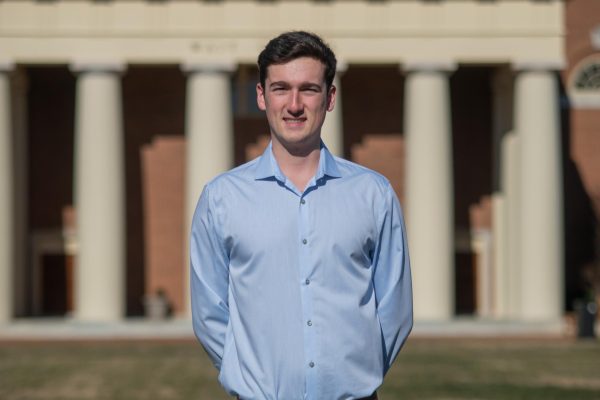


Senior Celeste Lynch thought she could get a job in Washington, D.C. after graduation. When nearly her entire professional network lost their jobs, she began to doubt her plans.
“Almost my entire network in D.C. this summer became unemployed,” said Lynch, who is majoring in Politics and International Affairs. “That was definitely a little jarring, and [it] sort of pushed me to pivot a little bit in a different direction. Now I’m considering roles in the private sector, with the defense industry.”
Uncertain futures
Similar stories are common among this year’s seniors as the economy slows and companies replace entry-level positions with AI.
Wake Forest graduates will soon enter a job market rife with uncertainty. The unemployment rate for individuals entering the workforce for the first time, including recent college graduates, is at its highest level since 2016.
Senior Brady Puckett, who is majoring in finance, expressed disappointment at seeing his classmates encounter difficulties while searching for employment.
“It is surprising to see, especially at a school like Wake Forest University, where so many kids who are so talented and apply themselves in many different ways are struggling,” Puckett said.
Student strategies and some hopeful news
As companies scale back hiring, many students are choosing to delay their job search by pursuing graduate or professional school instead of entering the job market.
According to an Aurora University study, 42% of college students and recent graduates say that economic concerns are pushing them to think about graduate school.
Senior Caleb Pembele acknowledged “a lot of uncertainty” surrounding his peers’ job searches but pointed out that college-educated individuals like Wake Forest students typically fare better than other groups.
“It’s understandable that college grads are disappointed about the current situation,” Pembele said. “But in the long term, they will be fine…there are other people in the economy that we should be more concerned about.”
Wake Forest Economics Professor Robert Whaples echoed these hopeful sentiments by explaining that this year’s graduates will enter a workforce with more opportunities than many previous classes.
“The good news is that despite the trends… even right now the unemployment rate for recent college graduates is only 5%,” Whaples said in a statement. “So it’s not like we’re getting to the really elevated levels we did during the gray bars when there’s a recession.”
Historic unemployment levels, though, cannot predict how the rise of AI will change the workforce. The rapid dissemination of new technologies like ChatGPT raises the question of whether companies will still offer traditional entry-level jobs for future graduates.
Economics professor Andre Mouton said in a statement that these concerns will only intensify in the coming years.
“In terms of large-scale business adoption, [AI is] still relatively early-stage,” Mouton said. “With that being said, young college graduates are really gonna be the first to feel a brunt…it’s not a given that if you put it off [for] two years by going to grad school, that it’s going to be better.”
Resources and reassurance
The Office of Personal and Career Development (OPCD) can be an excellent resource for Wake Forest students navigating employment uncertainty.
Patrick Sullivan, senior director of operations and special projects at the OPCD, recommends students familiarize themselves with AI technologies.
“More and more employers are using AI or their employees are using AI,” Sullivan said. “If we can help students prepare to use that kind of tool effectively once they’ve started in their first job, then they are going to look that much better to their employer.”
Senior Marley Schwarz, a Politics major, said that despite her worries for the future, she feels that her Wake Forest education will equip her for the future.
“There’s definitely a sense of nervousness,” Schwarz said. “Especially for people who aren’t in pretty cut-and-dry fields, like banking or engineering… but I also think here at Wake Forest, we’re coming from a really good institution. It’s not like we’re totally without resources.”