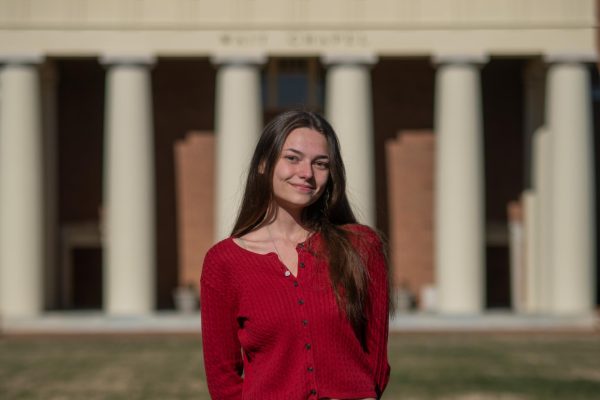


Working from two laptops at once, Ana Smith Iltis moves gracefully between Zoom calls, research notes and class materials, balancing her roles as teacher, mentor and university leader.
Iltis is a philosophy professor and director of the bioethics, humanities and medicine interdisciplinary minor. From her office on the second floor of Tribble Hall to the School of Medicine, Divinity and Law, Iltis’ work stretches across campus.
“I always think of [bioethics] as not as a specific discipline, but [something that] relies on the humanities and the social sciences and the health professions and the biological sciences–all–to kind of address the issues,” Itlis said. “And so we’re very interdisciplinary on purpose.”
The interdisciplinary nature of the minor has led to interaction among Wake Forest faculty.
“For both the undergraduate, minor programs and for this center, a lot of the work we do brings faculty together who normally wouldn’t be in the same room at the same time because they’re from either different departments in the college or from different schools,” Itlis said.
Her path began, like many STEM students, on the track to medical school. Iltis began as a biology major and a philosophy minor. After an internship in the pediatrics department of a hospital, she found herself more interested in the ethical issues, rather than the technical aspects of the job. This realization led her to switch to a philosophy major and pursue graduate school in the second semester of her junior year.
“Not ideal timing,” Iltis noted with a chuckle.
Iltis began her first job at St. Louis University after earning a Ph.D. at Rice University in philosophy. Part of her studies at Rice required a bioethics and health policy training at Baylor College of Medicine, right across the street. Then, in 2010, Wake Forest offered her a new opportunity. 15 years later, she’s continuing her work collaborating with others.
“I love the fact that they were building a center across the university that would intentionally bring in faculty from different schools, and people with lots of different disciplinary backgrounds,” Itlis said.
Playing in lots of sandboxes
Iltis’ personal interests lie in the realm of research ethics, specifically the intersection between ethics, genetics and genomics. She has spent several years collaborating with colleagues at the medical school on research involving genetic testing and organ transplantation.
She is also deeply interested in emerging biotechnologies and partners with experts in science and health policy. She works with collaborators at Rice University on projects related to science policy, health policy, and new biotechnologies. Currently, Iltis is focusing on a project in synthetic biology.
“I like to play in lots of sandboxes,” Itlis said.
Her work, largely composed of writing, is connected to the medical literature and medical world. As a coordinator for the community advisory board for her project on genetic testing and organ transplantation, Iltis also engages in hands-on community work. Her work has also had a positive impact on her teaching, bringing both real-world examples and contextualizing them in a theoretical framework.
“I think my teaching benefits from the fact that I have a lot of real-world experience,” Iltis said. “The examples that I use in class are real examples, protecting people’s identity and privacy. […] I think it’s very good for students to have their exposure to bioethics not just be theoretical. ”
Regarding teaching and collaboration, Iltis discusses the importance of working with students and promoting undergraduate research. She has mentored many research projects, some of which have turned into publications.
“I’ve had a class where I taught students how to write a specific kind of paper. And one of those student author groups worked kind of long after the semester was over and went on to publish their paper. So I really have enjoyed working with students on all kinds of different research projects and mentoring students in research as well,” Itlis said.
She also notes that her students come from a variety of backgrounds and prospective career paths.
“It’s much more interesting in the classroom when you have people who are anthropology, sociology, biology, religion and philosophy majors because everybody’s bringing a different perspective to these challenging questions,” Itlis said. “It makes class discussion much more interesting and much richer. […] So people can go in a lot of different directions, but I think [the bioethics, humanities and medicine interdisciplinary minor] is great preparation for anybody who’s interested in health or healthcare broadly.”
Overall, through her research, teaching and collaboration, Iltis blends theory with real-world applications, connecting students and faculty from every corner of campus.