

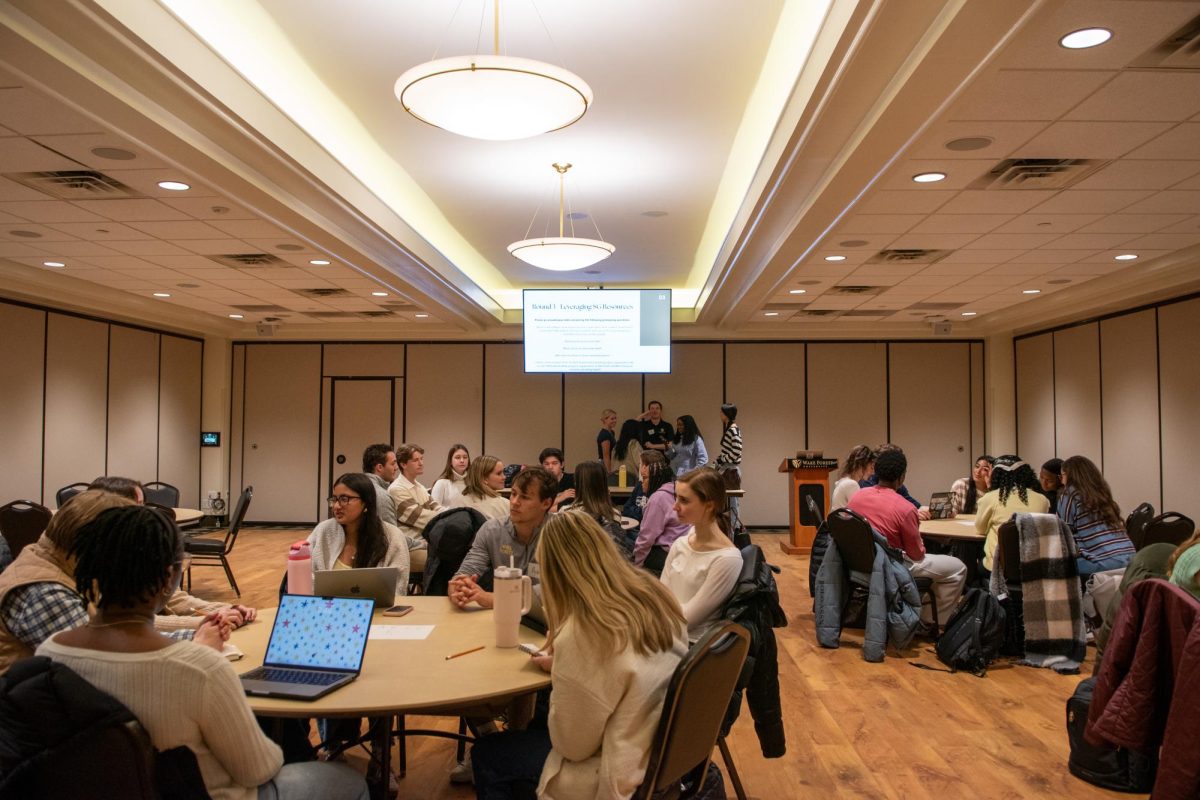
On Feb. 24, Student Government hosted a town hall with representatives from student organizations. The event – the first of its kind at Wake Forest, according to Student Government executive officers – aimed to facilitate communication among campus leaders to better advance student interests.
“Student Government works best when we’re hearing directly from student organizations,” Student Body President Amaya Williams said to open the meeting. “Tonight is about listening and understanding.”
Williams added that she hoped the event would be mutually beneficial for Student Government and participating organizations, both providing club leaders with insight into Student Government’s operations and allowing Student Government members to better understand their constituents’ hopes.
Dialogue among delegates
About 20 representatives from student organizations sat at five tables in Benson 401 alongside conversation facilitators and notetakers selected from Student Government committee co-chairs and senators. These breakout groups participated in three rounds of discussion followed by a question-and-answer session with the full room.
Representatives from Alpha Phi Omega service fraternity, Alpha Kappa Psi business fraternity, AfriCasa, Campus Kitchen, Catholic Campus Ministry, Emergency Medical Services, the Howler, Minority Association of Pre-Health Students, the Old Gold & Black, Phi Alpha Delta pre-law fraternity, Student Union and Wake ‘N Shake were in attendance.
Club leaders first introduced themselves and their organizations’ missions, followed by a reflection on what motivated them to attend the town hall. In the second round, they discussed the challenges they most frequently encounter while managing student organizations. Finally, they answered the question of what “meaningful support from Student Government would look like for [their] organization.”
Discussions center on one question: Is Wake Forest running out of room?
Many club leaders expressed concerns about the University’s decision to expand the student body in the coming years. Several said they feared the move would change school culture, while others worried that academic departments and administrative offices, like Global Programs and Studies, are not prepared to accommodate a larger population.
“They claimed they were going to expand all of these offices with the class size, but they haven’t,” Physical Planning Co-Chair Alex Passes said. “They want a tight-knit community, but they’re expanding.”
In a similar vein, conversations frequently returned to the topic of space planning. Several expressed frustration that the University is continuing to increase enrollment even as many students feel the campus is already stretched to its limits.
Club leaders added they are concerned that they will lose lounge areas, storage spaces and overall organizational visibility as Wake Forest proceeds with construction projects on Reynolda Campus and at the Grounds development.
Speaker of the House Sophia Sanders said her team is looking into preparing legislation that would “ask for more transparency” from the administration regarding increasing class sizes.
Additional conversations centered around Wake Forest’s ongoing presidential search, club funding distribution and engagement between Student Government and the broader student body.
Williams also briefly recounted her administration’s most recent initiatives. These included creating a progress tracker on the Student Government Instagram and webpage, continuing “Free Food Truck Fridays” on Manchester Plaza, programming events for Mental Health Week, introducing Old Gold meal swipe options at Bento Sushi and pioneering a punch card rewards program at Smith’s Cafe.
“Free food trucks seem to be a pretty enticing incentive,” Junior Senator Carter McDonald said. “Not having to pay for food on a college student’s negative salary is huge.”
Looking forward
Student Government executive officers and student organization leaders alike said the town hall fostered productive and constructive dialogue.
“I don’t know much about what Student Government does, so this is a good opportunity,” Catholic Campus Ministry Secretary Lily Engles said.
“We’re looking to hopefully synthesize some common themes, challenges and successes that you guys all have had in your respective organizations, and be able to leverage those… to shape priorities,” Williams said. “We’re doing this with the hopes of being able to build partnerships and relationships that we’ll be able to continue throughout the year.”
Student Government said they will publish a written summary of the town hall within the next 10 days.


