
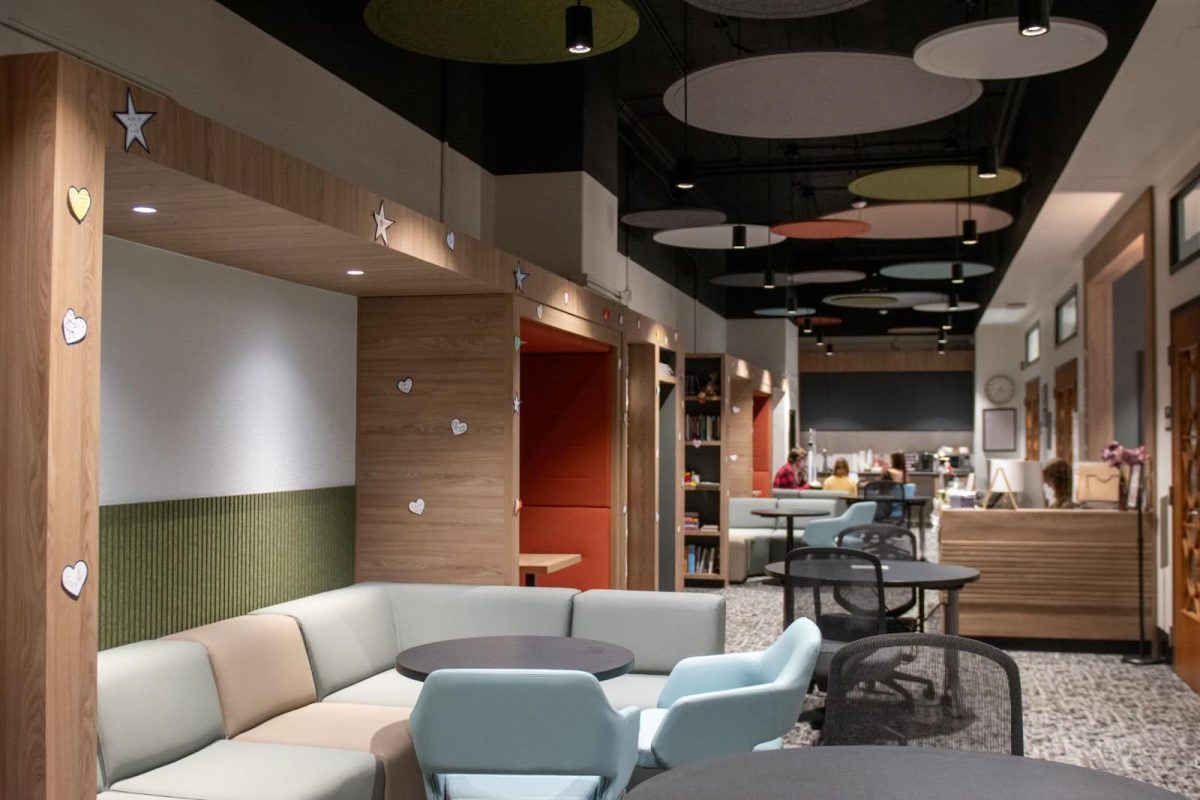
Take a right and a flight of stairs after walking in the main entrance of the Z. Smith Reynolds Library, and you’ll find a cheerful room that hosts one of Wake Forest’s most helpful and innovative campus resources. The Writing Center, a peer-led tutoring program, has undergone several transformations since its founding in 1984, including an extensive cosmetic renovation in summer 2025.
Despite changes in appearance and approach, organizers, tutors and clients agree that the Writing Center remains a friendly, empowering environment for anyone seeking assistance with their writing.
“We’re not here to grade or evaluate,” Director Ryan Shirey said. “We’re here to help you.”
Updated design refreshes an established campus initiative
By providing high-quality peer-to-peer writing advice, the Writing Center aims to collapse traditional power imbalances in academia.
“Sometimes you can talk about things in a different way with another student,” Shirey said. “You can maybe be a little more honest or a little freer with your frustration or your struggle… that’s a really, really motivating factor in how peer learning works.”
The Writing Center’s physical presence is finally catching up to this ambitious objective – it hasn’t always looked so welcoming. A September 1984 Old Gold & Black story characterized the initiative’s original location in the C-wing of Tribble Hall basement as a “barren, dark room.”
Today, that description couldn’t be further from the truth. The new and improved Writing Center boasts ample natural light, colorful decorations, multimedia capabilities and flexible seating for group collaboration.
Last year, each tutor/client pair was assigned a separate table. Now, tutors often socialize on the couches as they wait for clients to arrive, and clients can choose where they’d like to sit.
“I didn’t know that changing out a layout could really have an effect on the vibe and the atmosphere, but it absolutely changed the game,” senior Charlize Ezernack said. “I look forward to my shifts.”
Pedagogical preparation
Client experience is never an afterthought at the Writing Center. The staff, including Shirey and Academic Coordinator Caroline Livesay, carefully consider each step of the process to craft the most positive environment possible, beginning months before tutors meet with their first client.
A prerequisite for tutoring is “Writing Center Pedagogy,” Shirey and Livesay’s three-credit-hour course. Over the semester, enrolled students read about best practices for tutoring, then put what they’ve learned into practice.
“We do role plays, we have a lot of robust discussions in class,” Shirey said. “But the really important complement to that is what we call the field work, or you might now call experiential learning.”
Long before they receive a job offer, prospective tutors must spend several hours at the Writing Center outside of class. Their responsibilities gradually increase from receiving tutoring themselves, to shadowing veteran tutors, to co-tutoring. While some candidates find this comprehensive preparation daunting, Shirey has observed several benefits.
“We’ve had 15 weeks to get to know them well and… they’ve already built a nice community with their classmates,” he said. “It’s worked tremendously well for us, and I think our tutors today are better prepared than they have ever been.”
“The learning happens on both sides,” he continued. “A tutor is actually learning a lot too. And so I wanted to formalize it. I wanted tutors to get credit for all it takes to learn how to do this job well.”
Ezernack said the long onboarding process and high standards ensure that only truly dedicated tutors staff the Writing Center.
“Even at the end of the class, you get evaluated, and you can definitely express your interest, but [Livesay and Shirey]… can still stay no,” she said. “I’m glad they care enough to make sure that these tutors really want it or have put in the effort to get there.”
Looking to the future
The Writing Center has adapted to many changing technologies over the years, from typewriters to word processors. They also offer both synchronous and asynchronous virtual tutoring appointments. Now, like writers everywhere, they are working to understand how AI may affect the future of the written word.
“The course can’t be the same today as it was three years ago because students are using different tools [and] they have access to different information,” Shirey explained.
He maintains, however, that there is value in reviewing one’s work with other humans, rather than with AI agents.
“If you just think, ‘well, why would I go to the writing center when I can just plug it into ChatGPT?’ or whatever, I think that you’re missing the possibility that things happen in a conversation with the person,” he said.
Ezernack said many of her clients avoid AI, or restrict their usage to brainstorming.
“There’s still a genuine care that exists for writing,” she said. “You wouldn’t come if you’ve already used AI to write your entire paper and edit it for you.”
Ezernack added that personal connection is inherent to reviewing someone else’s writing in their presence.
“Anything a person writes is vulnerable because it’s their own words, and most people are a little bit nervous about it,” she said. “So off the bat, you’re peeling away layers and you just see each other as people.”
Building skills and community connections
Ezernack emphasized that tutors are not just a glorified “grammar check” for one-off assignments, but are passionate about helping their peers improve their writing in the long term.
“We’re gonna make you work for it,” she said. “Some kids just want to [say] ‘hey, can we look at this paragraph, line three?’ And I’m like, okay, let’s take one step back… what’s the goal?”
Writing Center clients sing the praises of this thorough approach.
“It really allowed me to slow down, focus and make some meaningful changes to my writing,” freshman Aidan Norton, a frequent visitor to the Writing Center, stated. “Having someone else peer review my papers is invaluable.”
While freshmen adjusting to college academics comprise the majority of Writing Center clients, the staff is working on reaching more upperclassmen and graduate students.
Ezernack is particularly fond of one client who is in her 50s.
“She’s a regular, and we love her,” she said with a smile.
The staff also emphasized that tutoring is not reserved for English or writing class assignments – tutors are ready to help with writing for any academic discipline or extracurricular pursuit.
“Writing happens everywhere… We have students coming in with their personal creative writing, cover letters or scholarship applications,” Shirey said. “So we try to kind of wrap our arms around the idea of writing as a practice that crosses lots of different academic boundaries.”
The Writing Center can be just as transformative an opportunity for tutors as it is for clients. Livesay, who first started working at the Writing Center as an undergraduate in Fall 2013, was thrilled to return as a staff member in 2022.
“The pedagogy we use in the Writing Center has really informed much of my adult life,” she said.
Shirey agreed that the Writing Center offers something for everyone, including student workers.
“The learning happens on both sides,” he said.