
Polly Findlay’s “Midwinter Break” unfolds, ever so slowly, over tables: in an elderly couple’s kitchen, outside the cafes lining Amsterdam’s canals, at bars, at altars. It is an intimate film of unusual emotional intelligence that politely invited me to pull up a chair, then made me ache to avert my eyes.
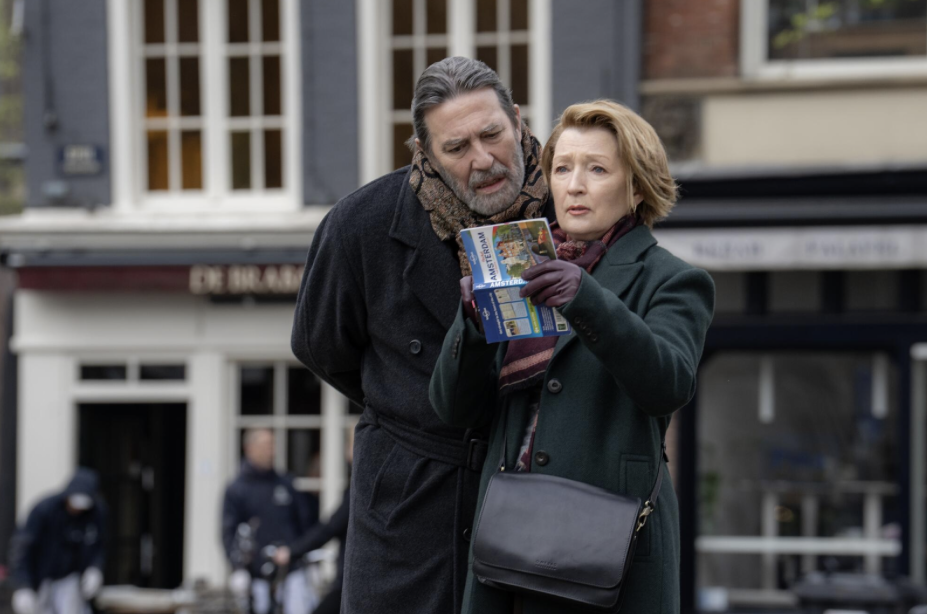
English actress Lesley Manville stars as Stella, a devout Catholic from Northern Ireland who plans a trip to Amsterdam with her alcohol-dependent husband Gerry (Ciarán Hinds). The journey, an unusual excursion for the modest, reserved couple, becomes a painful emotional experience for both. Together, they confront dysfunctional dynamics in their marriage, traumatic memories from the Troubles and their unfulfilled expectations for life.
Manville is radiant as the delicate, wide-eyed Stella; her performance is just as commanding as her wistful portrayal of the titular older house cleaner in “Mrs. Harris Goes to Paris” four years ago. Hinds is a gruff, good-willed Gerry, and while Findlay doesn’t develop his emotional arc as fully as Stella, he deals with his own share of heartbreak.
Plodding from an overly slow start to an abrupt end that arrives too soon after the film’s emotional climax, “Midwinter Break” reveals its own story haltingly. It finally becomes clear that Stella booked the trip not to rekindle a connection with Gerry but to explore an intense calling to commit herself more fully to her religious convictions.
Having long entertained fantasies of joining a religious order, she spends hours alone at the Amsterdam Begijnhof, a historical sisterhood of celibate women somewhat similar to a convent. Almost as soon as viewers realize the true extent of Stella’s decades-delayed dream, however, they too recognize the impossibility of her desire.
Stella’s faith, the audience comes to understand, is scarcely different from Gerry’s drinking. Both are emotional crutches that provide the couple with only a temporary escape from the pain of their lives. She wants transcendence and divine justification for the anguish she’s endured. He just wants to put the past behind him.
In one telling scene, the couple goes out to lunch after touring the Anne Frank House. Profoundly moved – more by her own reaction to the museum than by the museum itself – Stella begins crying. While patient, Gerry is clearly weary of his wife’s emotional upheaval.
“Why is anything spiritual so impossible for you to grasp?” Stella snaps.
In a clumsy attempt to defuse the argument through distraction, Gerry pushes a plate toward his wife.
“Cake?” he offers.
“Cake?” Stella repeats incredulously. Offended, she storms off, leaving Gerry alone at the table.
Were I there at that cafe, would I stay seated with Gerry, or would I leap up and run after Stella?
“Midwinter Break” is a bittersweet film about navigating disappointment – both how we proceed when we disappoint those we have committed to love, as well as when they disappoint us. Pivoting perhaps too quickly to a hopeful resolution, the film is most striking in its moments of lingering tension and resentment. And thanks to gorgeous coloring and costumes, it reveals that even these moments can contain overwhelming beauty.
“Let there be light,” Gerry says as he opens the curtains in their hotel room.
“Oh, look at that grey sky,” Stella frets.
There is much darkness in “Midwinter Break.” But there is light, too, in the sunrays that fall on the couple’s faces as they lean on each other while leaving the Begijnhof chapel and the bars in the red-light district. It glimmers again in the early-morning embrace they share in Schiphol airport as they glimpse the North Star calling them home.