
Community service is central to senior Mary Hauser’s life at Wake Forest. In addition to several other volunteer commitments, Hauser spends about one day each month building affordable housing with Habitat for Humanity of Forsyth County. Deputy Editor Miriam Fabrycky sat down with Hauser to discuss how she first discovered her passion for Habitat for Humanity’s work, the purpose she finds through volunteering and advice for students who want to get more involved in off-campus service.
This interview has been edited for clarity and brevity.
Miriam Fabrycky: When and why did you begin volunteering with Habitat for Humanity?
Mary Hauser: It was my sophomore year, and I wanted to learn some practical skills. I didn’t know how to fix a car or do stuff around the house. I was looking for opportunities to learn stuff like that in a way that also fit with the rest of my life – I couldn’t go become a construction worker, you know.
Fabrycky: Tell me about your first time volunteering.
Hauser: It was December, and it was very cold. I just showed up… I was completely by myself. There were maybe three or four older gentlemen there who all knew each other. We were putting up drywall. It was really dusty, but it was so much fun. [Then] I signed up for a ton of projects in the spring of my sophomore year.
Fabrycky: Sounds like it was a good fit.
Hauser: Definitely. I love Habitat for Humanity, I really love it. The days I volunteer are my happiest days. I’ve always loved working with my hands and doing physical stuff. I like feeling capable.
Fabrycky: So, did you pick up any of those practical skills you were interested in?
Hauser: I don’t think I ever hammered nails in my life before Habitat for Humanity, but now I’ve used those skills. We put some lights in my basement over the summer, and I could hammer in the wire clips.
Fabrycky: Are there any particular aspects of a building project that you find challenging?
Hauser: I don’t think so. [The work] is always within what you’re comfortable doing with your own body. They always have options for if you want to use a power tool or not, if you want to be on a ladder or if you don’t. It’s always within your comfort zone.
Fabrycky: How do you feel about power tools?
Hauser: I am still terrified! But using them with someone there showing you how, it’s not stressful. It’s not like I have to cut so many pieces of wood or I need to move faster. It can really be at my own pace. By the end of my most recent day, I actually felt pretty comfortable using a nail gun.
Fabrycky: Do you have any favorite building tasks?
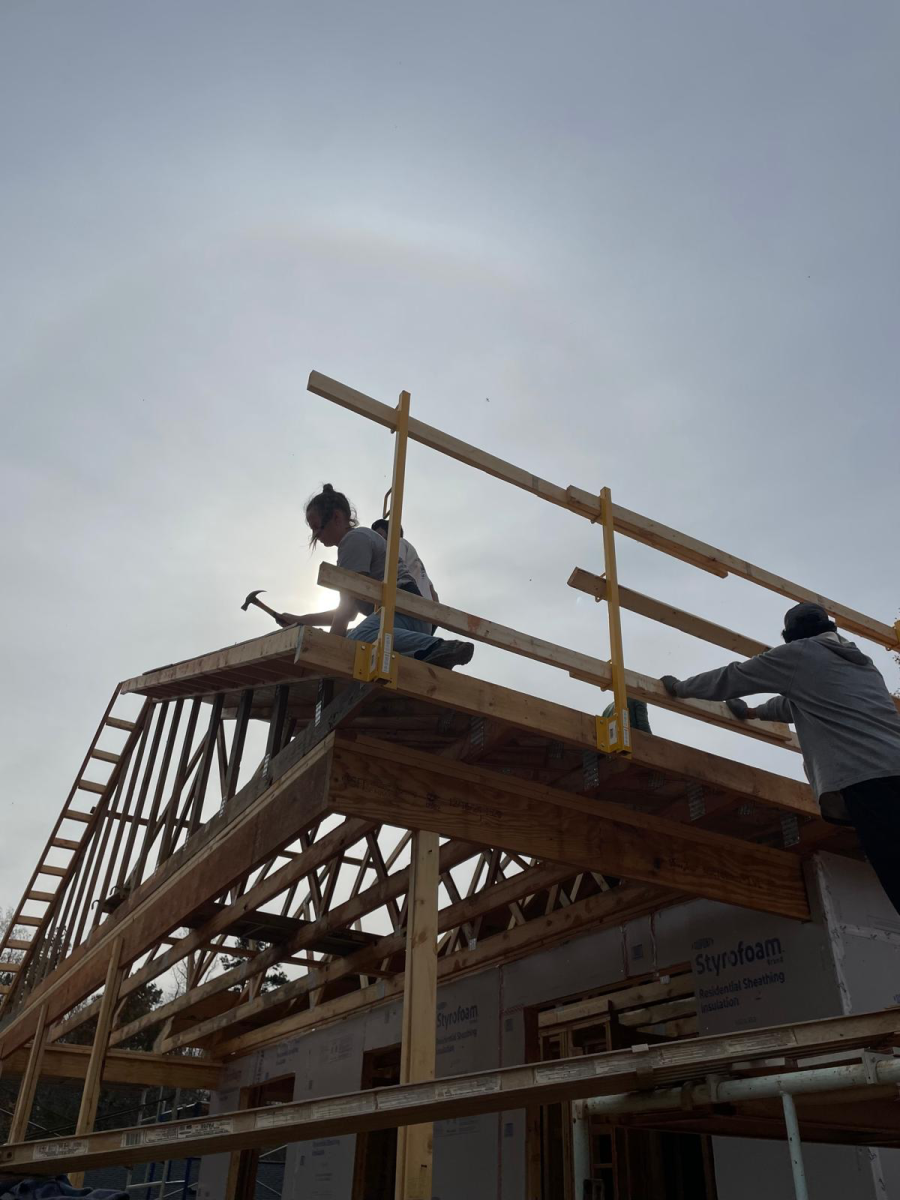
Hauser: I always love it when we get to go up on the roof. I enjoy it more when we’re working outside, and painting walls is fun.
Fabrycky: What’s been your most rewarding experience with Habitat for Humanity?
Hauser: I worked on one house for a number of days throughout the building process, including close to the end. We did some landscaping, and I planted some of the plants that you can still see outside.
Fabrycky: And now a family lives there – amazing. Sounds like it can be a new adventure every day.
Hauser: Yes, I show up and have no idea what we’re going to be doing or what stage the house will be at. You don’t even know the address until the day before. I almost certainly have no idea of how to do the tasks, but they teach me.
Fabrycky: How does it feel to jump in sight-unseen almost every time?
Hauser: It’s so different from anything in my classes, where you’re expected to know a lot and it can be stressful. Volunteering can be physically intense, but there’s something very refreshing about it. Every time I’ve shown up, it’s been a good day – it’s been the best day.
Fabrycky: Do you participate in community service beyond Habitat for Humanity?
Hauser: Every organization I’m involved in on-campus is off-campus, facing volunteering. I like being out in Winston-Salem. I love Wake Forest, but it’s really important for me to leave the bubble.
Fabrycky: Tell me about those other organizations.
Hauser: There’s Elemental Explorers – we do chemistry experiments in elementary schools, and once a semester the students come to campus and tour around. I also volunteer with the Student Association for the Advancement of Refugees. I go to a Syrian family’s house, and I tutor the kids and help the parents if they need help reading forms.
Fabrycky: Sounds like they’re all very meaningful experiences for you.
Hauser: Community service gives me joy. It gives me purpose. I’ve learned so much from working with students and having a relationship with the Syrian family, and I’ve learned so much from Habitat for Humanity.
Fabrycky: What advice would you give to students who want to get more involved in community service?
Hauser: Whatever your interests are, you can find a way to make them align with a good cause. If you don’t have any ideas, ask your professors and friends, or go to the Office of Civic and Community Engagement. Then just try something. If it doesn’t make you happy, go find something else, because there’s something for everyone.