
My First Year Seminar (FYS) professor, Adrian Greene, once told our suburban Gothic literature class his elementary-aged daughter wanted to dress as Carrie from Stephen King’s novel “Carrie” for Halloween. Having studied the intricacies of the horror classic, which is frightening even to adults, we all laughed, imagining their conversation.
I couldn’t have guessed how much I would learn and how many life-long friends I would make in an FYS about the deep, dark secrets of suburban neighborhoods. Rather than analyzing elements of horror and sci-fi, Greene prompted us to examine the emotions of the characters and settings in the works we read. None of my classmates had a preexisting interest in the field, but we found it came to life through Greene’s fascinating, funny, and frightful teachings.
From Twin Peaks to Frankenstein: emotion as motivation
I was curious to learn how Greene arrived at such an unusual academic niche. So I asked him.
“The first thing I saw that really spoke to me was ‘Twin Peaks,’” he said.
Greene watched the disturbing crime drama while in elementary school. The show’s message that places can sometimes hide their true nature resonated with him. He said the undertones of the town of Twin Peaks was like nothing he had ever experienced before. The show drew him to explore Gothic literature.
“I read [“Frankenstein”] in elementary school…I was obsessed with that,” Greene said. “Victor Frankenstein has so many big emotions and is so sensitive… but you know, it was still the ‘80s.”
Greene said Victor Frankenstein’s actions spoke to him and taught him a new way to approach his feelings. Growing up in an environment where he was encouraged to suppress his emotions, he was fascinated by Gothic characters’ outward expression of feelings. It’s that same childhood revelation that he hopes to share with his students today.
“[I want] to help students through the novels… primarily to move forward from trauma and express complex feelings,” Greene said.
A thriving classroom
Greene’s level of attention and care makes a difference in the culture of his classrooms. In my experience, class discussions flowed the entire length of the one hour and 15 minute period, and we became comfortable sharing our opinions and analyses with one another.
But I also learned that Greene begins each class hoping that his lesson plan will derail.
“The best classes I’ve had were the ones where I went in with a plan, and then we got off on a tangent, and that’s way more fruitful,” Greene said.
I’ve rarely had a class where a teacher is as dedicated to keeping their students engaged.
Between fascinating assigned readings like the amazingly weird “Wind-Up Bird Chronicle” and the dizzying “Haunting of Hill House,” alongside the free-flowing discussions that followed, Greene’s FYS felt like a class made for students.
Greene sees himself as holding more of a supportive role than a directive one. Most of our classes started with Greene posing a single question, which would spiral into countless other topics before Greene reeled it back in at the end for a concluding message.
“You start the semester as a coach, but then hopefully quickly transition into more of a cheerleader where you’re encouraging the kids to do what they do,” he said.
Our class discussions frequently returned to themes of personal demons, trauma, and real-life atrocities.
“I’m so interested in ways we can shock people into remembering that this aestheticized version of historical trauma is connected to hideous and violent historical trauma,” Greene said. “We can be shocked into awareness that will help us see how we’re complicit in perpetuating it.”
It’s this shock value that helped new understandings emerge from our conversations on the readings. A simple baseball bat, for example, means so much more to my classmates and me after discussing “The Wind-Up Bird Chronicle.”
A semester of being forced to talk to my peers about haunting tales and what could be lurking in our own backyards led me to form bonds that will last a lifetime. I can say that the FYS was one of the best classes I’ve ever taken.
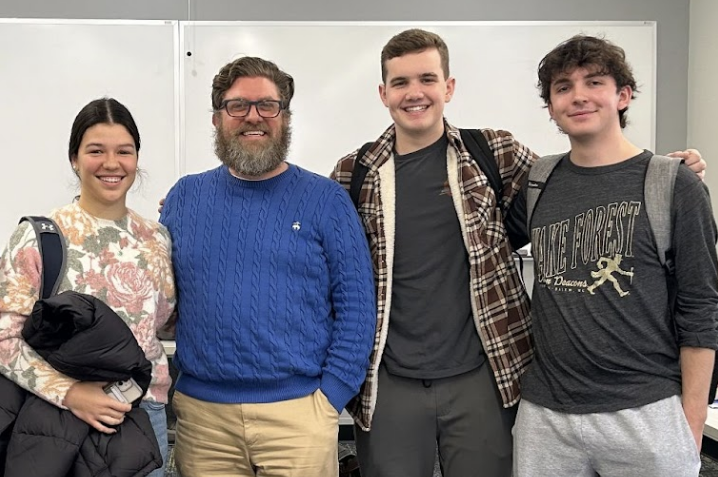
My friends and I still try to meet every semester with Greene for coffee. We eagerly anticipate each gathering, as we view his class as the “starting point” for our friend group. I recently learned that Greene looks forward to our coffee chats just as much as we do.
“So few students stay in touch, and it’s a real bummer, because people get busy and move on with their lives…but I’m just glad we’re getting together,” he said.
So if you’re deciding which FYS, English or Communications class to take, dive headfirst into the horrors of suburbia with Greene.
And who knows – you may discover friendships and life lessons from your very own therapy session with Victor Frankenstein.