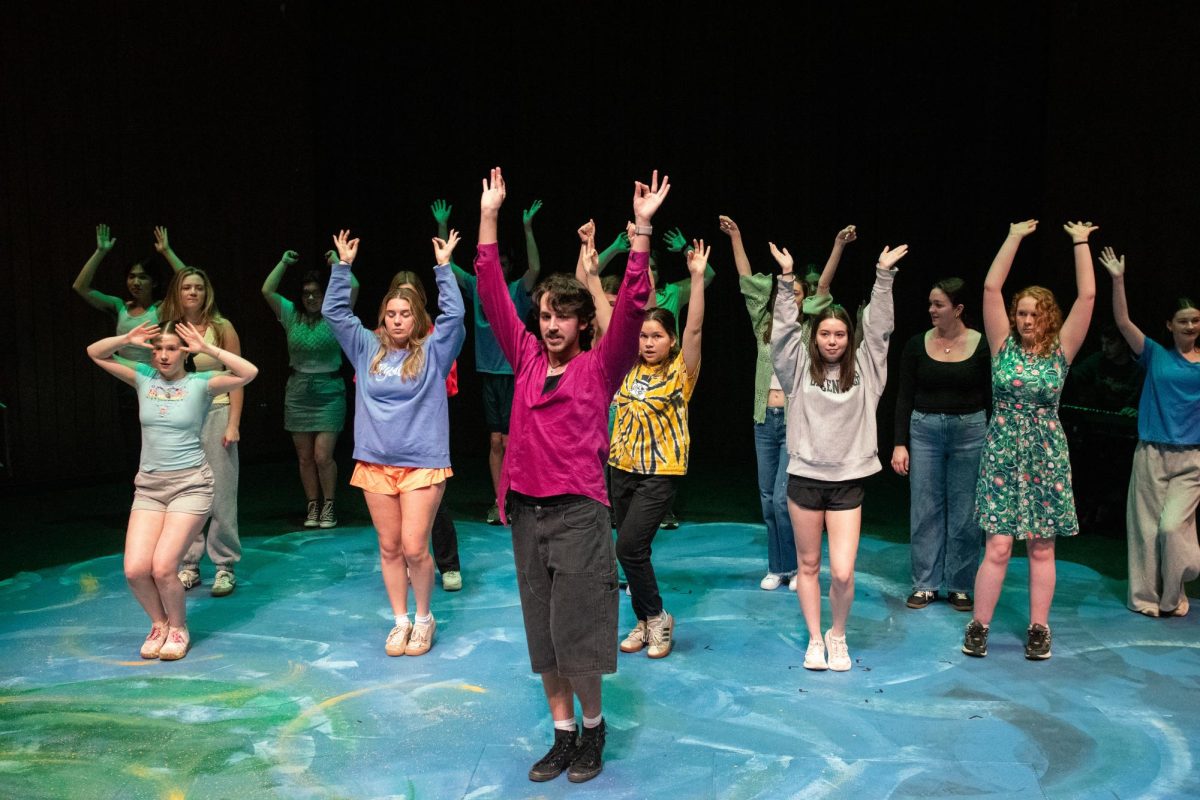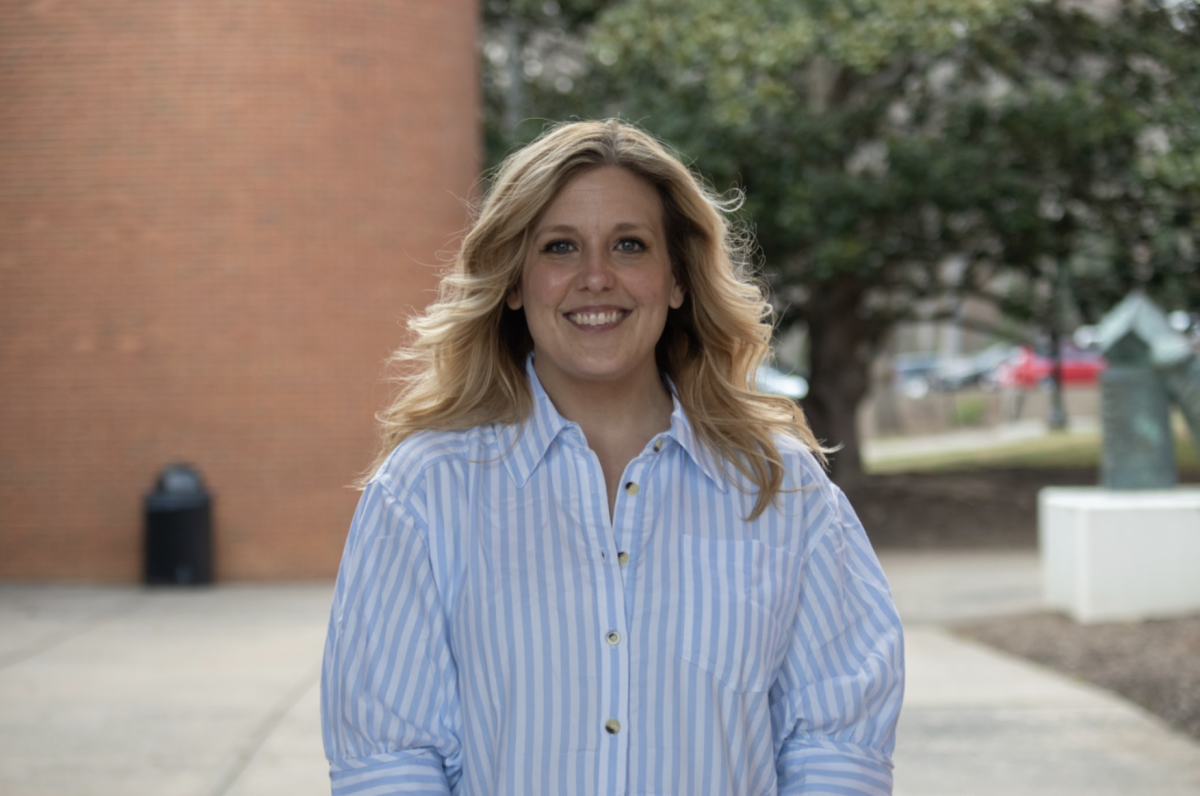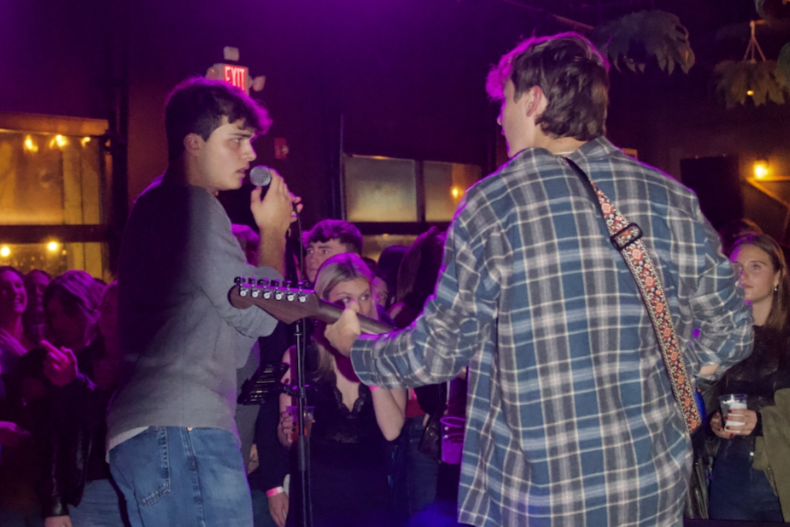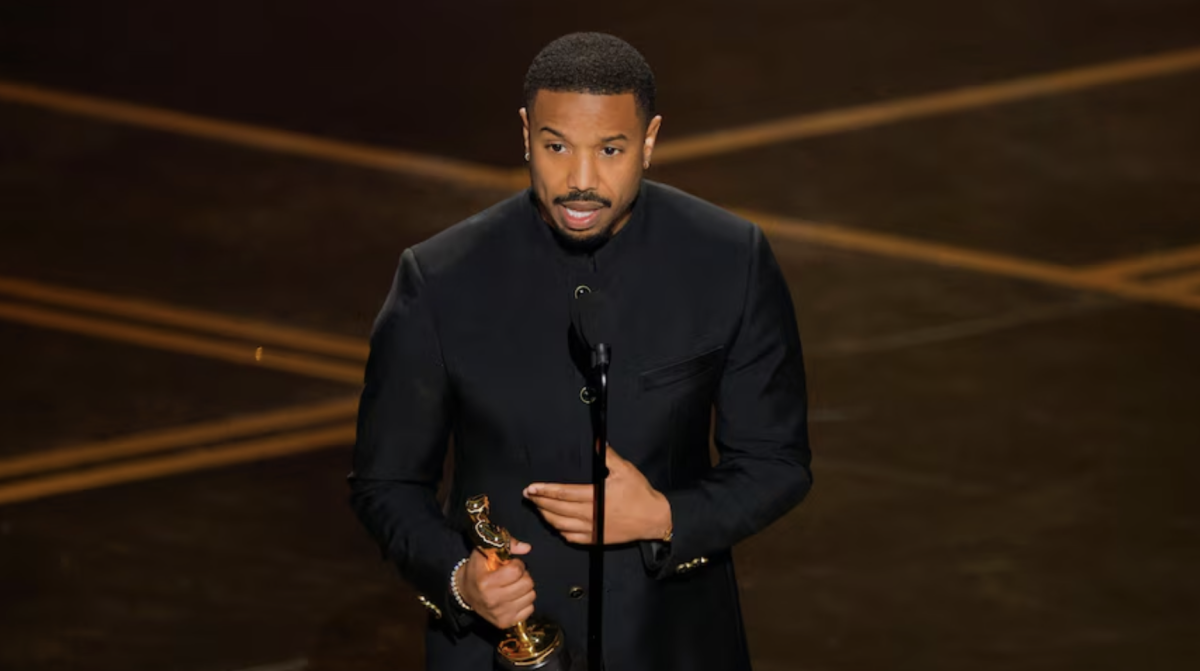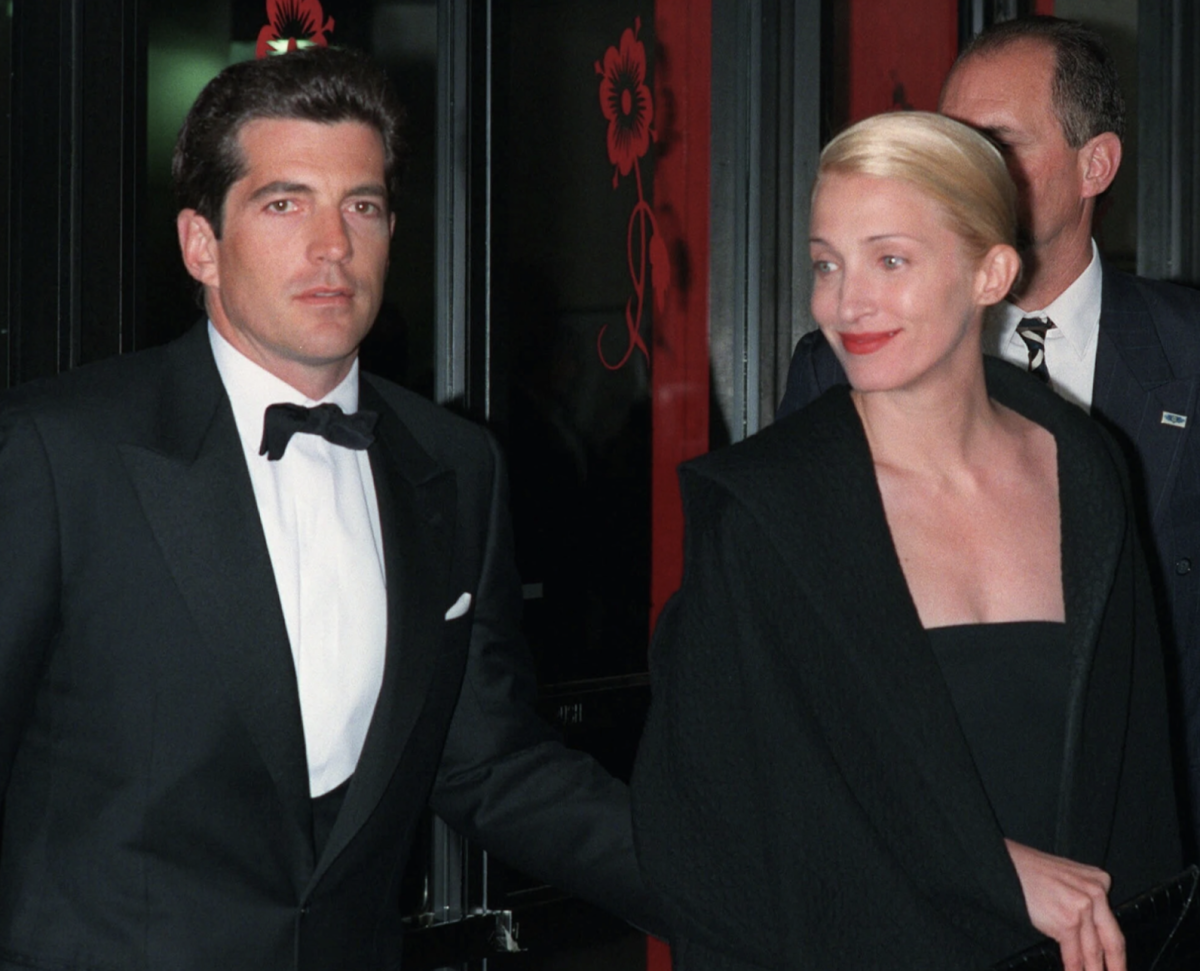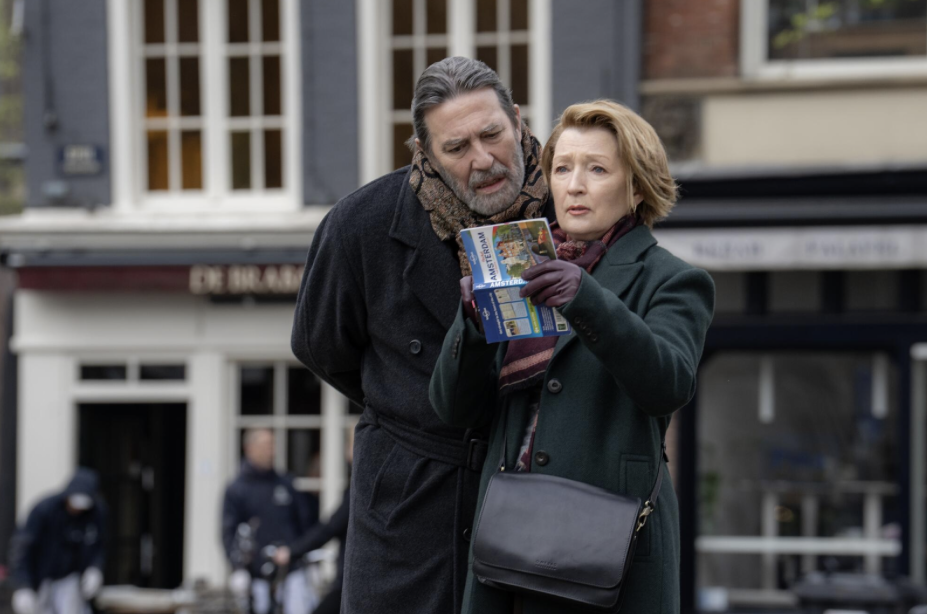

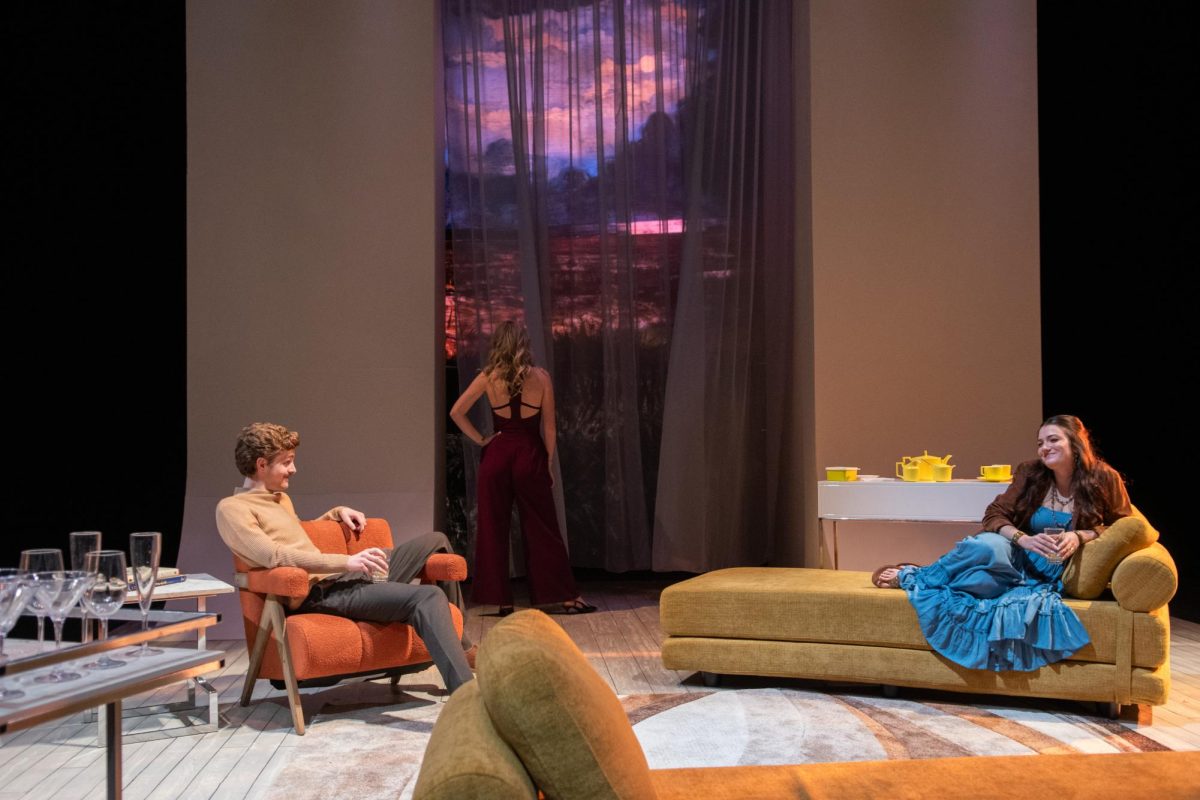
Directed by Cindy Gendrich, Harold Pinter’s three-person play “Old Times” ran in Scales Fine Arts Center’s Ring Theatre from Feb. 11-15. The third mainstage production of the season, “Old Times,” turned memory into both subject and weapon, asking audiences to consider how recollection shapes identity and how easily it can be bent.
The plot is deceptively simple: married couple Deeley (Bennett Haara and Conner Hunt) and Kate (Gabi Velinova and Lauren Veldhuizen) host Anna (Ashlyn Collings and B.G. Cave), Kate’s friend from twenty years earlier. Over drinks and conversation, the three trade stories about their shared past, yet their memories do not align. What begins as a nostalgic recollection slowly morphs into a quiet battle over who remembers “correctly.”
“‘Old Times’ reveals how much we come to define ourselves through memory and how disorienting its distortion and weaponization can be,” Gendrich wrote in her director’s note.
That idea guided the play’s production from its earliest stages. Last semester, under Gendrich’s guidance, junior Ziqi Huang researched the mechanics of memory in preparation for the show. She studied how the brain encodes information, how recall changes over time and how easily memories can be reshaped.
“We came to the realization that Pinter had this good intuition about the ability of memory,” Huang said. “Back when the play was written, neuroscience was not that advanced to tell us how we can change or implant the memory — yet Pinter is able to use his words to capture how memory plays a role in human connection.”
Huang’s research framed the play as a psychological process unfolding in real time. Each character’s version of the past becomes an attempt to stabilize the present. If memory defines who we are, then controlling the narrative of memory becomes a way to control identity itself.
Now, Huang calls “Old Times” her favorite play.
“It has rich subtext and invites you to observe everything that is happening between the three characters,” Huang said. “It’s purposely ambiguous.”
That ambiguity extended to casting. Unlike most mainstage productions at Wake Forest, “Old Times” featured two separate casts who alternated performance nights. After initially rotating scene partners in rehearsal, each cast developed individual dynamics after Gendrich finalized their performance arrangements.
As Huang sees it, ambiguity has the power to create different subtexts — and it certainly did in the case of “Old Times.” Though both casts spoke the same lines, their interpretations were strikingly different.
“Bennett [Haara, who was cast as Deeley in one production] and I are bringing our different lives and experiences to it and thus creating entirely different characters and different worlds,” said Hunt, the other actor playing Deeley.
In a play about perspective, the double casting emphasized the argument that no single version of events holds absolute authority. It’s a reminder that how we remember — and how we live — is never universal. Each perspective is valid in its own way.
“Memories are not necessarily what we think they are,” Hunt said. “My lived experience in this moment will differ from your lived experience, and in ten years, both of us will remember this conversation differently. And that is a fantastic thing.”
In “Old Times,” that difference is not a flaw. It is the point.