
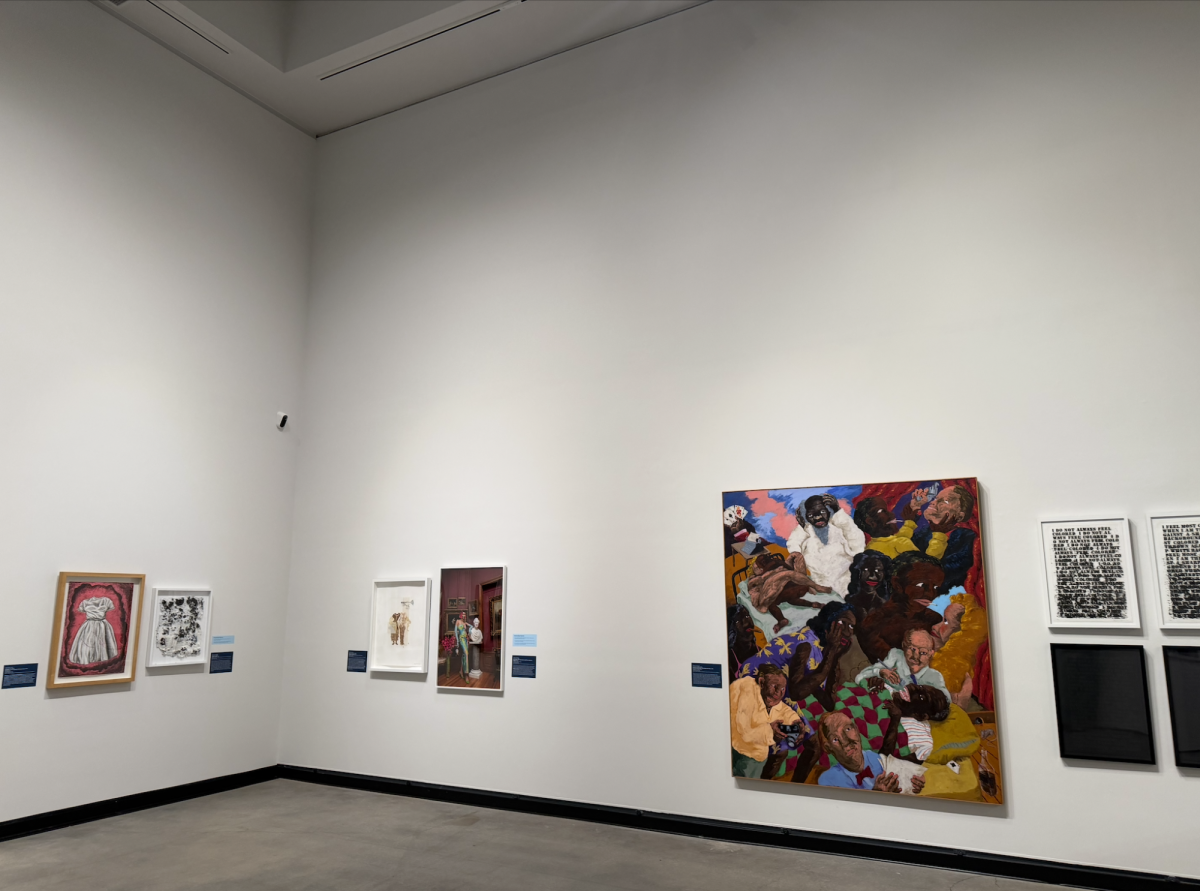
The exhibit “Timely Conversations” opened at the Hanes Gallery on Feb. 5. The artwork on display, most of which is sourced from the Mark H. Reece Collection of Student-Acquired Contemporary Art, explores the entanglement of history and time.
Works in the gallery are arranged in pairs. The result is a series of exchanges on identity, erasure and the environment which unfolds in intimate visual and conceptual dialogue across the exhibit.
The exhibition brings together artists who approach similar historical questions through vastly different formal languages. Robert Colescott and Glenn Ligon, for example, both reexamine race in American history. However, Colescott’s saturated, biting figuration dismantles sanitized historical narratives, while Ligon’s text-based works interrogate the instability of language and authorship. Intertextually, their works show how history can be challenged through highly variable aesthetic lenses.
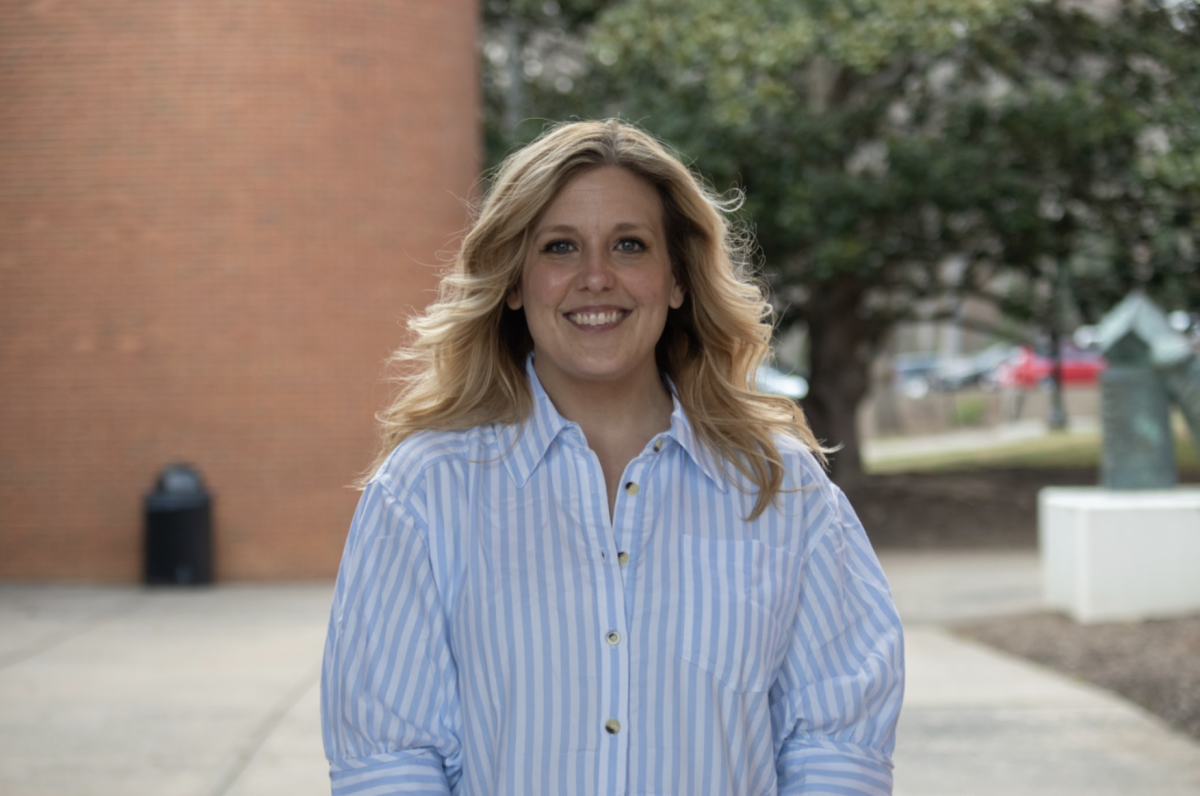
“This exhibition is focused on getting works to talk to each other through meaningful visual representation and drawing connections between messaging and themes the artists may have inspired or provoked,” junior Gianna Palacio-Stiegele, the Hanes Gallery’s curatorial intern this semester, said.
“A big focus this year is increasing student engagement with the gallery and arts at Wake Forest more broadly,” Palacio-Stiegele added.
Elsewhere in the exhibit, Martine Gutierrez and Shahzia Sikander confront the Western art historical canon’s fixation on the body. Both artists complicate who is permitted visibility and authority within that tradition. Their interventions are not subtle as they destabilize inherited narratives and expand them, insisting on multiplicity where there was once rigidity.
Questions of labor and lineage surface in the works of Suchitra Mattai and Jay Lynn Gomez. Drawing from personal and familial histories, they layer materials and imagery to foreground stories often relegated to the margins. Domestic work, migration and generational memory are not treated as background details but as central, structuring forces.
While “Timely Conversations” is installed on the lower level of Hanes Gallery, additional works are currently on view in the mezzanine as part of the Wake Forest Collections. These works are separate from the exhibition downstairs. This semester, professors selected pieces owned by Wake Forest to be installed in the mezzanine for use as teaching materials. Faculty have incorporated these works into their curricula to aid course understanding and provide direct engagement with various types of art across mediums and time periods. Many of these works were acquired through funded student buying trips and continue to serve as educational resources for future classes.
Across painting, photography and mixed media, “Timely Conversations” resists chronology. Instead, it positions time as cyclical and porous, something we reinterpret ad infinitum. The intentionality in these juxtapositions does not imbue viewers with a point of view, but they make it difficult to remain passive.
The exhibition suggests that history is not fixed, but rather negotiated and carried forward. And contemporary art, at its most effective, makes that negotiation visible.
Editor’s Note 2/20: The version of this article that is in the Old Gold & Black’s Feb. 19 print edition features art that was not part of the “Timely Conversations” exhibit. The online story has been updated for clarity.